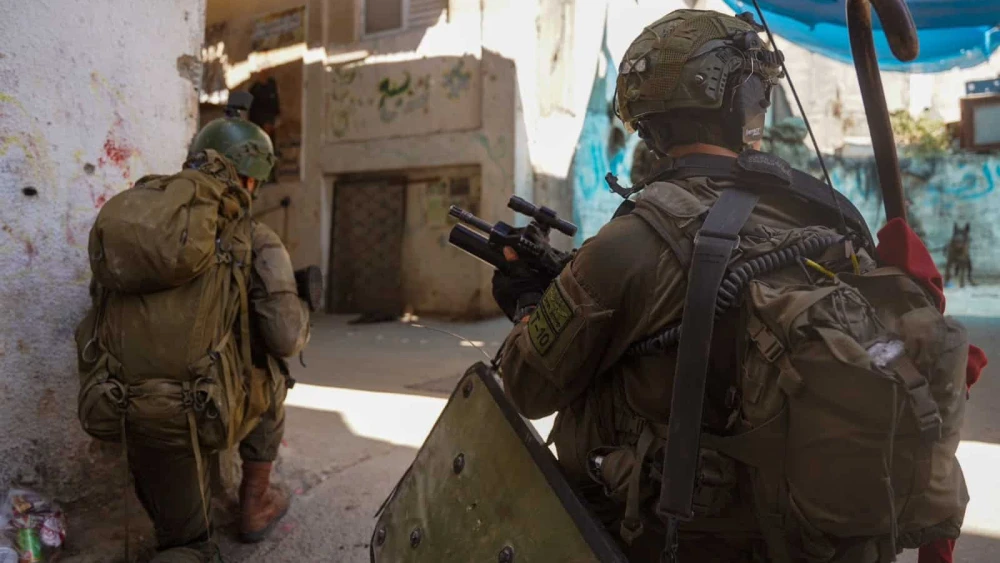

The Israel Defense Forces is planning for the construction of a permanent military base in the Jenin area to consolidate operational gains and prevent the resurgence of unified terror infrastructures in northern Samaria, a military source told JNS on Monday.
The decision is part of a fundamental departure from the previous security approach that governed the area for over two decades. Following the conclusion of the Second Intifada, the military largely relied on intelligence-driven, targeted raids.
However, this operational model allowed the broader terror ecosystem to survive and continuously replenish its ranks, weapons, and fortifications in the absence of a permanent Israeli security presence. This changed in January 2025, when the IDF launched “Operation Iron Wall” in Samaria.
“The fact is that every time we entered into a pinpoint operation of a few days, seized weapons, and targeted operatives, in the end we kept going back to the same baseline,” said the source. “Ultimately, when you leave them with their terror stronghold and their hub, you essentially fail to change anything, which is why ‘Operation Iron Wall’ in January 2025 was launched to change this situation.”
“By remaining inside the camp to alter the reality on the ground, the operation worked, leading to a 70 percent decrease in terror since it began,” the source observed.
“The decision to establish a base there is a directive from the political echelon, which essentially states that they are currently not interested in a withdrawal of forces,” said the military source.
The decision is driven by a number factors, including the need to protect renewed Israeli nearby settlement presence in the region, specifically the communities of Sanur, Ganim, and Kadim.
Planners also recognized the inherent unreliability of the Palestinian Authority’s security forces.
Before the launch of “Operation Iron Wall,” the various armed factions inside the camp abandoned their traditional organizational rivalries. The military observed intense efforts to amalgamate Hamas, the Palestinian Islamic Jihad, and various local terror networks into a singular cohesive fighting force funded directly by Tehran. This newly formed alliance was designated as a centralized terror organization specific to the camp, operating under the moniker Abnaa al-Mukhayam (Sons of the Camp).
“They really tried to imitate the terror organizations from Oct. 7, since on Oct. 7 the Palestinian Islamic Jihad, as well as Hamas, all raided together, and that is exactly what they attempted to do here,” the source stated.
“They sought to unite Hamas, the Palestinian Islamic Jihad, and all of these bodies under one head that is funded by Iran. So that is what we succeeded in doing ultimately, neutralizing all the attempts to organize as a group, at least in these areas.”
Still, Israel faces continuous attempts to orchestrate terrorism against civilian and military targets alike, forcing the defense establishment to maintain high readiness.
“Obviously, like always, there are desires and attempts and warnings to carry out attacks, there is no question here,” the source cautioned.
The external funding and strategic direction for this terror hub flowed directly from the Iranian regime. Iranian leadership views the destabilization of Judea and Samaria as a vital component of its multi-front war of attrition against the State of Israel. By trying to flood the territory with terror financing and smuggled weaponry, the Islamic Republic sought to ignite a major escalation that would stretch Israeli forces and attention.
“You also see the Iranians [in action], who understand that Judea and Samaria is ultimately the soft underbelly of Israel,” the source analyzed. “Ultimately, an intifada in Judea and Samaria diverts the attention of all the arenas directly into that sector.”
This effort was heavily supported by various Hamas command centers operating safely in foreign capitals.
“This includes Hamas in Turkey and Hamas in Tunisia, but you also see the Iranians attempting to drag Judea and Samaria into this,” the source concluded.
The Iranian strategy has included an arms smuggling campaign across the eastern border with Jordan. Smuggling rings utilized criminal networks to move vast quantities of assault rifles, explosives, and cash across the frontier, destined for the terror cells operating in Samaria. To counter this, the IDF deployed the newly established 96th Division to secure the Jordan Valley and interdict the supply lines fueling the violence.