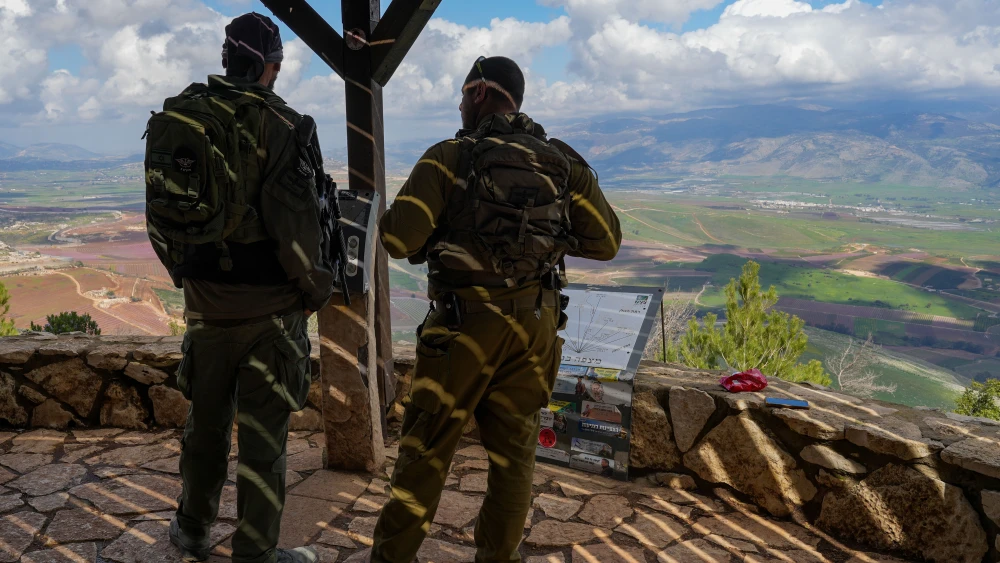

Over the past two weeks, the Israel Defense Forces has been steadily ramping up pressure on Hezbollah as Lebanon increasingly emerges as a parallel front to Iran in “Operation “Roaring Lion.”
In recent days, the IDF has begun supplementing its intensive aerial bombardment with infantry maneuvers. While these operations have not yet reached the scale of a committed ground offensive, the deployment of elite infantry, heavily armored battalions and specialized engineering units across multiple axes indicates that beachheads are being formed for full-scale invasion.
Israeli Defense Minister Israel Katz indicated the government’s commitment to push military policy on the northern front to its logical conclusion. The goal of the operation is “to remove threats and protect the residents of the Galilee and the north,” Katz said in a recent briefing, adding that Israel wishes to permanently dismantle all of Hezbollah’s surface and subterranean infrastructure in southern Lebanon.
The current escalation marks the final bell for the inherently unstable status quo established by the November 2024 ceasefire, which came in the wake of a year of violent confrontations between Israel and the Iranian-backed Shi’ite terrorist organization. That diplomatic agreement formally mandated the comprehensive deployment of the Lebanese Armed Forces to the southern border regions.
It explicitly required the total disarmament and withdrawal of Hezbollah forces from the territory south of the Litani River.
However, throughout the ceasefire period, Hezbollah had covertly maintained its presence, rehabilitated its military infrastructure and continued the clandestine transfer of advanced weaponry into the southern sectors.
The Lebanese government, chronically paralyzed by deeply entrenched sectarian divisions and intimidated by Hezbollah violence, consistently failed to uphold its end of the ceasefire bargain.
To mitigate the accumulating damage, the IDF has maintained a policy of constant pressure, leading to almost daily airstrikes in Lebanon, throughout the ceasefire period, against Hezbollah assets. However, despite the persistent attacks, Hezbollah managed to push forward its agenda of reorganization and rearmament.
Despite this highly volatile dynamic, the transition to conflict at the current scale required a significant external catalyst. Hezbollah, while heavily armed and rhetorically belligerent, was generally hesitant to unilaterally initiate a conflict that would undoubtedly invite significant destruction, particularly as it is still in a weakened state from the last round of fighting.
However, several factors converged that pushed Hezbollah past its hesitation.
The central cause behind the current round of fighting in Lebanon is the joint U.S.-Israeli assault on Iran that began on Feb. 28. The operational viability of Hezbollah has historically hinged on the regime in Tehran. This dependency was reworked in the aftermath of the fall of the Assad regime in Syria in December 2024, which led to the severance of important smuggling routes through the Levant that were feeding Hezbollah. However, Iran remained critical for Hezbollah in terms of financing, training and armament.
The catastrophic damage inflicted upon its primary sponsor by the U.S.-Israeli operation was a material threat to Hezbollah’s long-term viability as a coherent fighting force, pushing them to join the conflict to try and tip the balance in favor of Iran before their last line of support is snuffed out.
Beyond the group’s material self-interest, Hezbollah’s position as a proxy in Iran’s wider regional architecture, and the Islamic Revolutionary Guard Corps (IRGC) penetration of the organization’s command-and-control infrastructure, made standing on the sidelines impossible.
During his first public address since the start of hostilities, Hezbollah Secretary-General Naim Qassem sought to claim that the timing of the war was unrelated to Iran and was purely in the interest of Lebanon. “This fight is not linked to any other battle,” he said, adding, “Our goal is ending Israeli-American aggression and [causing] Israeli withdrawal [from Lebanon].”
However, recent reports indicate that IRGC commanders, in the Lebanon Corps, ”actively took command of Hezbollah’s military buildup and operational deployments in the past several months.”
The IDF’s operations at the outset of hostilities with Lebanon highlight the fundamental link between the operations in Iran and in Lebanon. In the immediate response to the initiation of hostilities, the IDF quickly and systematically targeted Iranian assets in Lebanon.
On March 2, precision strikes in Beirut eliminated Reza Khazaei, the chief of staff of the Lebanon Corps, while the unit’s overall commander was killed simultaneously in Tehran. By March 3, the IDF issued a 24-hour ultimatum demanding the expulsion of all Iranian regime representatives from Lebanese territory.
Compounding the material, hierarchical and ideological pressure stemming from the attacks on Iran, a significant factor pushing Hezbollah towards war also originated from Damascus.
Since its rise to power, the new Syrian government under President Ahmed al-Sharaa has adopted an actively hostile posture toward Iranian proxies. Reversing Assad’s historical role as a logistical conduit, Al-Sharaa deployed military units and heavy armor to cut Hezbollah’s supply lines.
While a Syrian military source characterized the deployment as strictly “defensive and sovereign in nature,” the scale of the mobilization has, in recent months, begun exceeding what could reasonably be justified by a border control mission.
A recent Reuters report, quoting Syrian officials, western diplomats and intelligence officials, confirmed the potentially offensive nature of the Syrian deployment, saying “Syria’s Sunni Islamist-led government has been considering a cross-border operation.” The report added that Washington was actively supporting the initiative.
“Syria has massed and deployed four full divisions along the border with Lebanon. And the prevailing assumption in Lebanon is that Al-Shaara is prepared to take revenge on Hezbollah for its role in the civil war in Syria,” Col. (ret.) Dr. Jacques Neriah, an analyst at the Jerusalem Center for Security and Foreign Affairs, told JNS. “Hezbollah is pressed between Israel and Syria. It feels isolated and put in the corner,” he added.
The military campaign
Beginning on March 2, Hezbollah unleashed a sustained barrage of fire against Israeli military installations and civilian population centers. According to the Alma Research and Education Center (AREC), as of March 16, the group had launched a total of 522 missile barrages against Israel, ranging from single launches to massive waves of over 100 rockets. On March 14, the IDF reported that Hezbollah had been launching an average of around 100 rockets per day, pointing to a total of around 1,000 to 1,500 rockets fired by mid-March.
The IDF spokesperson explained in a recent meeting that these attacks have been meticulously orchestrated and that “some days we’ve seen those attacks coordinated with Iranian ballistic missile attacks.” Beyond the relentless missile attacks, Hezbollah has also launched dozens of UAVs and guided anti-tank missiles.
The immediate Israeli response materialized as a massive and precise aerial bombardment campaign. According to AREC, the Israel Air Force executed 306 distinct waves of airstrikes between March 2 and March 15, with approximately 63% concentrated south of the Litani River to dismantle launch sites and forward operating bases.
Concurrently, strikes targeted the Bekaa Valley and the Dahiyeh suburb, Hezbollah’s stronghold in Beirut, focusing on eradicating financial networks, military-industrial capacity and command-and-control centers.
In recent days, the IDF campaign in Lebanon has begun to merge aerial bombardment with large-scale ground maneuvers. Ground-force elements, including the 91st, 36th, 146th and 98th Divisions, have expanded operations across several strategically important regions of southern Lebanon.
Outlining the scope of the operation, Katz stated that the military has been told to destroy terror infrastructure close to the border “just as was done against Hamas in Rafah, Beit Hanoun and the terror tunnels in Gaza.”
IDF infantry presence has so far been reported in multiple border villages, including Aitaroun, Yaroun, Bint Jbeil and Alma al-Shaab.
The ongoing combat operations have come with sweeping evacuation orders across southern Lebanon and the Dahiyeh neighborhood.
An estimated 800,000 to over one million Lebanese citizens, primarily from Hezbollah-affiliated Shi’ite villages, have been displaced so far. Israel has explicitly linked this policy of mass evacuation to its long-term border security goals.
Katz definitively declared that the “hundreds of thousands of Shi’ite residents of south Lebanon who are evacuating from their homes will not return to the area south of the Litani until the safety of the residents of the north is guaranteed.”
The current operation is widely expected to expand into a full-scale infantry offensive throughout southern Lebanon. “Israel’s security needs mean that they have to face Hezbollah in the south of the Litani and get rid of its presence, which means that we have to do a land invasion,” Neriah explained.
Hinting at the timetable of the campaign, an Israeli military spokesman noted in a recent press briefing that the IDF expected operations against Hezbollah to continue for at least three more weeks.
Neriah warned that the operation will be complex and that Hezbollah had rebuilt much of what was destroyed in the previous round of fighting.
“We knew that Hezbollah was reconstituting its ranks. Hezbollah has appointed new commanders for its forces and opened factories to produce missiles and drones. Right now, Hezbollah still has about 40,000 rockets, still has hundreds of drones, and still has hundreds and maybe thousands of anti-tank missiles,” he explained.
“We have to face the reality that Hezbollah has reconstituted itself and is a significant threat, as it used to be in the past,” he added.
The IDF has not articulated a long-term strategy beyond the dismantlement of Hezbollah’s presence in southern Lebanon.
Some experts have indicated that the ground offensive is likely to be followed by a withdrawal of the IDF back to a shallow buffer zone near the current border with Lebanon following a diplomatic settlement.
Neriah explained that in his view, “War is another way of diplomacy. We have to reach a diplomatic arrangement at the end of the day. We have to create a new security arrangement vis-à-vis Lebanon.”
This approach would seek to leverage the dominant position the IDF would have after conquering southern Lebanon into an advantageous negotiating position for a future agreement with Lebanon.
Neriah cited the deals with Egypt and Syria as potential models for emulation. “I don’t think that Israel has any intention to stay south of the Litani,” he said. “It would mean enormous human resources, at least three to four divisions to maintain all the time there,” he added.
Others have argued that the only viable long-term solution would be the establishment of an occupied buffer zone all the way to the Litani River.
“Israel is increasingly likely to widen the campaign, potentially creating a de facto buffer zone in southern Lebanon and imposing a new strategic reality by force,” Mark Dubowitz, CEO of the Washington-based Foundation for Defense of Democracies, argued in a recent report. In support of this doctrine, multiple analysts and public officials have begun referring to the Litani as the “Yellow Line,” indicating that Israel should retain a similar level of control in southern Lebanon as in the demilitarized parts of Gaza.
In a recent statement, Amit Halevi, a Likud Party Member of Knesset, explicitly said the Litani River “must become the north’s new yellow line.”
The application of the Gaza-linked terminology implies that, under this model, the areas south of the Litani River would be demilitarized, depopulated of the Hezbollah-supporting inhabitants and under full Israeli military control.