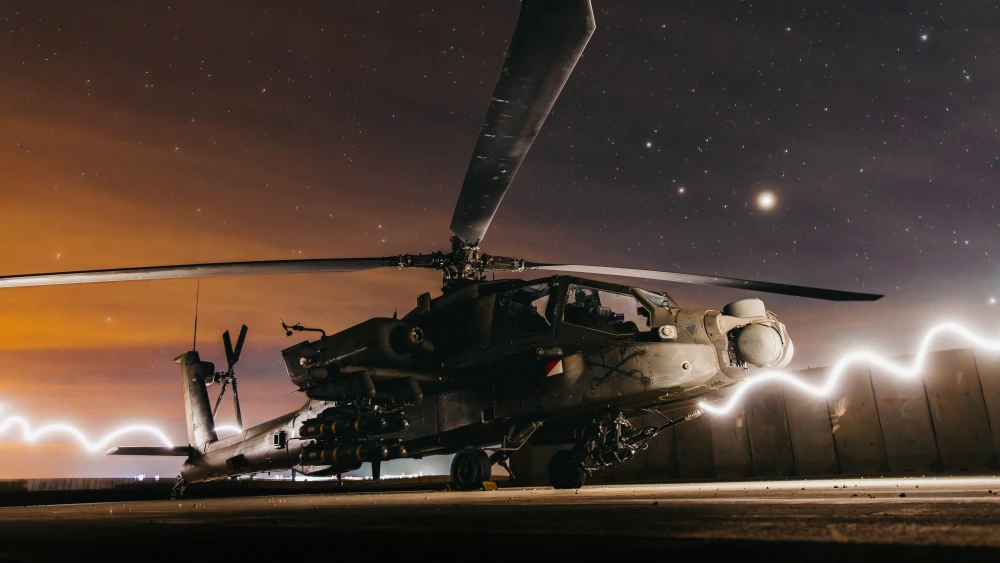

The U.S. State Department’s recent approval of a $6.6 billion weapons package to Israel marks an additional and critical boost in defense capabilities, amid an ongoing arms race between Israel and the Iranian-led axis.
While the deal, which includes 30 Apache attack helicopters and 3,250 armored tactical vehicles, signals robust support from the current administration, it also ignited controversy among congressional Democrats, due to what they said was the administration’s decision to bypass standard congressional review procedures.
Rear Adm. (ret.) Mark Montgomery, who serves as senior director of the Washington, D.C.-based Foundation for Defense of Democracies’ Center on Cyber and Technology Innovation (CCTI) and as an FDD senior fellow, told JNS Israel should maximize the current favorable political climate, while preparing for an uncertain future.
Montgomery, who served for more than three decades in the U.S. Navy as a nuclear-trained surface warfare officer, retiring as a rear admiral in 2017, and who held senior leadership roles in Congress, told JNS, “It is clear that progressive Democrats’ opposition to arms sales to Israel will only increase each time Israel has to fight its way out of a corner.”
In Montgomery’s opinion, “the IDF should be identifying, procuring and storing away as many U.S. munitions as they can afford, and then some. Right now, President Trump will sell Israel anything, and Israel has to focus its short-term resources—the next 3-4 years’ budget—on attacking any and all shortfalls.”
Regarding the push for Israeli weapons production independence, Montgomery assessed that “building an Israeli-only defense industrial base is pie in the sky thinking,” but added that there is a “discrete list of weapon systems [mostly offensive] that Israel is already building and needs to maintain capacity to continue.”
Defensive systems, he said, like the Arrow missile interceptors, “can and should be worked overseas when appropriate.”
Looming political threat
Professor Eitan Gilboa, an expert on the U.S. at Bar-Ilan and Reichman universities, and a senior researcher at the Begin-Sadat Center for Strategic Studies, warned of a looming political threat from both sides of the American aisle when it comes to arms sales.
“Military aid to Israel is liable to encounter significant opposition in the next Congress,” Gilboa said, pointing to the midterm elections in November 2026. He identified a convergence of interests between “progressives in the Democratic Party” and “isolationists and right-wing extremists” in the Republican Party.
According to Gilboa, Democratic criticism has mutated from procedural complaints to substantive opposition regarding Israeli combat operations themselves.
“This is not theoretical; they did this during the war,” he noted. Internal primary battles are pressuring candidates to condemn Israel, said Gilboa, adding, “It is very worrying.”
This is the situation, he said, even though the U.S. invests heavily in defending Japan, South Korea and Europe to the tune of tens of billions of dollars, far more than the annual baseline $3.8 billion support package to Israel under the current Memorandum of Understanding.
Gilboa proposed redefining future arms agreements. Under this new model, Israel would also quantify the value it provides to the U.S., including battlefield testing and intelligence.
“We would buy weapons in the U.S., but transfer to them a lot of information that is important for those weapons,” Gilboa said. He suggested future memorandums could be shorter, perhaps for five years, based on Israeli “weapons purchases and our contributions to the security of the United States.”
Move toward independence
The shift toward greater production independence was formally outlined by Brig. Gen. (res.) Prof. Jacob Nagel, a senior fellow at the FDD and a former head of Israel’s National Security Council. Nagel led a committee on the subject in 2024 and published its findings at the end of that year.
In an interview with JNS in December 2025, Nagel emphasized that “Israel can’t again find itself unable to buy what it needs,” adding that independence in certain areas was essential.
“We need to be independent in the things that we need for the war,” Nagel told JNS. He specified that while total independence is impossible, Israel must ensure it can produce essential munitions domestically to avoid the vulnerabilities exposed during the recent war.
Nagel’s report calls for a “drastic change” in how Israel manages its defense procurement, moving away from reliance on U.S. aid for critical items that can be produced locally. This includes expanding local production lines for air-to-ground munitions, a step already begun with the Ministry of Defense’s recent 570 million shekel ($183 million) deal with Elbit Systems, which was announced on Feb. 3.
The goal, according to the report and government officials, is to achieve full financial independence from American security aid within a decade, transforming the relationship from one of dependence to one of joint development and production.
Prime Minister Benjamin Netanyahu announced that Israel would commit to 350 billion shekels ($112 billion) in investment in the coming decade to boost local arms production in several areas, speaking during a meeting with defense chiefs at Shin Bet headquarters on December 25.