


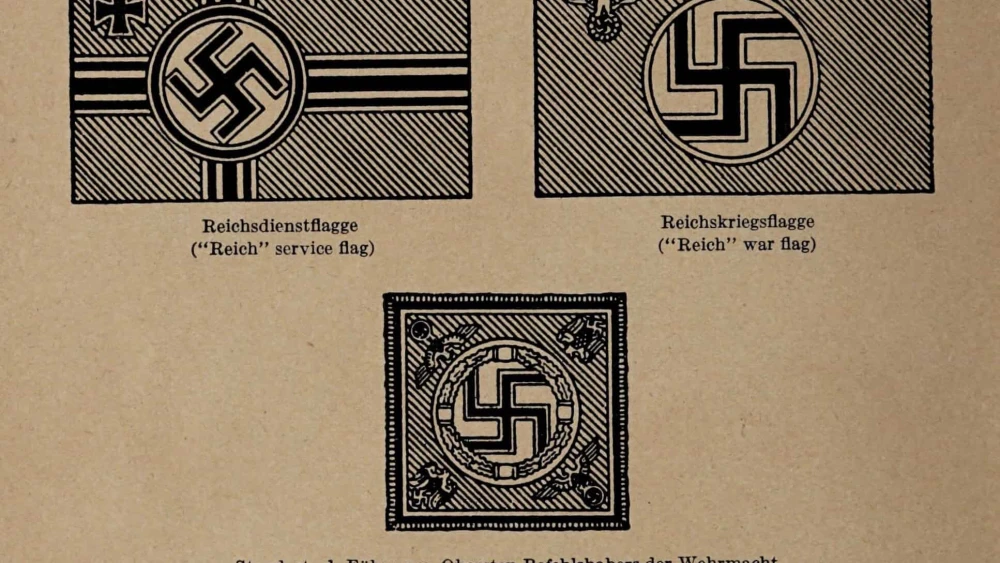
A banner displaying Adolf Hitler’s personal standard was recently uncovered in a storage space at Poland’s National Museum in Poznań.
Art historian Aleksandra Paradowska discovered the flag, labeled as a “German banner from the Second World War,” while reviewing thousands of items in preparation for an exhibit that would focus on life in the Polish city during World War II.
Paradowska researched further, using archival imagery and an analysis of the materials to identify the flag as Hitler’s personal standard, used to signal the dictator’s presence at official events. She described the flag as in “perfect condition.”
The flag in Poznań has been considered unique, as no such banners of its size had previously been thought to have survived.
“The fact that this may be the only such banner in the world does not particularly fill us with pride,” Paweł Oses, a spokesman for the museum, told the Polish Press Agency.
Though the promotion of Nazism and Nazi symbols is illegal under Polish law, educational displays are exempt from punishment. However, the museum will withhold the banner out of concern that “an object so strongly associated with Hitler could become an object of neo-Nazi worship.”
“The banner will be placed in a warehouse in Rogalin and will not most likely leave the warehouse anytime soon,” Oses said. “We are not planning to conduct any further research on it or to display it.”
The museum, which received the banner in 1970, believes the object belonged to Arthur Greiser, who served as the Nazi governor of German-occupied Poland, which included Poznań. It had been found hidden above the stage at the city’s opera hall in the late 1960s.
Paradowska, who will also not use the banner in her exhibit, theorizes that the flag was sent to Poznań in case Hitler visited the city and attended a performance at the opera house.



