Anti-Semitism has apparently decreased in Russia.
According to a recent survey, 75 percent of Russians said anti-Semitism has either declined or remained constant over the last five years, while 17.6 percent said it has increased.
Conducted by the independent research firm Levada and commissioned by the Russian Jewish Congress, the survey was administered over the past year in Russia’s major cities, including Moscow and St. Petersburg.
“Studies of the environment for Jews in Russian cities show that manifestations of anti-Semitism against Jews are increasingly unlikely,” said the authors behind the report.
Just 1 percent of respondents said they have witnessed physical assaults on Jews, while 73 percent said they’ve seen verbal attacks.
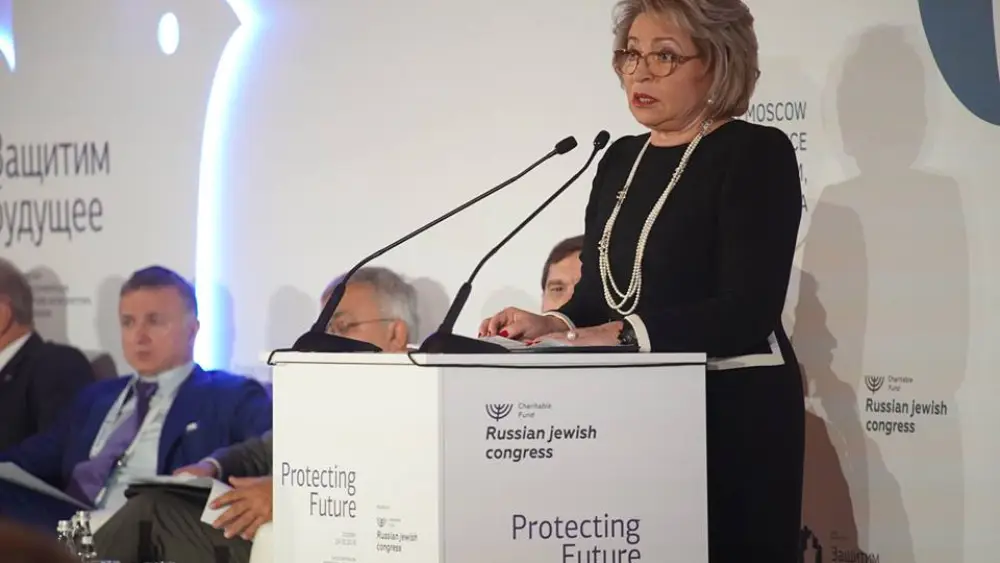
“There will be no anti-Semitism and xenophobia in Russia, and the Russian authorities together with civil society will do everything that is necessary for it,” said Valentina Matviyenko, chairwoman of the Council of the Federation of Russia—the Russian parliament’s Upper House—in a speech last week at the International Conference on Countering Xenophobia and Anti-Semitism in Moscow.
The conference was arranged by the Russian Jewish Congress alongside the Euro-Asian Jewish Congress, with the backing of the Moscow Municipality, the Russian Foreign Ministry, the Russian bank Sberbank and the Genesis Foundation.
A string of anti-Semitic attacks occurred in the aftermath of Israel shooting down a plane in Syria in September in which Russia blamed the Jewish state.
“We have no doubt that the Russian government is working to eradicate anti-Semitic phenomena. After the plane crash, we heard for the first time in many years anti-Semitic slogans in the official media, social networks and on the street,” said Yuri Kanner, president of the Russian Jewish Congress. “The wave spread very quickly, in a few days.
“However, after two weeks it ended, and we believe that it was done with the direct intervention of President Vladimir Putin.”