Archaeology
News and features about archaeological finds linking stories from the Torah and Prophets, or other historical events to the State of Israel

Archaeologists trace the mosaics to an upscale villa in the third or fourth centuries after Lod became the Roman city of Diospolis.

The new 10,000-square-foot museum is geared to inspire visitors to contemplate the Holocaust while connecting with contemporary anti-Semitism, racism, current world events and life in Canada.

TAKE A TOUR OF ISRAEL: Enjoy a respite from nearby Tel Aviv, “the city that never sleeps.”

“The Jewish community is an integral part of Greek identity, a fact that has been too often denied for centuries,” Greece’s Chief Rabbi Gabriel Negrin said at the exhibition’s inauguration ceremony. “This history should be passed on to future generations in order to combat ignorance and prejudice.”

“The Montefiore Mainz Mahzor” (circa 1310-20) is a cultural, religious and research manuscript more than 700 years old.
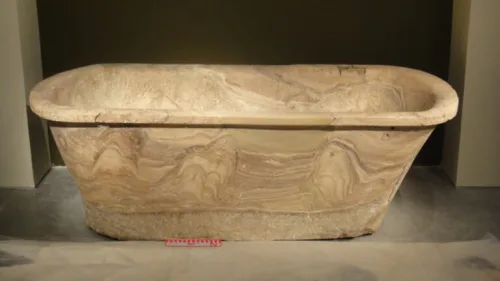
Alabaster was quarried locally, not in Egypt as always assumed, according to Bar-Ilan University researchers.

A cornerstone of the museum will be the inclusion of the “Dimensions in Testimony” program.
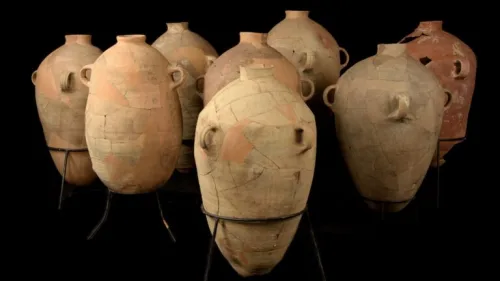
Israel Antiquities Authority says unearthed wine jugs help reveal what people ate and drank prior to Jerusalem’s destruction by Babylonia in 586 BCE.
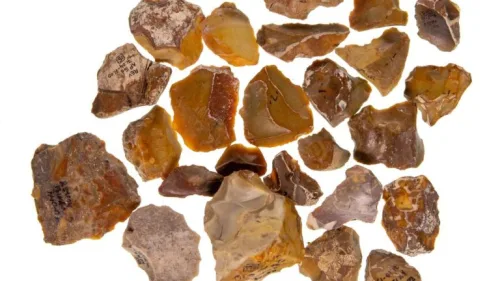
Study finds that humans from 500,000 years ago in what is now southern Israel reshaped and reused stone tools rather than make new ones.

Workers took down “Flowers,” painted by German artist Lovis Corinth in 1913, and packed it for the family of Gustav and Emma Mayer.

The vertebra from Ubeidiya belonged to a young individual 6-12 years old, who was tall for his age, the researchers found.

The metal pendants, each different from the others, are from Lviv in Ukraine, Poland and the Czech Republic, according to researchers.