Newsletter
Newsletter Support JNS

Buffett’s Berkshire Hathaway doubles shares of Teva

It now owns a 3.45 percent stake in the Israeli generic pharmaceutical company.

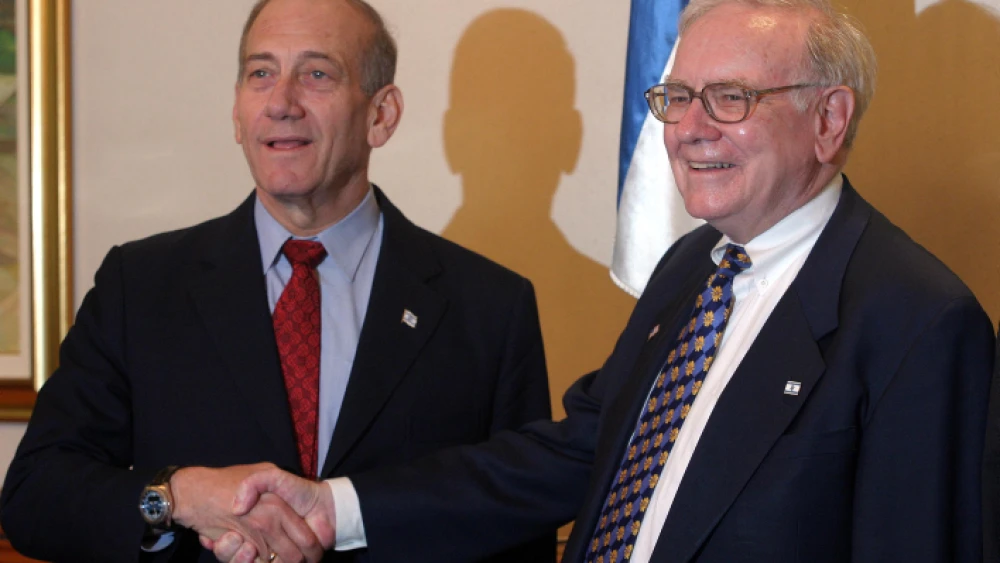
Israeli Prime Minister Ehud Olmert (left) shakes hands with investor Warren Buffett during a meeting at the Prime Minister’s Office in Jerusalem on Sept. 18, 2006. Photo by Orel Cohen/Flash90

Investment giant Warren Buffett’s Berkshire Hathaway doubled its stake in Israel’s Teva Pharmaceutical Industries on Tuesday.

It owned 18.8 million shares at the end of 2017—a 1.8 percent stake worth $358 million.

Berkshire published its holdings as of March 31 after the close of trading on Wall Street on Tuesday, showing it now owns 40.5 million shares—a 3.45 percent stake in Teva. The announcement shot Teva’s share price up by nearly 5 percent in after-hours trading.

The price dipped slightly when Buffett announced that he had not personally picked the stock.

The news is a boon for Teva, which has suffered serious decline in recent years. Its 2016 acquisition of generic drug-maker Allergan left the company in serious debt just as Teva’s star treatment for multiple sclerosis, Copaxone, was eligible for generic competition.

The downturn led to the resignation of multiple upper-echelon executives, including Teva’s CEO, and the plummeting of Teva’s New York-listed shares by 50 percent.

Teva has been making a turnaround in 2018, with revenues higher than anticipated.

The unequivocal remarks come in reaction to allegations of ties between Michigan Senate Democratic candidate Abdul El-Sayed and the Islamist group.
The Israeli prime minister called cooperation with Abbas and Tibi a “disaster"; Eisenkot says lawmakers accepting his principles could be partners.
“Abdul promises to get money out of politics,” the Michigan congresswoman wrote. “He can begin by getting Israel out of his explanation for everything Michigan cannot afford.”
Threats to the Jewish state’s natural gas assets and sea approaches have multiplied across the Mediterranean, Red Sea and Persian Gulf, and Turkey is developing its own undersea fleet in an assertive maritime expansion.