


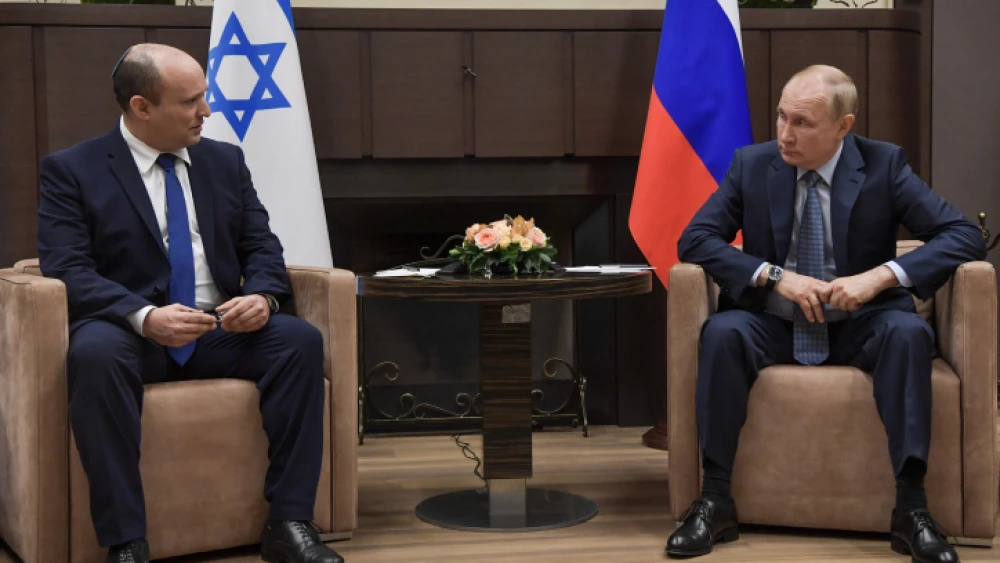

Ever since biblical times, the people of Israel have had to navigate the harsh terrain between clashing global powers. Now, here we are again, in Ukraine, having to maneuver between Russia and the West. The terrain this time around is exceedingly difficult, with significant security and ethical pitfalls along the way.
On one hand, our security situation requires us to keep all channels with Russia open. For the past seven years, ever since Russian forces entered the Syrian civil war, the IDF has managed to avoid any head-on collisions with Moscow, despite Israel’s intensive campaign to dislodge Iran from the war-torn country.
Unequivocally condemning the Russian invasion of Ukraine could give the Kremlin pause and perhaps even push it to terminate this cooperation.
Moreover, as the nation-state of the Jewish people, Israel must take into account the wellbeing of the nearly 800,000 Jews living in Russia, in addition to the 200,000 Jews living in Ukraine who could find themselves under Russian occupation. In light of these considerations, it’s easy to understand Israeli Prime Minister Naftali Bennett’s decision to refrain from denouncing Russia and its aggression in Ukraine.
However, a strong counter aspect to these considerations is in play, especially in light of the Ukrainian people’s determination to fight the Russian army tooth and nail. Can Israel, as a freedom-loving country, maintain neutrality? Can the Jewish state stand idly by as a popular rebellion—led by a Jew—fights tanks and jets with small arms and Molotov cocktails?
And yet, there are strong strategic and security-related counterpoints to these moral arguments, as well. Case in point: Former U.S. Secretary of Defense William Cohen wondered on CNN over the weekend: “Where is Israel on the Ukrainian issue, when it says it’s our most important ally in the Middle East.” Maintaining complete neutrality could also harm support for Israel among U.S. Jews, which is strained to begin with these days.
Finally, perhaps it’s also fitting to ask: Why is Israel so afraid of the Russian military presence in Syria? After all, this force consists of some 4,000 troops and a few dozen planes. Does our seemingly constant projection of trepidation damage our image and deterrence capabilities in the region?
It’s important to note here that despite our repeated requests, Moscow has chosen to continue selling some of the most advanced weapons systems in the world to our enemies. Hezbollah in Lebanon, and even Hamas in Gaza are equipped with Russian weapons, and Russia built the nuclear plant in Bushehr, Iran, and has promised to build another eight in the Islamic Republic.
As stated, navigating this environment is exceedingly perilous and requires Israel to tread very lightly. On one hand, it must keep as many channels with Russian President Vladimir Putin open and must continue caring for the welfare of Ukrainian and Russian Jewry, including the possibility of a mass absorption of immigrants.
On the other hand, Israel mustn’t remain silent—not in the face of the Ukrainian people’s courageous fight, which could be reminiscent of the dogged resistance to Soviet occupation after World War II; and not in the face of public opinion in the U.S., our most important ally. Israel should continue offering its services as a mediator and continue providing humanitarian and medical support to the Ukrainian people. We should also uphold our purpose as a strong and ethical Jewish state.
Michael Oren is a former Israeli ambassador to the United States.
This article first appeared in Israel Hayom.


