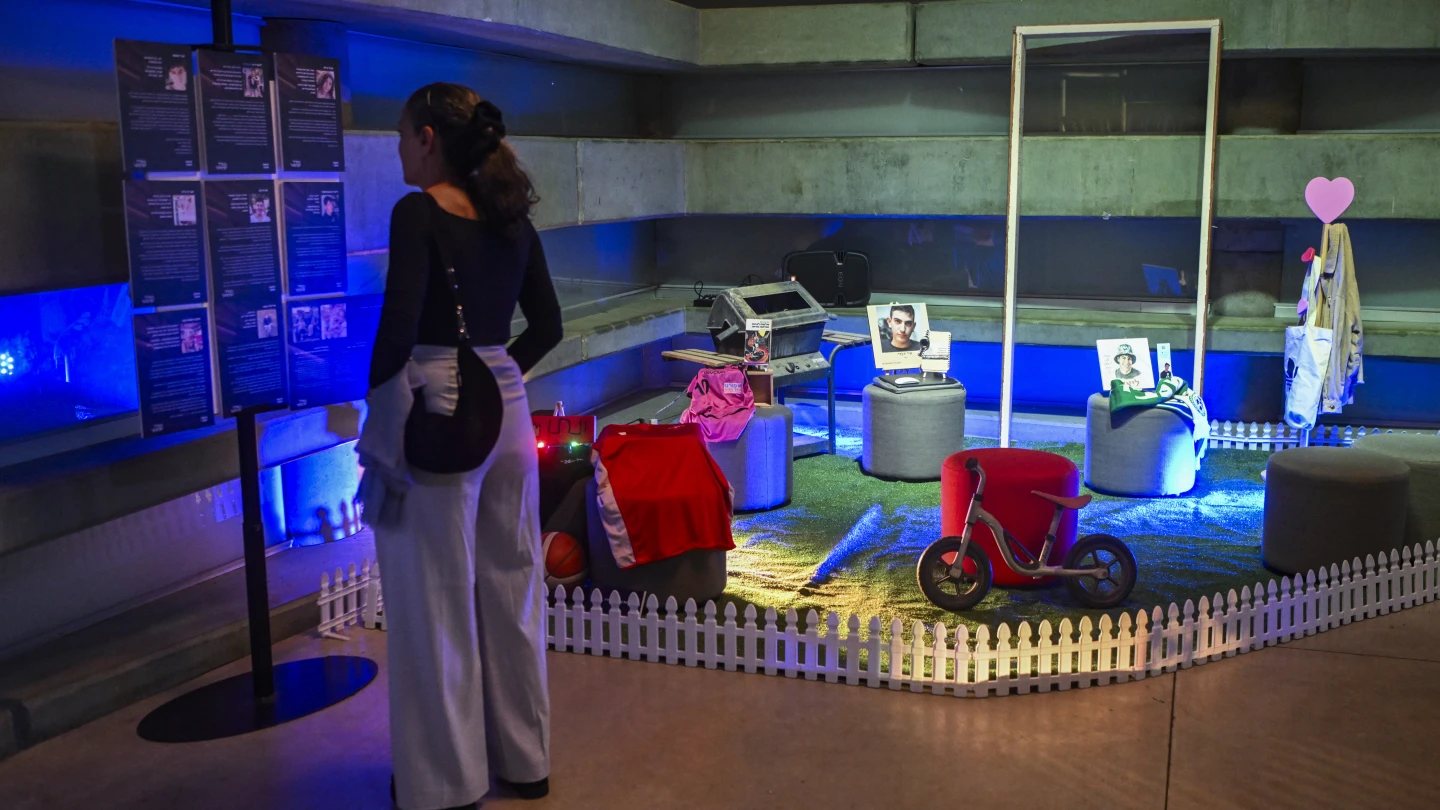
Three years after the Oct. 7, 2023, Hamas massacre, thousands of objects recovered from the devastated Gaza border communities are being preserved as witnesses to what happened that day.
Some 6,000 items are housed at a national storage and conservation center in Netivot, while thousands more are held elsewhere. They include scorched photo albums, religious items, children’s drawings and ordinary household objects transformed by fire, bullets and destruction.
To Dr. Nirit Shalev-Khalifa, curator and head of the Visual History and Documentation Department at Jerusalem’s Yad Ben-Zvi Institute, these remnants are not debris. They are evidence, memory and historical witnesses to the lives that existed before Oct. 7, 2023, and the violence that shattered them.
“What you record enters history,” Shalev-Khalifa told JNS in an interview in her Jerusalem office. “What isn’t recorded is forgotten. Forgetting is death. It is the dark hole. In the world of history and documentation, what isn’t recorded doesn’t exist.”
When the project began shortly after the massacre, Shalev-Khalifa thought the work might take two weeks.
“Those two weeks have now become three years,” she said.

‘A Sisyphean task’
It was the beginning of what she described as “a Sisyphean task”—the painstaking process of identifying, documenting and preserving objects one by one.
In a haunting coincidence, Shalev-Khalifa had been in Kibbutz Be’eri on Oct. 4, 2023, just three days before the massacre.
She was there as part of Yad Ben-Zvi’s ongoing work documenting local heritage collections and was shown preparations for the kibbutz’s upcoming anniversary celebrations. She photographed the hut housing Be’eri’s gallery, but her camera battery died.
“I said to myself, ‘The hut isn’t going anywhere,’” she recalled. “A day and a half later, it was gone.”
In the weeks after the massacre, Shalev-Khalifa and her colleagues visited displaced communities in hotels, but, like everyone else, she said, they were still struggling to comprehend what had happened.
The turning point came on Nov. 19, five weeks after the massacre, when representatives of organizations involved in the Heritage Ministry’s preservation program were brought to the devastated communities.
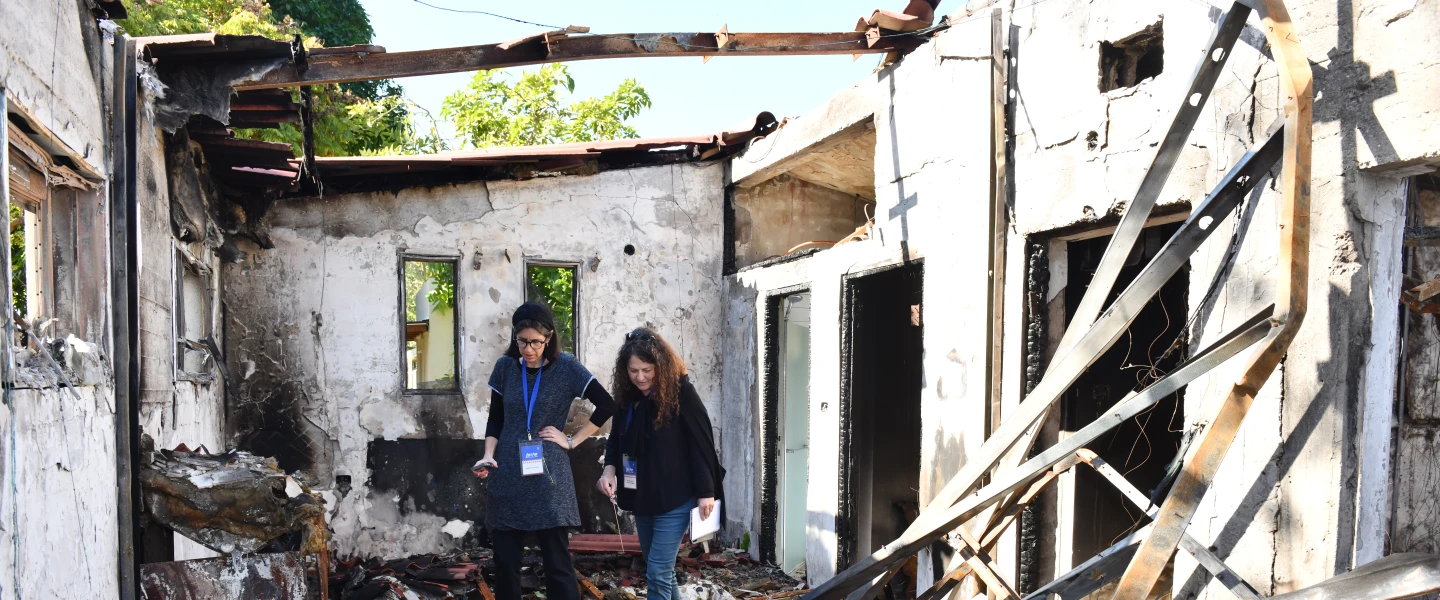
In Be’eri, archaeological teams were already using photogrammetry to create three-dimensional documentation of the destruction.
“They did the zoom-out, and we did the zoom-in,” Shalev-Khalifa said. “They showed how it looked, and we dealt with the objects.”
At the kibbutz’s dental clinic, she saw the randomness of the destruction: One part had barely been touched, while nearby offices had been overturned, shot up and burned.
She faced a fundamental question: What should they preserve?
“What do you take out? What don’t you take out? How do you document it? What do you write down? What even constitutes an object?” she recalled.
“In documentation, it is always too late and always the last moment,” she added. “That’s our motto. That’s my motto.”
‘Trauma objects’
Yad Ben-Zvi did not begin working with material history after Oct. 7. Shalev-Khalifa’s department had spent years developing ways of documenting Israel through photographs, wall art and everyday objects.
The work began in 2008 with Israel Revealed to the Eye, documenting history through private family albums. In 2018 came Eretz Hefetz, an initiative devoted to collections of everyday objects held by communities, heritage centers and private collectors.
For Shalev-Khalifa, cataloguing an object gives it an identity, allowing researchers to trace where it came from, who owned it and how it was used.
After Oct. 7, that methodology had to be applied to objects subjected to extreme violence.
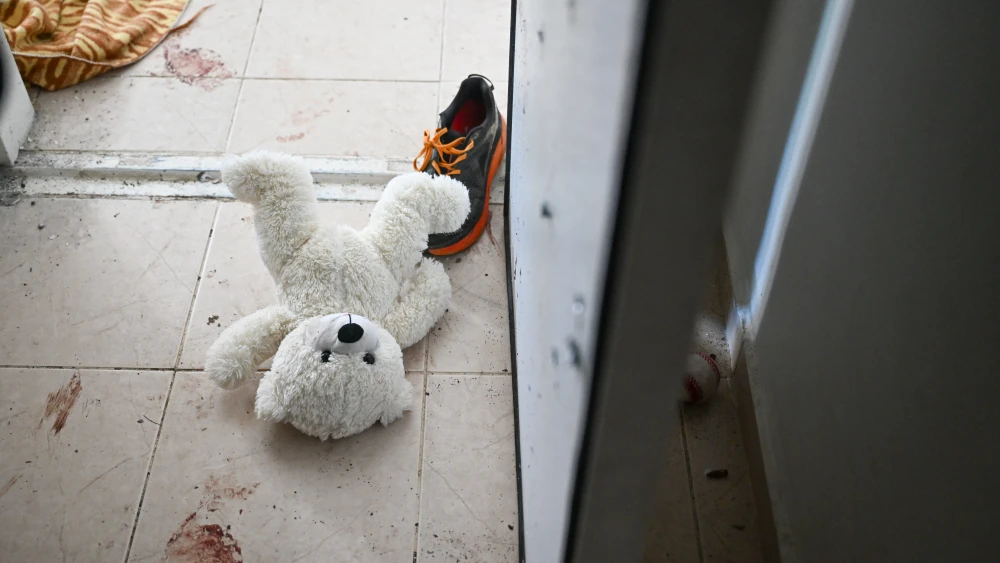
Consider an ordinary air-conditioner remote control, she said. It has physical components, a recognizable shape and a function. But when it is burned into a blackened mass and can no longer perform that function, its meaning changes.
“It becomes an object that has completely changed its purpose,” Shalev-Khalifa told JNS. “Now it is an object of memory. And it is evidence.”
“Instead of the study of objects, it became the study of trauma objects,” she said.
Among the objects recovered was an orange juice presser bearing the name of the Bibas family of Kibbutz Nir Oz. Before Oct. 7, it was simply an everyday household object. After Yarden and Shiri Bibas and their young sons, Ariel and Kfir, were abducted to Gaza, it became a physical remnant of a family home whose occupants had been violently taken away.
For Shalev-Khalifa, that transformation lies at the heart of the “trauma object”: An ordinary item acquires a second identity because of what happened to it, its owners or the place where it was found.
The work resembles archaeology, she said, except that the researchers recognize the objects in this contemporary destruction layer.
“If I found this 2,000 years from now and didn’t know what it was, I might say, ‘Oh, perhaps it was a ritual object,’” she joked. “That’s what we say in archaeology when we don’t know.”
That familiarity has also made the work difficult.
During the first months, team members spent their weeks surrounded by burned and shattered homes and returned home on weekends.
“You would walk into your house and think, ‘What’s wrong here?’” Shalev-Khalifa recalled. “It isn’t burned. You had become accustomed to seeing everything destroyed.”
Learning from 9/11
Within days of her first visit to the Gaza border communities, Shalev-Khalifa reached out to experts involved in preserving objects from the Sept. 11, 2001, terrorist attacks in New York.
“Within half an hour, I got an email back: ‘We are at your service,’” she said.
She subsequently spoke with Jan Ramirez, chief curator of the 9/11 Memorial & Museum.
Ramirez had been working at the New-York Historical Society on Sept. 11. As Shalev-Khalifa tells the story, the husband of one of Ramirez’s colleagues arrived covered in dust from the World Trade Center and placed his dust-covered mask on her desk.
“Here is your first item to exhibit,” he told her.
The American experts gave the Israelis a term for what they were encountering: “Trauma objects.”
Shalev-Khalifa rejects attempts to equate Oct. 7 with the Holocaust, noting that Jews did not have sovereignty or an army during the Holocaust, whereas Oct. 7 occurred in a sovereign Jewish state.
But she sees a parallel with the suddenness of mass terrorist attacks such as 9/11.
“You don’t understand what happened,” she said. “It comes like a bolt from the blue. There is astonishment; there is chaos and there is this constant enigma: What happened?”
Objects, she pointed out, are quite different from human witnesses.
“The objects don’t try to give themselves an answer. They don’t go to a psychologist. They don’t go to a support group. They don’t go on a retreat.”

‘Everything has a name’
The Yad Ben-Zvi teams do not enter private homes without permission from the owners or their families. Over time, families began asking them to search for possessions that carried memories of the people who had lived there.
In one burned home, Shalev-Khalifa recalled, a photo album survived because melted plastic around it eventually cut off the oxygen needed to keep the fire burning. Its discovery led the family to ask the team to search for other possessions.
One grandmother approached Shalev-Khalifa after three of her young grandchildren were murdered.
The thought of winter arriving, the ruined house deteriorating and her grandchildren’s dolls and other belongings eventually being scooped up by a tractor and discarded was unbearable.
The team conducted what amounted to an archaeological excavation.
“We actually sifted the ashes,” Shalev-Khalifa said, searching for fragments of plates and cups and remnants connected to the children.
“And everything is preserved,” she said. “It doesn’t go into the garbage.”
There is a principle behind the painstaking work: A person’s possessions remain theirs even after death, Shalev-Khalifa said. If the owner has been killed, the property belongs to the heirs.
But the project also revealed something the museum professionals did not expect.
A resident of one of the communities watched as the team documented a dining area from a destroyed home—the table, a newspaper crushed beneath part of the ceiling, a grandchild’s coloring book and other scattered remnants.
A traumatic event, he told them, is absolute chaos.
“You put a label on everything,” he said. “Suddenly everything has a name.”
For people whose world had been violently stripped of order, identifying, cataloguing and respecting individual possessions could itself be consoling.
“As museum people, we suddenly discovered this therapeutic, comforting element,” Shalev-Khalifa said. “For us, every object is treated with respect.”
Even the walls have stories. In some homes, parents had marked their children’s heights over the years. The house might have to be demolished, but those markings need not disappear with it.
The team learned an old conservation technique that allows the surface of a wall to be carefully removed and transferred to another backing. A piece of wall destined for demolition can thus become a record of a family’s history.
It is one of countless lessons Shalev-Khalifa and her colleagues learned over the past three years.
“We learn a million things,” she said. “Every time, we learn something new.”
Oct. 7 brought chaos. Homes were destroyed, families torn apart and their possessions blasted, burned and scattered. Then the Yad Ben-Zvi teams arrived and began, object by object, to restore some kind of order.
One resident’s observation about the teams’ work still captures the essence of the project, Shalev-Khalifa said.
“You put a label on everything,” he told them. “Suddenly everything has a name.”