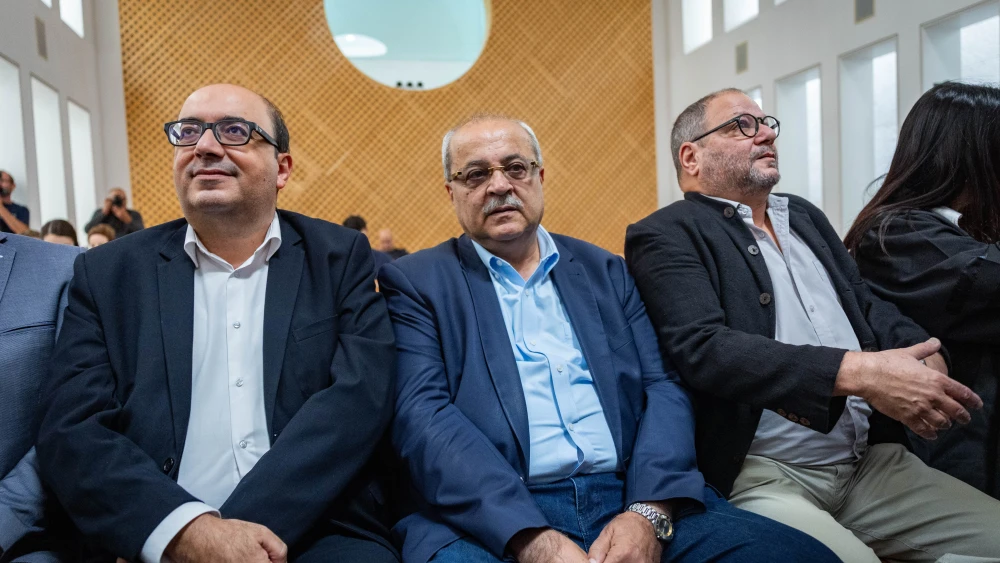
Israel’s Supreme Court, sitting as the High Court of Justice, on Friday overturned the Central Elections Committee’s decision to disqualify four Arab parties (running in two political blocs) and two candidates for parliament for the Oct. 27 general election.
The Joint List is composed of Balad, Ta’al and Hadash, a communist and predominantly Arab party. Ra’am is led by lawmaker Mansour Abbas, who has been facing accusations that his faction’s ideology is rooted in the Muslim Brotherhood movement.
The court in an expanded panel of nine justices unanimously accepted the appeals by Ra’am and the Joint List, saying that the criteria for applying Section 7A of Basic Law: The Knesset are narrowly construed and limited to extreme cases.
Knesset member Ofer Cassif of Hadash was allowed to run by a vote of seven justices to two, the Calcalist reported.
Justices David Mintz and Alex Stein held that he should be disqualified for supporting an armed struggle against the State of Israel, which is forbidden under Section 7A. The other panelists, however, said that his case did not fully meet the stringent criteria.
The proceedings concerning Balad chairman Sami Abu Shehadeh were dismissed after he announced earlier in the day that he was withdrawing his candidacy for the Knesset. His announcement came after the justices appeared to indicate that he would be disqualified by a majority vote.
The Central Elections Committee voted 30-4 on Sept. 23 to disqualify Abu Shehadeh, accepting petitions arguing that he supported armed struggle against Israel and denied Israel’s existence as a Jewish and democratic state. The petition was filed by National Security Minister Itamar Ben-Gvir’s Otzma Yehudit party.
The case centered on an Arabic-language article Abu Shehadeh published on Oct. 8, 2023, one day after Hamas-led terrorists invaded Israel. In the article, he described the attack as “an important historic event militarily, politically and strategically,” and wrote that others could learn from Hamas’s ability to surprise Israel.
Abu Shehadeh has denied supporting the Oct. 7 attack or political violence, saying he opposes armed struggle. He has described the disqualification effort as an attempt to silence him and the Arab community’s political voice.