


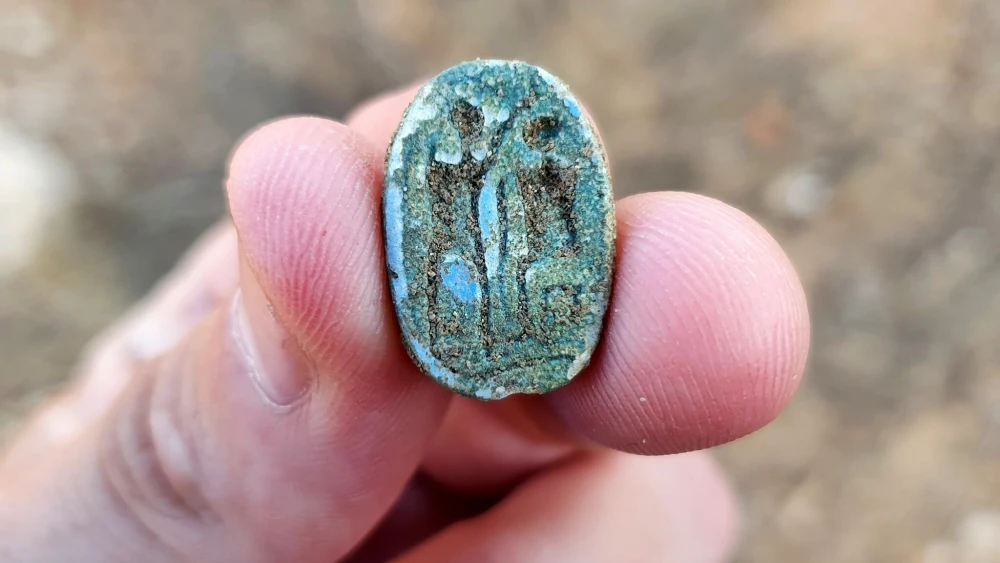
A 3,000-year-old stone scarab was recently discovered at Azor, some four miles southeast of Tel Aviv, during an eighth-grade school field trip, the Israel Antiquities Authority announced on Wednesday. The carvings on the scarab depict what is believed to be the bestowing of legitimacy on a local ruler.
“We were wandering around when I saw something that looked like a small toy on the ground,” said Gilad Stern of the IAA Educational Center, who was leading the tour. “An inner voice said to me: ‘Pick it up and turn it over.’ I was astonished: It was a scarab with a clearly incised scene, the dream of every amateur archaeologist. The pupils were really excited!”
The tour, of students from the Rabin Middle School, took place in the context of a tour-guide course organized by the IAA for the third year running.
“The scarab was used as a seal, and was a symbol of power and status. It may have been placed on a necklace or a ring. It is made of faience, a silicate material coated with a bluish-green glaze,” said Amir Golani, an IAA specialist on the Bronze Age period. “It may have dropped from the hands of an important figure of authority who passed through the area, or it may have been deliberately buried in the ground along with other objects, and after thousands of years it came to the surface,” he added.
“This scene basically reflects the geopolitical reality that prevailed in the land of Canaan during the Late Bronze Age (ca. 1500-1000 BCE), when the local Canaanite rulers lived (and sometimes rebelled) under Egyptian political and cultural hegemony. Therefore, it is very possible that the seal is indeed from the Late Bronze Age, when the local Canaanites were ruled by the Egyptian Empire,” said Golani.
Hundreds of scarabs have been discovered in Israel, some of them having been imported from ancient Egypt and many more imitated by local artisans under Egyptian influence.
“The find of the scarab in the framework of a field tour with pupils participating in the tour-guide course is symbolic, in that the pupils were gaining archaeological knowledge and at the same time contributing to our archaeological heritage. This cooperation is truly moving, as we are working towards connecting communities with their cultural heritage,” said IAA Director Eli Escusido.
The scarab, or common dung beetle, was associated by the ancient Egyptians with death, birth and rebirth.



