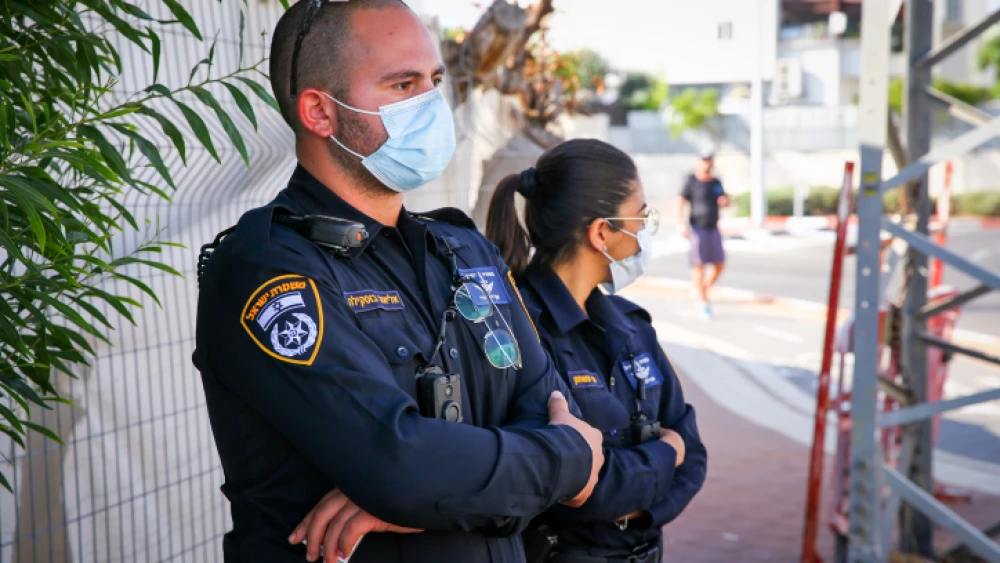
Nightly curfews will go into effect in 40 “red” cities and towns across Israel on Tuesday evening, amid a raft of other regulations aimed at halting the rise in new COVID-19 cases in the country.
The list of “red” cities, so named due to their high coronavirus morbidity rates, includes the ultra-Orthodox city of Bnei Brak and the Arab town of Umm el-Fahm.
The regulations are set to go into effect on Tuesday at 7 p.m. The curfews will last from 7 p.m. to 5 a.m. for the next seven days.
The final list was approved on Tuesday morning by the Ministerial Committee on Declaring Restricted Zones and released to the press, after days of indecision within the coronavirus Cabinet over the extent of the measures and the areas that would be affected by them.
The following are the cities, towns and neighborhoods that will be subjected to the seven-day measures, which will be extended if the government and health authorities deem it necessary.
- Abu Snan
- Umm el-Fahm
- Eilat’s Shahamon neighborhood
- Elad
- Ashdod’s Gimmel, Zayin and Chet neighborhoods
- Ashkelon’s Mitzpe Barnea, Ganei Barnea, Neot Barnea, Givat Zion and Karmei Zion neighborhoods
- Buq’ata
- Beit Shemesh’s Ramat Beit Shemesh Alef and Gimel, and Menucha VeNachala neighborhoods
- Bnei Brak
- Beitar Illit
- Nujeidat in Bu’eine Nujeidat
- Baqa al-Gharbiyye
- Julis
- Jaljulia
- Jat
- Daliyat al-Karmel
- Ibtan
- Taibe
- Tira
- Yafa an-Naseriyye
- Jerusalem’s Kfar Ekev, Beit Hanina, Ramat Shlomo, Ramot, A-Tur, Issawiya, ‘Anata, Shuafat and Sanhedriya neighborhoods
- Kisra
- Kafr Bara
- Kafr Manda
- Kafr Qasim, (other than the Lev Haaretz and Nof Haaretz industrial zones)
- Kafr Qara
- Laqiya
- Musheirifa and Salem
- Nazareth
- Netivot
- Ein Mahil
- Emanuel
- Isfiya
- Ar’ara
- Fureidis
- Qalansawe
- Reineh
- Rekhasim
- Sderot’s Neot Yitzhak Rabin and Neot HaNeviim neighborhoods
- Shefa-'Amr (Shfaram)
In addition to having to abide by the curfew—during which residents of the above areas will not be permitted to stray more than 500 meters (approximately 1,600 feet) from their homes other than to purchase food and medical supplies—businesses will operate daily only until 7 p.m., and all schools, with the exception of kindergartens and special-education institutions, will be closed.
According to Israeli Health Ministry data, 3,425 new COVID-19 cases were recorded on Tuesday, bringing the total number since the onset of the pandemic to 135,288. Of 27,962 active cases, 467 were categorized as “serious,” with 134 patients on ventilators and a national death toll of 1,031.