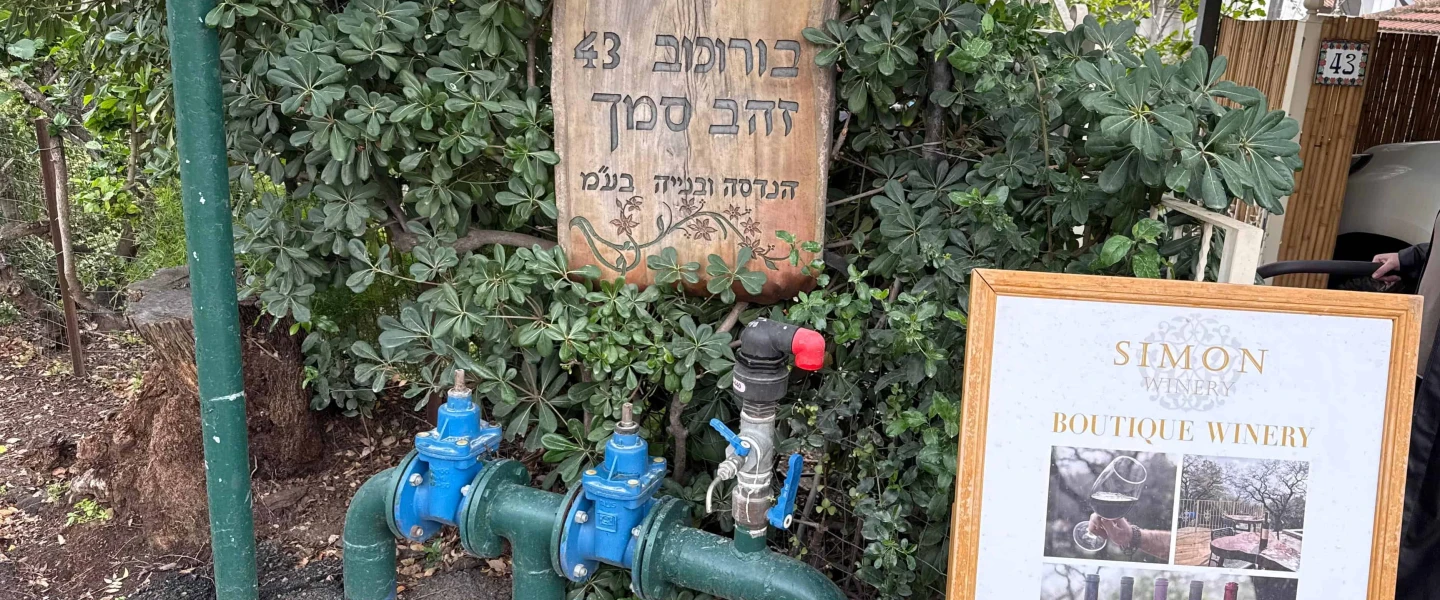
In northern Israel, a few kilometers from the industrial parks of Yokne’am, a small business in Kiryat Tivon looks more like a backyard gathering than a boardroom.
Six of us sit and discuss familiar topics: supply chains, export markets, climate adaptation, irrigation and ag-tech.
Only this time, the founder is pouring wine—his own.
The “startup” is Simon Winery, established in 2010 by Zeevi Simon. A civil engineer and business owner by trade and a winemaker by choice, his boutique operation is one of hundreds of small vineyards that have quietly appeared across Israel over the past two decades.
Simon is part of one of Israel’s oldest national projects—and one of its most overlooked economic stories: a steadily growing wine industry.

Kiryat Tivon has recently drawn attention from global technology companies such as NVIDIA, which is building a new hub nearby. Yet long before semiconductors arrived, another economic ecosystem was already thriving: wine.
At Simon Winery, Israel’s characteristic blend of innovation and tradition is unmistakable. Many wineries here are not centuries-old estates but ventures founded by engineers, reservists, immigrants and mid-career professionals.
Simon explains how he sources Shiraz grapes from the Ben Zimra vineyard in the north, and Cabernet Sauvignon, Merlot, Carignan and Malbec from vineyards in Binyamina and the Kadesh Valley. The grapes are hand-harvested and aged for a year in French oak barrels.
Production has grown from 4,000 bottles annually to about 9,000.
We taste reds, whites and rosés with cheese and conversation overlooking greenery. Couples, families and friends pass through—a leisurely ritual many Israelis embraced after the Oct. 7 attacks as a way to support local businesses and reconnect with normal life.
Israel’s national wine story
Israel’s wine culture is both ancient and new. Archaeological evidence shows winemaking here more than 3,000 years ago, yet the modern industry largely emerged in recent decades as trained winemakers returned from France, California and elsewhere.
Like the tech sector, Israel’s wine production is small globally but influential for its size. In 2025, Israel unveiled its first official national wine map, identifying seven regions: the Galilee and Golan, Carmel, Judea, Samaria, the coastal plain, the Negev and the valleys.
Most of Israel’s 300-plus wineries produce fewer than 50,000 bottles annually. Overall production is about 45 million bottles per year, exported to roughly 40 countries.
Despite the war in Gaza, Israel exported $65.1 million in wine in 2024 (the most recent reporting year), mainly to the United States, ranking 26th worldwide among exporters, according to the Observatory of Economic Complexity.
Unlike countries such as France or Georgia, Israel’s wine tradition is defined less by uninterrupted continuity than by reinvention. Winemakers often arrive from different professions, bringing entrepreneurial instincts to an ancient craft.
Tie to the past
Wine in Israel is not only agricultural; it is civilizational. Rituals such as kiddush connect it directly to Jewish identity.
For many Jews, wine is first encountered not in restaurants but at Shabbat tables, weddings and holidays. It functions as both a beverage and a religious object.
When Israeli winemakers speak of “terroir,” they often mean two things at once: soil and climate, and historical belonging.
New wineries continue to merge past and present. In 2025, Gal Pauker opened Pauker Winery using grapes grown by his grandfather, Gideon, in Nir Oz before Hamas terrorists murdered him on Oct. 7, 2023.
Past, present and future
At Simon Winery, conversations drift from tannins to travel plans for the next vineyard visit. The country known for speed—startups, apps and acquisitions—is also investing in patience.
I sip the wine and discuss the tannins with my friends. One prefers the oaky taste of the previous bottle, another wants to return to the white that had the grapes from a different part of the country. The founder, however, sits on, embracing the energy of the crowd he has gathered in his garden—the meeting spot for his latest creation.
Leaving the winery, already planning the trip to my next one, I consider the difference between Israel’s tech sector and its wine industry—two areas of the country I have gotten to know well during the war. I can see how a country that, for many, is known for its speed—its apps, product deployments, acquisitions—is also investing in its slowness. Foundations today are designed to be enjoyed for decades to come.
The success of Israel’s growing wine industry represents a significant return to a people’s historic ties to a country and a commitment to build on its past for its future. The barrels and vineyards will be around long after these founders retire, which may be exactly why they do it.
In a nation defined by urgency, wine may be the Jewish state’s most deliberate act of continuity.