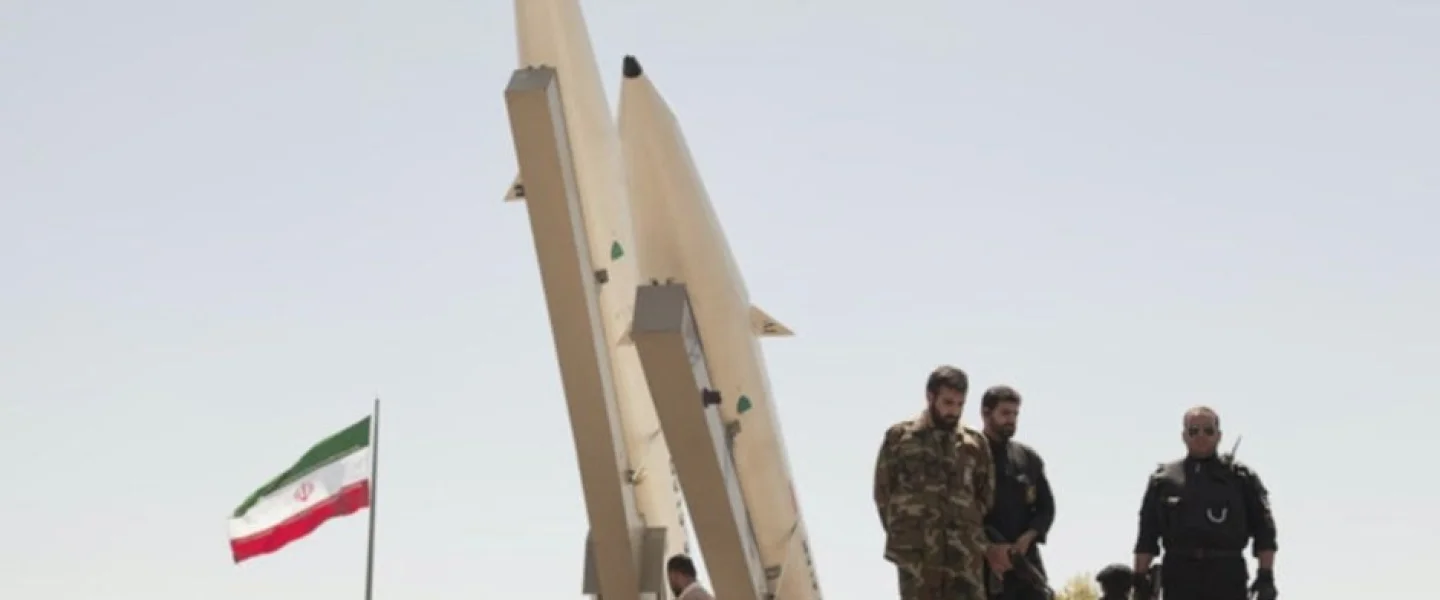
Despite the recent American mobilization of a cruise missile submarine to the Persian Gulf, the United States lacks “real deterrence” against the Islamic Republic at this time, according to a former senior Israeli defense official.
IDF Brig. Gen. (res.) Jacob Nagel, who has served as Israel’s acting national security adviser and headed Israel’s National Security Council, spoke to JNS days after the Pentagon shared an image of the USS Florida, a guided-missile submarine capable of carrying up to 154 Tomahawk missiles, passing through the Suez Canal en route to the Persian Gulf.
Nagel, a senior fellow at the Foundation for Defense of Democracies and a visiting professor at the Technion–Israel Institute of Technology Aerospace Faculty, said that despite that flexing of military muscle, U.S. conduct in the region under U.S. President Joe Biden had led to the loss of U.S. deterrence against Iran.
In late March, Biden said that the United States does not seek conflict with Iran, but will respond to protect its personnel in Syria and elsewhere. The statement came after American retaliatory airstrikes were launched against Iranian-backed groups following deadly rocket attacks on a U.S. base.
The Biden administration will go to great lengths to avoid striking Iran, according to Nagel. As a result, he said, Iran has developed a doctrine based on the assumption that it has broad freedom of action in the region.
“It is certainly possible that Israel may have to do what is needed on its own,” said Nagel, referring to a potential strike on Iran’s nuclear program. “What we’ve requested recently from the United States is that it at least support Israel, with words and equipment, before, during and after [such an attack],” he added.
The former defense official added that Israel’s own deterrence, too, has been significantly damaged, albeit for different reasons. A major factor, according to Nagel, is “irresponsible and inaccurate statements by former Israeli officials, but also current, who say that Israel is not ready and needs time. Some even claim that we should go back to the nuclear agreement to earn time and prepare for an attack. That’s like building a stable that will be ready after the horses escaped.”
According to Farzin Nadimi, an associate fellow at the Washington Institute, “Typically, U.S. submarine deployments are not announced in advance, especially when the vessels are entering a potentially hot zone of operation that may require them to rely on stealth.”
Yet following the March 23 drone attack near Hasaka, Syria, which killed an American contractor, U.S. airstrikes on Iran-backed militias in Iraq, and rocket attacks on another U.S. compound in Syria, as well as suspicious Iranian drone activities in the Gulf of Aden, Arabian Sea and Red Sea, Washington resorted to signaling deterrence with submarines, wrote Nadimi in a post published on the Institute’s website.
Ohio-class submarines such as the USS Florida carry cruise missiles with a sufficient range that all Iranian regime and military sites are within range of the Persian Gulf.
However, Iran’s conceptual doctrine holds that the United States is weak and that while it has the capability to strike Iran, the American administration does not wish to do so and will not do so, said Nagel, who agreed with that assessment.
A second Iranian assumption is that Israel is too weak to act alone, and will not strike if it sees that the United States will not—an assumption that according to Nagel is wrong, despite statements by “irresponsible” Israeli voices.
The internal Israeli political crisis has only further encouraged this Iranian assumption, he added.
A third pillar of Iran’s doctrine is that the Iranian people can withstand sanctions for a prolonged period—also correct, according to Nagel.
With Iranian decision-makers believing that there is no true credible military threat against the country’s leadership, economy or regime, “it’s no wonder that the Iranians behave as they do,” he stated.
“Israel must seriously prepare for a widespread conflict with Iran, and not wait until the last of its capabilities are ready—something that will never happen,” said Nagel. “The same is true regarding Iran’s proxies in the north and south.”
In a recent opinion piece published by Israel Hayom, Nagel said that Iran is clearly behind the recent escalation in rocket attacks on Israel that occurred earlier this month from Lebanon and Gaza, “through Hamas and Hezbollah.”
“Iran is pushing for confrontation in four theaters: Lebanon and Syria, Gaza, Judea and Samaria, and Jerusalem. The time has come to implement the change in Israel’s National Security Strategy from 2018 and aggressively punish the attackers, but also the country from which the attacks originated and the country that sent them,” he added.
On April 12, the Hebrew-language Walla news site reported that IDF Military Intelligence has recently told the Israeli government that a regional war is currently more likely than restored calm.
Intelligence assessments cited in the report said tensions are expected to persist after the Muslim holy month of Ramadan ends on April 21.