Newsletter
Newsletter Support JNS

High Court postpones judicial reform hearing due to war

The Judicial Selection Committee hearing was moved to Nov. 12 after Justice Ministry lawyers were called up for IDF duty.

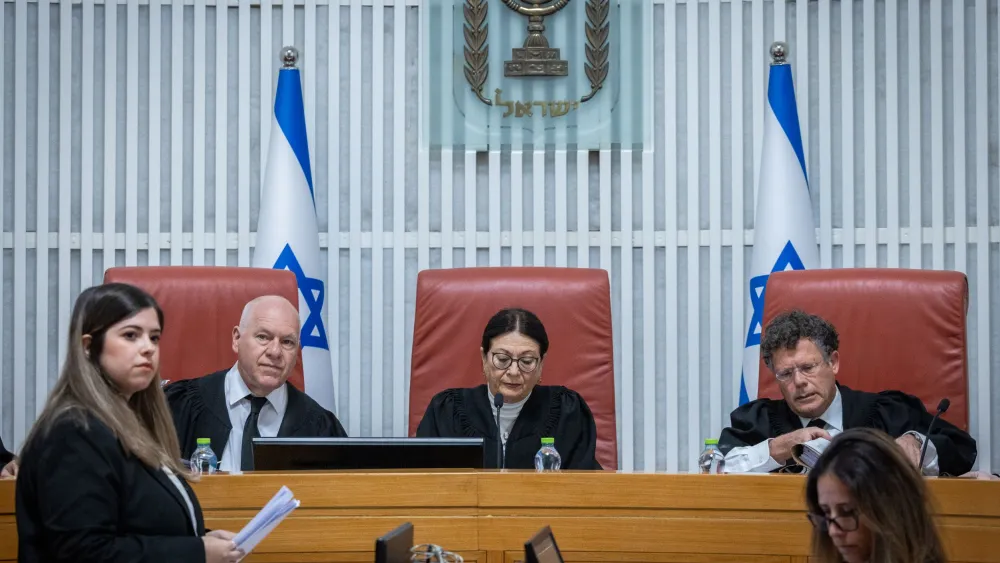
Israeli Supreme Court president Esther Hayut and fellow justices arrive for a court hearing on petitions demanding the annulment of the appointment of Shas leader Aryeh Deri as a government minister, at the Supreme Court in Jerusalem, Jan. 5, 2023. Photo: Yonatan Sindel/Flash90

With Israel engulfed in a war with Hamas in Gaza, the High Court of Justice on Thursday decided to postpone a hearing related to the government’s judicial reform initiative.

Instead of this Sunday, petitioners against Justice Minister Yariv Levin’s refusal to convene the Judicial Selection Committee will be heard on Nov. 12, with submissions to the court able to be submitted until Nov. 5.

Supreme Court Justice Yael Willner’s decision came after Levin requested a postponement on Wednesday to submit his affidavit due to members of his legal team being mobilized for IDF duty as part of the largest reserve call-up since 1973.

The Movement for Quality Government in Israel, one of the petitioners, opposed the postponement.

Judicial reform was moved off the legislative agenda after a unity government was formed that includes members of the opposition following the Hamas terrorist assault that began on Oct. 7.
Sam Raskin, a spokesman for the mayor, said that Mamdani talked to shoppers at Eichler’s and “heard directly from community members about the issues facing the neighborhood and how the administration can best support its residents.”
The diplomatic move comes as Israel presses for Hezbollah’s disarmament.
The Israeli defense chief vowed strikes on critical infrastructure, noting economic troubles could push Tehran into desperate measures after repeated defeats.
“Gloria was iconic,” Ruth Messinger, a former Manhattan borough president, told JNS. “This is a sad day for women.”