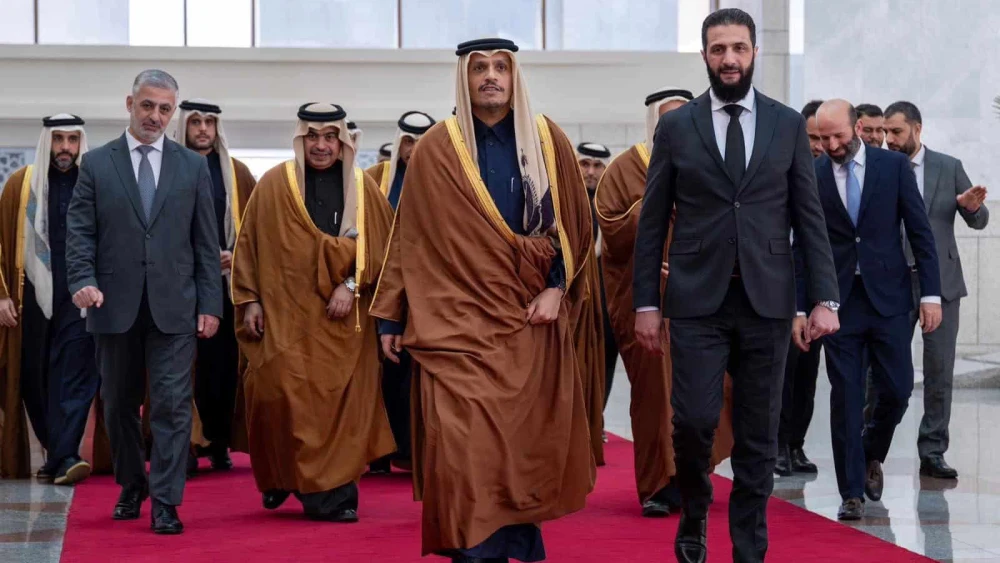
Qatar will pressure Israel to leave the Golan Heights buffer zone “in the coming days,” Syrian leader Ahmed al-Sharaa claimed on Thursday afternoon, speaking during a press conference alongside Qatari Prime Minister Sheikh Mohammed bin Abdulrahman Al Thani in Damascus.
Al-Sharaa, the country’s de facto leader who is also known by his nom de guerre, Abu Mohammad al-Julani, said Doha was playing a “major role” in mustering opposition against Jerusalem’s moves in Syria.
“It will also play an active role in the coming days in shaping this pressure, through cooperation with some Western and American countries and regional countries,” al-Sharaa continued, claiming that “all of them agree on the mistake of the Israeli advance on the region and the obligation to return to what it was before the last advance.
“Qatar will support this approach and will use all available means to exert pressure on Israel to return [the situation] to what it was before,” he said.
The Syrian leader told Reuters that “Israel’s advance in the region was due to the presence of Iranian militias and Hezbollah.” Al-Sharaa reiterated his call for Israel to withdraw from the Syrian side of the Golan Heights, accusing Jerusalem of endangering “the entire region.
“After the liberation of Damascus [with the fall of the Assad regime], I believe that they have no presence at all. There are pretexts that Israel is using today to advance into the Syrian regions, into the buffer zone,” the Sunni Islamist leader continued.
Al-Sharaa claimed his regime was prepared to allow U.N. peacekeepers to be deployed to the area, in accordance with the 1974 Disengagement of Forces Agreement that concluded the 1973 Yom Kippur War.
Sheikh Mohammed, who became the first Qatari official to visit Syria on Thursday after Doha restored ties with Damascus following the fall of the Assad regime on Dec. 8, in a statement stressed his commitment to “providing support to our Syrian brothers in the transitional phase in coordination with regional and international partners.”
Qatar formally broke off relations with Syria in 2011 as it voiced support for the opposition rebels who were seeking to overthrow Assad’s rule.
Since the fall of the Iranian- and Russian-backed Assad regime, Israeli forces have taken up positions inside and beyond the Golan buffer zone, including on the strategic Syrian side of Mount Hermon. The Israeli Air Force has conducted hundreds of strikes on former Assad military assets to prevent them from falling into the hands of hostile forces.
Israeli Foreign Minister Gideon Sa’ar vowed on Jan. 2 that Jerusalem would not allow another massacre to take place “on any front,” writing on social media after a visit to IDF soldiers serving on the Syrian border.
Al-Sharaa, whose Hayat Tahrir al-Sham militia led the assault that unseated Assad, previously asked the United States to pressure Israel to withdraw from the Golan buffer zone and the peak of Mount Hermon.
Jerusalem’s “excuses have run out, and they have crossed the lines of engagement” for striking the Assad regime’s military infrastructure, as well as for deploying troops in Syrian territory, The New York Times quoted al-Sharaa as telling a group of journalists last month.
Qatar, together with the United States and Egypt, was instrumental in brokering the impending ceasefire and hostage release deal between Israel and Hamas, which is supposed to be implemented on Sunday.