About five years ago, I participated in a head-to-head debate about contemporary anti-Semitism that was published in the Congressional Quarterly. Facing off against a particularly tiresome Jewish anti-Zionist, I tried to shed some light on the issue by drawing a distinction between what I called “Bierkeller” and “Bistro” anti-Semitism.
“Bierkeller” anti-Semitism—named for the drinking establishments in Germany where the Nazis chugged down beer while shouting themselves hoarse about the “Jewish menace”—is, I said, pretty transparent. You wear a uniform, you yell about Jews (not “Zionists,” mind you, but “Jews”), and you burn down a synagogue. By contrast, “Bistro” anti-Semitism—named for the trendy eateries adored by bien-pensant metropolitan leftists—is an altogether more refined affair. It does not demonize Jews as Jews. It regards any talk of anti-Semitism as a reprehensible technique to divert attention away from Israel’s “crimes.” And it insists that there is no common ground between today’s calls to destroy the Jewish state and Hitler’s obsession with destroying the Jewish people; the former is grounded upon principles of justice, while the latter refers to a regrettable historical event that is, whatever the paranoid fantasies conjured up by Jewish leaders, over and done with.
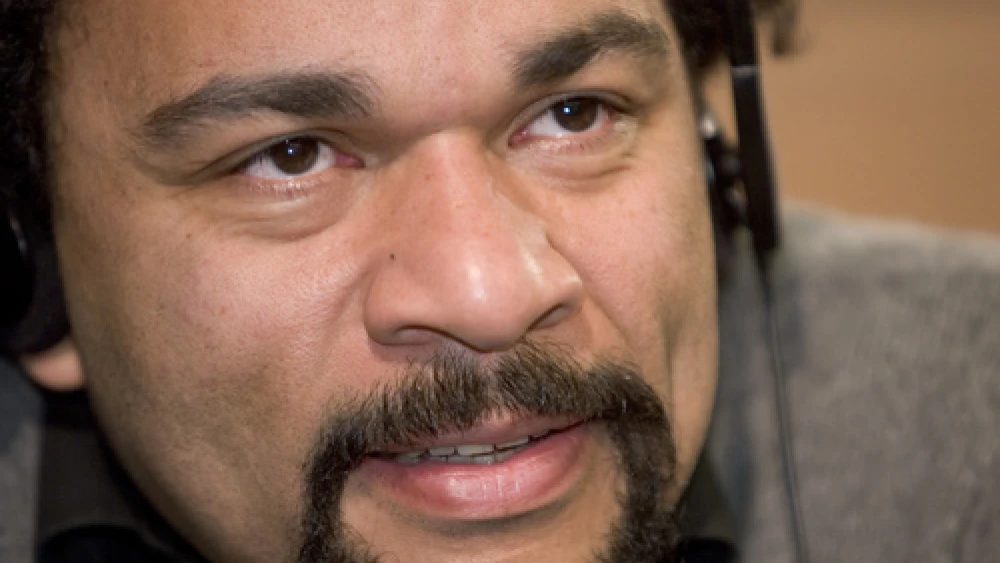
As I observed the furor around two separate but related events in recent weeks—the mushrooming of a movement in American universities in favor of an academic boycott of Israel, and the disturbing trend in France for performing the “quenelle,” an inverted Nazi salute, in public spaces—I thought once more of that distinction. What, I asked myself, connects the worldview of Dieudonné M’bala M’bala—the anti-Semitic French comedian who invented the quenelle, and who heads a party called the “anti-Zionist List” while admitting that the voice of a Jewish journalist makes him nostalgic for the gas chambers—with the worldview of the Israel-haters in the American Studies Association, the Modern Language Association, and similar academic bodies? Put another way: Is there now an inviting bistro in some corner of the loud, intimidating bierkeller?
It’s likely that many, though not all, American advocates of the academic boycott of Israel would be horrified by any association with Dieudonné. In their minds, a huge expanse separates their opposition to what they call Israel’s “apartheid” system of government from the young man who gave the quenelle while standing outside the Jewish school in Toulouse where, during a March 2012 terrorist atrocity, a rabbi and three small children were murdered. That fellow, they would say, is motivated by hatred of Jews; we, on the other hand, are motivated by justice for the Palestinians.
The truth is that it’s nowhere near that simple. Here’s why: In the post-Holocaust era, there isn’t a single example of something defined as “anti-Zionism” that hasn’t been contaminated by anti-Semitism. When the Arab League launched its “anti-Zionist” boycott in 1945, three years before Israel’s creation, its target was the besieged Jewish community in British Mandate Palestine. When the Soviet Union threw in its lot with the Arab regimes during the Cold War in the name of “anti-Zionism,” the primary victims were Soviet Jews. When Poland’s ruling communists launched an “anti-Zionist” campaign in the late 1960s, the people whom they purged were Jewish. And when left-wing German terrorists hijacked an Air France plane in 1976, they demonstrated their “anti-Zionism” by separating the Jewish passengers from the non-Jewish ones.
Today’s boycott activists need to be reminded of this sordid history. They need to be asked why the cause of Israel’s elimination is a magnet for individuals like Dieudonné, as well as for the myriad others who warn darkly about the power of the so-called “Israel Lobby,” or the existence of an “Israel Firster” mentality among Jews. Is it just a coincidence? Or are we dealing with a situation in which anti-Semitism is acceptable so long as it calls itself by some other name? Are we really so dim as to be fooled by an exercise in rebranding? After all, if the anti-Semitic Nazi salute were not illegal in France, there would be no need for the “anti-Zionist” quenelle.
Israel’s defenders might also want to ponder the important question of what the future holds. Will forthcoming incarnations of anti-Zionism belong to the earnest dogmatists of the academy, or will they be trumped by the theatrical provocations of Dieudonné and his quenellistas?
Only the latter have the possibility of becoming a mass phenomenon, because they exercise an appeal that stretches from the street corners of depressed European cities to glitzy VIP rooms filled with celebrity athletes. That’s why the days when we look back upon the academic boycott of Israel as a comparatively innocent affair may not be too far in front of us.
Ben Cohen is the Shillman Analyst for JNS.org. His writings on Jewish affairs and Middle Eastern politics have been published in Commentary, the New York Post, Ha’aretz, Jewish Ideas Daily and many other publications.