


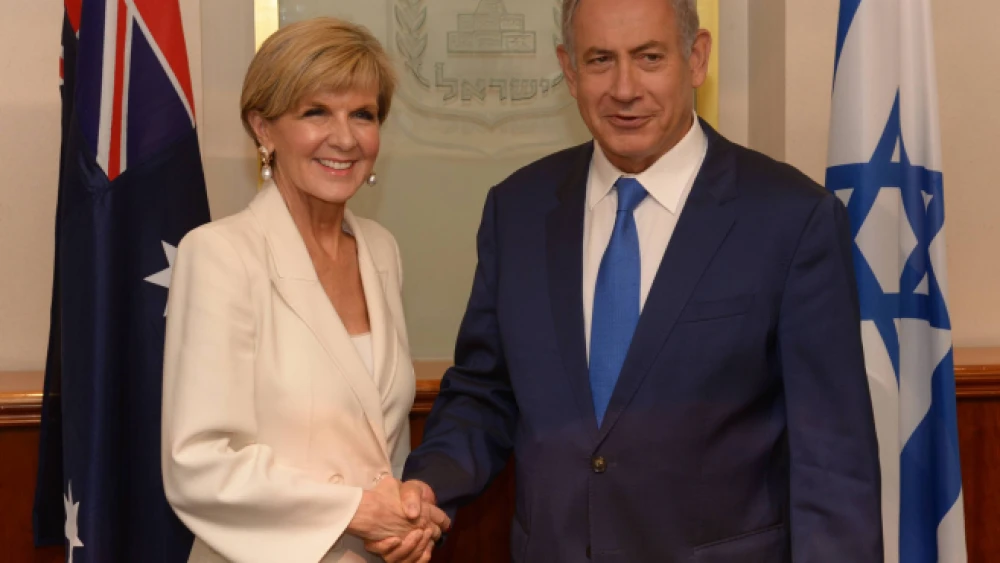
Australia will no longer give direct financial aid to the Palestinian Authority, citing concerns that international aid is being used to provide payments to convicted terrorists and their families.
“Any assistance provided by the Palestine Liberation Organization to those convicted of politically motivated violence is an affront to Australian values, and undermines the prospect of meaningful peace between Israel and the Palestinians,” Australian Foreign Minister Julie Bishop said in a statement.
“I wrote to the Palestinian Authority on May 29, to seek clear assurance that Australian funding is not being used to assist Palestinians convicted of politically motivated violence,” she added. “I am confident that previous Australian funding to the P.A. through the World Bank has been used as intended. However, I am concerned that in providing funds for this aspect of the PA’s operations there is an opportunity for it to use its own budget to activities that Australia would never support.”
Though the direct funding Australia provided through the World Bank will be terminated, Australia will reroute its funding to Palestinians through the United Nations’ Humanitarian Fund for the Palestinian Territories, which purports to contribute to areas such as health care, sanitation and basic needs. According to Bishop, the bulk of the Australian funding, AUD 10 million ($7.36 million) will be used in Gaza.
An Israeli bill to subtract the amount paid to terrorists by the P.A. from the tax revenues collected for the P.A. by Israel is expected to pass on Monday in the Knesset. Confiscated funds will be transferred to organizations who work with Israeli terror victims.
In March, the U.S. Congress passed the Taylor Force Act, named after an American murdered in Israel by a Palestinian in 2016, which cuts funding to the Palestinian Authority as long as the body pays salaries to terrorists.
Figures from Israel’s Defense Ministry show that in 2017, the P.A. paid NIS 687 million ($198 million) to the “martyrs’ families fund” for terrorists killed while committing terror acts, and NIS 550 million ($160 million) to the Palestinian Prisoners’ Club for Arabs who have been incarcerated in Israel for committing security violations, a whopping 7 percent of the body’s entire annual budget.
Salaries are determined by length of sentence (longer sentences earn higher salaries), marital status, number of children and residency (Jerusalem residents, and Israeli Arabs receive higher payments).
According to the Defense Ministry, some terrorists will earn as much as $2.78 million over the course of their lifetimes.
In June 2017, P.A. leader Mahmoud Abbas called terror payments a “social responsibility to look after innocent people” whose loved ones were jailed or killed by Israeli forces.
He said the individuals were not terrorists, but rather “victims of the occupation.”


