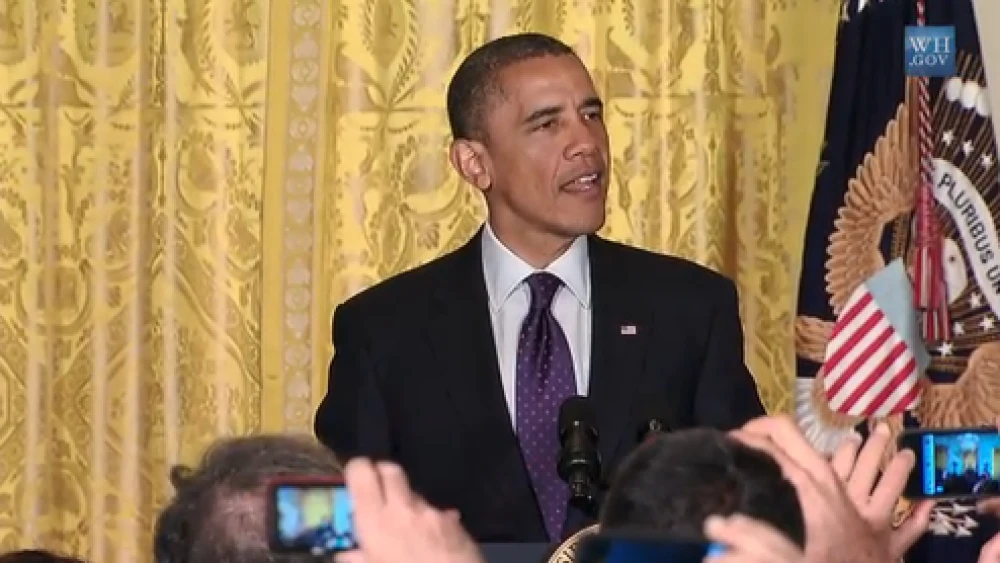
A failing economy is the paramount concern of most Americans with worries about taxes, spending and domestic issues overshadowing any discussion of the Middle East or the Iranian nuclear threat. Yet the stiff competition for Jewish votes, especially in battleground states such as Florida, Pennsylvania and Ohio, means that Republicans and Democrats are bound to keep hammering each other on the question of President Obama’s attempt to claim that he is the best friend Israel has ever had in the White House.
That was the subtext to a minor dustup in Miami last month in which the attempt of Democratic National Committee Chair Rep. Debbie Wasserman Schultz to use a Friday night synagogue service to make a speech promoting her party’s talking points about the president led to resignations and ultimately a decision to cancel her appearance on the bima. Wasserman Schultz and the Democrats claimed she was “silenced” by GOP “bullies” in the congregation who had demanded equal time if she was going to use the pulpit to promote the president’s re-election. But what’s interesting about the way Democrats have sought to use religious institutions (especially the Reform movement) to bolster their campaign is that in doing so, they have reversed a position they vociferously defended in the past few presidential elections that held that any debate about Israel was itself out of bounds.
In 2004 and 2008 Republicans made an explicit pitch to Jewish voters that a sea change in American politics had created a new alignment in which the GOP had surpassed the Democrats in devotion to Israel. The response from Democrats was to assert that to even raise the question of a candidate’s pro-Israel bona fides was to undermine that alliance. Given the overwhelming advantage they held among Jews and that Israel was the one issue on which Republicans had any traction, that effort to suppress discussion of the relative positions of John McCain and Barack Obama was disingenuous. But given that Obama (as John Kerry had four years before him) won the Jewish vote handily against a man with a better record on Israel, it may well have worked.
But after three years of constant fighting with Israel, the administration has been conducting a charm offensive determined to wipe out the memory of the sparring that preceded it. Whereas previously its position was one that sought to suppress discussion of Israel, now it knows that is impossible and is working hard to portray the president as an ardent ally of the Jewish state—even if doing so requires some short-term memory loss.
Cynics may regard this change of tune with hilarity, but the willingness of Democrats to engage in this debate is still a good thing. The pro-Israel consensus is a bipartisan phenomenon, but the only way to preserve it is to make sure politicians are held accountable for their behavior. Put it down to pandering or the search for Jewish campaign donations, but there is little doubt Democrats are worried about the Jewish vote.
The GOP may claim there is every reason to believe that a re-elected President Obama will go back to Israel-bashing in 2013. But the fact that he was forced to spend over a year walking back previous disputes and altering his positions on the peace process (the Palestinians, who were never far from his thoughts previously, are never mentioned these days) and Iran (he is now on record as saying the U.S. will not attempt to “contain” Tehran if it gets a nuclear weapon) have tilted the diplomatic playing field in Israel’s direction after years of the opposite effect being manifested.
The voters are able to sort out these issues without filters, and if the polls are any indication, Obama may lose anywhere from 10 to 25 percent of the 78 percent of Jewish votes he won in 2008 anyway. Despite the previous cries of horror from Democrats about the issue being raised, and no matter what the results in November turn out to be, the Democrats’ decision to counter-attack on the issue is good for Israel.
JNS Columnist Jonathan S. Tobin is senior online editor of COMMENTARY magazine and chief political blogger at www.commentarymagazine.com. He can be reached via e-mail at: jtobin@commentarymagazine.com. Follow him on Twitter at https://twitter.com/#!/TobinCommentary.