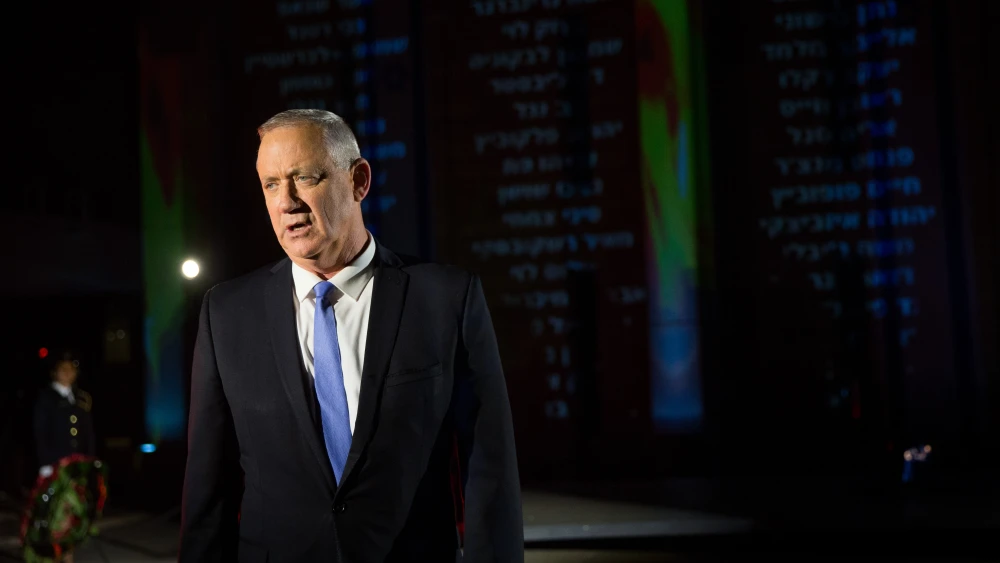
Defense Minister Benny Gantz reiterated his commitment on Wednesday to return the remains of Israel Defense Forces’ soldiers Oron Shaul and Hadar Goldin, as well as abducted civilians Avera Mengistu and Hisham al-Sayed, believed to be held by Hamas in Gaza.
“As a commander, as a former IDF chief of staff, as the current defense minister and as a social-political-national leader, I am fully committed to bringing back (the remains) of (Staff Sgt.) Oron Shaul and (Lt.) Hadar Goldin. ... We mustn’t stop the efforts to bring them back,” he told the Knesset plenum, in response to a motion for the agenda titled “Six Years Since Operation Protective Edge.”
Shaul and Goldin were both killed at the end of “Operation Protective Edge,” Israel’s 2014 summer war against Hamas terrorists and infrastructure in the Gaza Strip. Photos of their personal effects at the time of their killing and capture indicate that Hamas continues to hold their remains.
Mengistu and al-Sayed, both special-needs individuals who, in 2014 and 2015 respectively, crossed into Gaza on foot of their own accord and are assumed to have been held hostage by Hamas ever since.
During the Knesset session, Gantz also addressed the residents of Gaza, saying: “[I]f you want to continue to develop, an agreement requires a return (of the soldiers’ remains and the civilian captives). What should be developed in Gaza will not be able to be developed without the boys and captives returning home.”
According to reports in the Hebrew press earlier this month, Israel recently presented Hamas with a proposal for a prisoner swap and is awaiting a response. The alleged proposed deal—the details of which have not been released—was conveyed through a third party.
In April, Channel 13 cited a senior Israeli source saying that the coronavirus crisis had created “an exceptional and rare opportunity to reach a prisoner deal with Hamas.” Other media outlets reported significant progress in a prisoner exchange.
In May, Hamas leader Ismail Haniyeh threatened to kidnap more Israelis if a prisoner deal is not reached.
“A prisoner-exchange deal has a known price,” he said. “Israel knows that. Either we will come to a respectable deal or we will go to the other option, which is increasing our loot. Our arm is long.”