Newsletter
Newsletter Support JNS

Hamas, Palestinian Islamic Jihad leaders meet in Beirut to coordinate activity

The terror groups held talks about how they can coordinate actions in light of the restrictions on movement into and out of Gaza, and the normalization deal between Israel and the United Arab Emirates.

Ismail Haniyeh
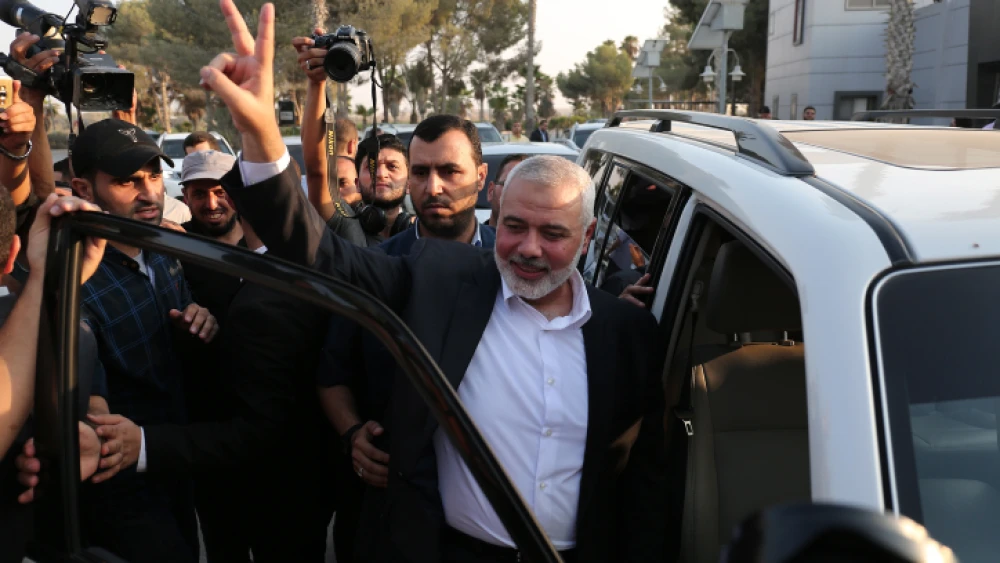
Hamas chief Ismail Haniyeh arrives in Gaza, at the Rafah border crossing from Egypt, after reconciliation talks with Fatah mediated by Egyptian intelligence, Sept. 19, 2017. Photo by Abed Rahim Khatib/Flash90.

Hamas leader Ismail Haniyeh met with Palestinian Islamic Jihad leader Secretary-General Ziad al-Nahala in Beirut on Wednesday to discuss cooperation between the two terrorist groups.

The two organizations held talks about how they can coordinate their actions in light of the restrictions on movement into and out of Gaza and the normalization agreement between Israel and the United Arab Emirates, and the Trump peace plan, Ynet reported on Thursday.

The Hamas leader is in Beirut for a week-long visit to meet with other Palestinian factions over the warming relations between Israel and some Arab states, AlJazeera recorded.

Hamas representative in Lebanon, Ali Baraka, said the joint discussions in Ramallah and Beirut seek to develop “a unified Palestinian strategy to confront normalization schemes ... and to reject plans to annex the West Bank, as well as [the Trump administration’s] ‘deal of the century.’ ”

That deal also refers to the Mideast peace plan, formerly called the “Peace to Prosperity” vision.

According to Ahmad Majdalani, a member of the executive committee of the Palestine Liberation Organization, speaking in Ramallah, the talks aim “to open a new page, to end divisions, achieve national reconciliation and build a national partnership between all factions,” according to the report.

Rabbi Elliot Cosgrove, of Park Avenue Synagogue, told JNS that he will address “Yizkor, memory and revelation,” rather than politics, during Shavuot morning services.
“The bill will continue to return our intelligence agencies back to their core mission: the collection of clandestine foreign intelligence to protect our homeland,” said Sen. Tom Cotton.
“There’s much that goes into a security-layered approach, and as far as I’m concerned, you can never have too many layers,” the village’s police chief told JNS.
Removing sanctions on the anti-Israel United Nations adviser “will undermine important national security and foreign policy interests of the United States,” the Justice Department said.
“Reconstruction financing will not follow where weapons have not been laid down,” warned Nickolay Mladenov, amid a stalled peace process he largely blamed on the Gazan terror group.
Regardless of the findings of a recent Democratic National Committee “autopsy” report, a “majority of Americans, including Democrats, support the U.S.-Israel relationship,” Brian Romick, of Democratic Majority for Israel, told JNS.