


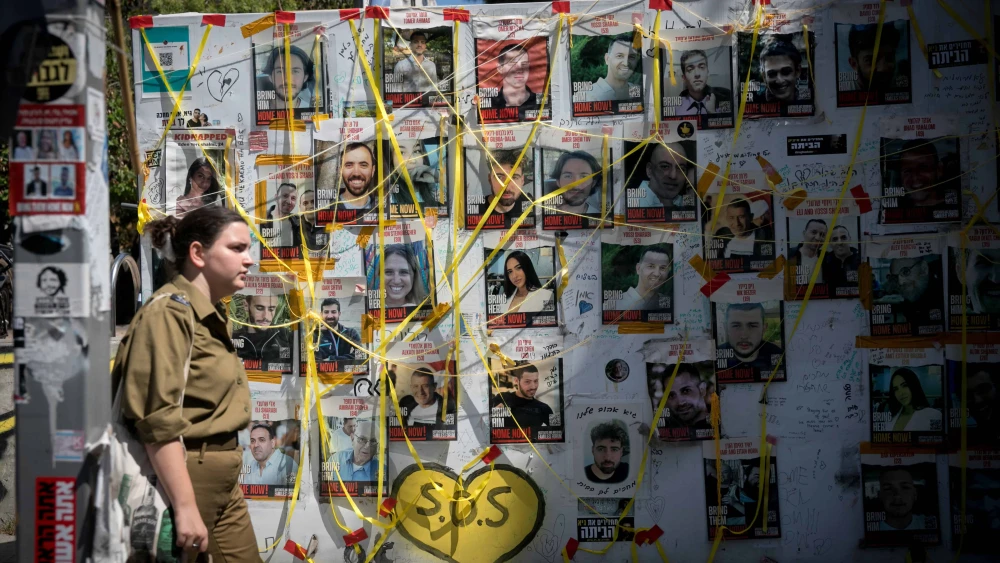
Israeli Prime Minister Benjamin Netanyahu agreed to dispatch on Thursday a high-ranking delegation to Doha, Qatar, for talks to secure the release of 115 hostages being held by Hamas in Gaza in exchange for a ceasefire in the war.
The delegation is being led by Mossad chief David Barnea and Israel Security Agency (Shin Bet) head Ronen Bar.
Negotiations are set to resume with the participation of senior American, Qatari, Egyptian and Israeli officials. Hamas reaffirmed on Wednesday that it will not attend the session, but an official briefed on the talks told Reuters that the terrorist group would be consulted after they conclude.
Hamas kidnapped 251 people during its onslaught of the northwestern Negev on Oct. 7, in which thousands of terrorists followed by Gazan civilians murdered some 1,200 people, wounded thousands more and looted and destroyed property while committing mass atrocities.
It is believed that 111 of the hostages from Oct. 7 remain in Gaza, 39 of whom the IDF has confirmed are deceased. Hamas also holds two mentally ill Israeli civilians who entered the Strip in 2014 and 2015, and the bodies of two IDF soldiers killed in 2014.
‘Living the next step’
“We must be optimistic,” Omri Lifshitz, the son of hostage Oded Lifshitz, who recently turned 84 in Hamas captivity, told JNS.
“We must make this deal happen for the hostages, for their families and for the people of Gaza. We must end the war and start living the next step,” he said.
Speaking of Wednesday’s visit to the Hostage and Missing Families Forum’s headquarters in Tel Aviv by the U.S., U.K. and German envoys to Israel, who called for an immediate deal to save the lives of the captives, Lifshitz said he appreciated their diplomatic push.
“We feel that there is a lot of pressure coming from around the world, the highest level of pressure we’ve felt in over 300 days,” he said.
Lifshitz told JNS that the last piece of information he received about his father’s status concerned day 20 of his captivity.
“My father was injured and they treated him. He was being held with another hostage in the same room until he fainted and was taken elsewhere,” Lifshitz said.
“Then he just disappeared. Nobody knows anything about him, but we keep hoping. The chances are really slim, we need to prepare ourselves for everything, we need this deal,” he continued.
“We always think of the day we will be reunited. The first word, the first hug. My father is very involved, he was a fighter for peace all his life. How are we going to tell him what happened in the last months? He missed a whole chapter,” Lifshitz said.
Regional tensions
White House Press Secretary Karine Jean-Pierre stressed on Wednesday the importance of reaching a Gaza ceasefire deal to reduce regional tensions. Her comments echoed those of State Department spokesperson Vedant Patel, who said the previous day that Qatar had assured Washington that it will “work to have Hamas represented” at the talks.
Meanwhile, President Joe Biden said he expects Iran to hold off attacking Israel if a ceasefire agreement is reached.
Asked by reporters during a visit to New Orleans on Tuesday whether a deal could prevent a promised retaliation for the targeted killing of Hamas leader Ismail Haniyeh in Tehran last month, the president replied, “That’s my expectation.”
Three senior Iranian officials told Reuters on Tuesday that only a Gaza ceasefire agreement can prevent an Iranian strike on the Jewish state.
One of the sources, a senior Iranian security official, said the Islamic Republic and its regional terrorist proxies, including Hezbollah in Lebanon, would carry out a direct attack if the Gaza talks fail or if Jerusalem is perceived to be dragging out the negotiations.
Iran, Hamas and Hezbollah have accused Israel of targeting Haniyeh, but Jerusalem has not taken responsibility for the assassination. Separately, Hezbollah has vowed revenge for the killing in Beirut of its top commander Fuad Shukr, which Israel did take credit for.
U.S. presidential envoy Amos Hochstein said in Beirut on Wednesday that he believes that a broader regional war can be averted.
“We continue to believe that a diplomatic resolution is achievable because we continue to believe that no one truly wants a full-scale war between Lebanon and Israel,” Hochstein said.
“We can reach an end to the conflict now, but we understand that we also need to work to an end to the conflict in Gaza,” he added.


