By Jonathan S. Tobin/JNS.org
President Donald Trump’s optimism about Middle East peace might be justified. Perhaps Palestinian Authority (PA) President Mahmoud Abbas’s pledge that he will be a “true partner” to Trump in the search for a solution to the conflict with Israel is genuine. Maybe the president’s negotiating skills, and his lack of interest in the details or loyalty to formulas like the two-state solution, will provide what is needed to achieve progress.
But a statement issued only a couple of days before Trump’s meeting with Abbas in the White House—a statement touted as even more evidence of progress toward peace—actually shows there’s more at stake here than the real estate deal of the century.
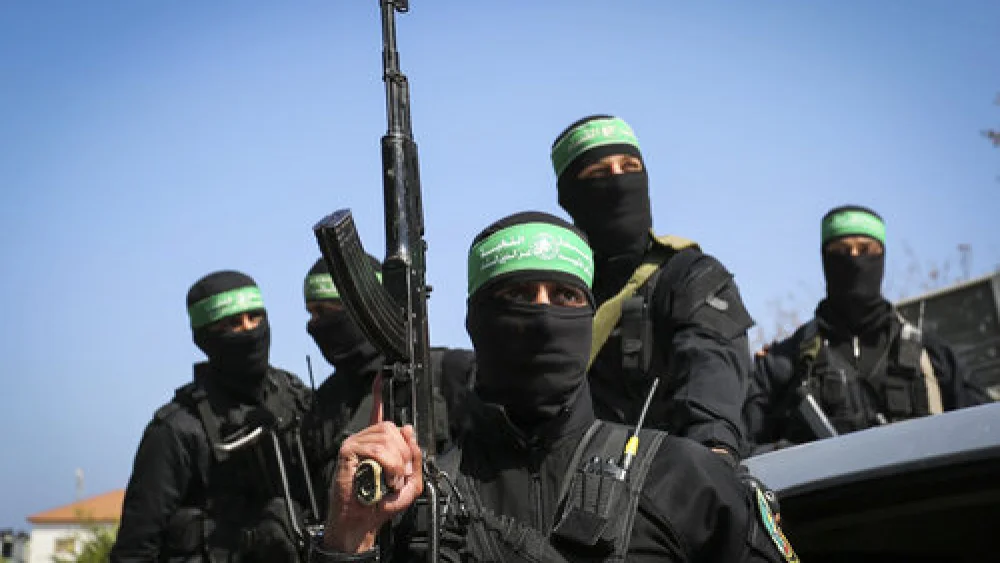
Just prior to the red carpet reception Abbas got in Washington, his Fatah party’s Hamas rivals sought to make some news of their own. The Islamist terror group, which runs Gaza as an independent Palestinian state in all but name, remains focused on its longtime campaign to unseat Abbas. The relationship between the two factions is complicated and at times deadly. But as much as Abbas fears Hamas (and depends on Israeli security cooperation to ensure his survival), he knows he can’t make any deals without Hamas approval. At the same time, Hamas terrorists worry about increased assistance from the U.S. and the Arab world enabling Abbas to maintain his stranglehold on the West Bank.
That’s why Hamas recently produced what was touted as a new statement of principles. The document eschewed some of the usual anti-Semitic rhetoric Hamas generally uses, while stating its willingness to accept a Palestinian state within the pre-1967 borders. Optimists hailed the “shift” as an indication that even Palestinian extremists were moving closer to peace. Yet what they missed is the document also explicitly states any such independent state would be merely a stepping-stone toward the ultimate Palestinian goal of destroying Israel.
Hamas still refuses to recognize the legitimacy of a Jewish state no matter where its borders are drawn, a position the terror group actually shares with Abbas’s Fatah. Nor did the Islamists disavow terrorism. Realists understand the objectives of both Abbas and Hamas are very different from the hopes of Israelis and President Trump. That’s why Trump will need to give more than lip service to concerns about Palestinian behavior if he wants the product of his diplomatic offensive to amount to more than a piece of paper.
Trump deserves credit for pointing out, even in the midst of a feel-good appearance with Abbas, that the Palestinians must cease paying terrorist prisoners and their families. He also asked Abbas to stop using his official television and other media, as well as PA-run schools, to incite violence against Israel and Jews. A senior adviser to Abbas dismissed that request as “mad.” Previous U.S. administrations have made similar requests to no avail, but such efforts were never considered priorities. This was a mistake, and as a result, for the past 23 years the PA has continued to receive subsidies from both Americans and Europeans while fomenting and subsidizing terror.
Given Prime Minister Benjamin Netanyahu’s political and legal troubles at home, Abbas may think he can win a game of chicken with the prime minister in which the Israelis will pull out of talks before the Palestinians, thus enabling the Palestinians to look good without actually making peace. But the U.S. objective here needs to be laying the groundwork for a genuine change in Palestinian behavior, rather than a show or symbolic handshake that would give Trump a political boost or support his assertion that Middle East peace “is frankly maybe not as difficult as people have thought over the years.”
One of the prerequisites of peace is for the Palestinian to reject Hamas’s vision of endless war against the Jews. Rather than Fatah co-opting Hamas, the two rivals are merely seeking to position themselves to take advantage of an American president whose hubris about a diplomatic coup may impel him to ignore a Palestinian political culture rooted in rejection of Zionism.
There is no “new” Hamas any more than Abbas is prepared to reform the PA to reject terror and hatred of Jews, let alone actually move toward peace and coexistence with the Jewish state. Unless Trump holds both the PA and Hamas accountable for their behavior, then what he is asking Israelis to do is to trade away their only negotiating chips for a deal that will give them neither security nor genuine peace. That’s the sort of bad deal Trump would never accept, and it’s not one he should expect the Israelis to swallow either.
Jonathan S. Tobin is opinion editor of JNS.org and a contributing writer for National Review. Follow him on Twitter at: @jonathans_tobin.