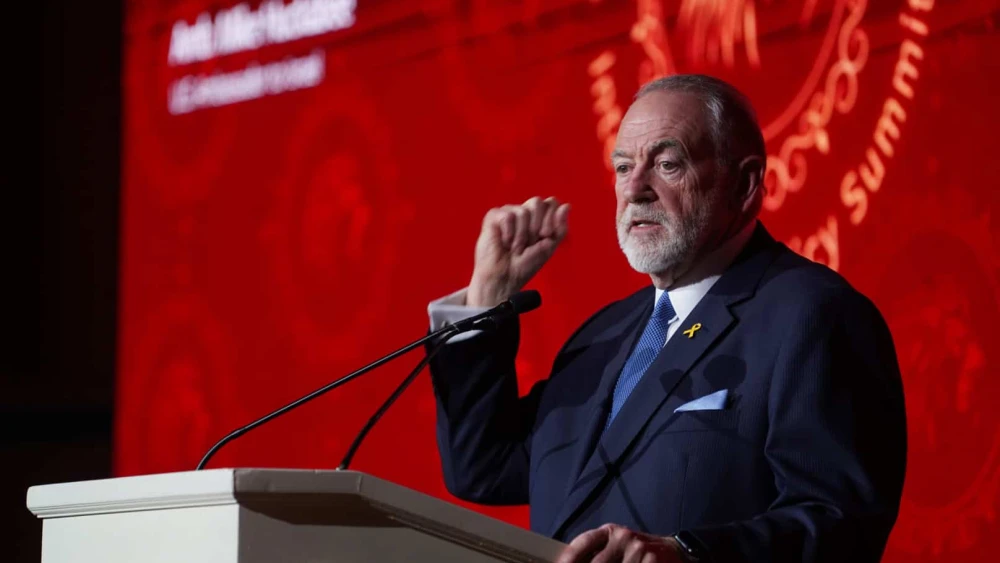
Growing international momentum to recognize a Palestinian state frustrated Washington’s efforts to persuade Jerusalem to release billions in frozen tax revenues to the Palestinian Authority, U.S. Ambassador to Israel Mike Huckabee said on Wednesday.
Huckabee told Reuters that he had been “shuttling back and forth” between the two sides, motivated in part by concerns that worsening economic instability in Judea and Samaria could trigger violence.
“I felt like we were making progress,” he said. “We weren’t quite there yet, but we were talking.” However, he noted that moves toward recognition “hardened Israeli positions.”
Israel is withholding about $3 billion in revenue it collected on behalf of the P.A. under a longstanding tax-transfer arrangement. It does so in retaliation for Ramallah’s continued funding of terrorism through its “Martyr’s Fund,” a pay-for-slay program in which terrorists and their families get monthly stipends for killing Jews.
On July 27, Israeli Finance Minister Bezalel Smotrich signed an order to seize an additional $48 million in P.A. funds and transfer them to the families of terror victims.
The U.S. hoped to convince Israel to release the tax revenue to keep afloat the P.A., which is heavily reliant on those funds along with foreign aid.
Huckabee acknowledged the impact but stressed that the P.A. bore responsibility by maintaining its pay-for-slay policy and for pushing unilateral recognition efforts.
A coalition of countries led by France—including the United Kingdom, Canada, Belgium, Australia and Portugal—is preparing to recognize a Palestinian state at the United Nations General Assembly’s annual debate (Sept. 9–23) in New York.
In response, Israel is considering applying sovereignty to parts of Judea and Samaria. Over the weekend, Huckabee told Israel’s Channel 14 that the United States “has never asked Israel not to apply sovereignty” in Judea and Samaria.