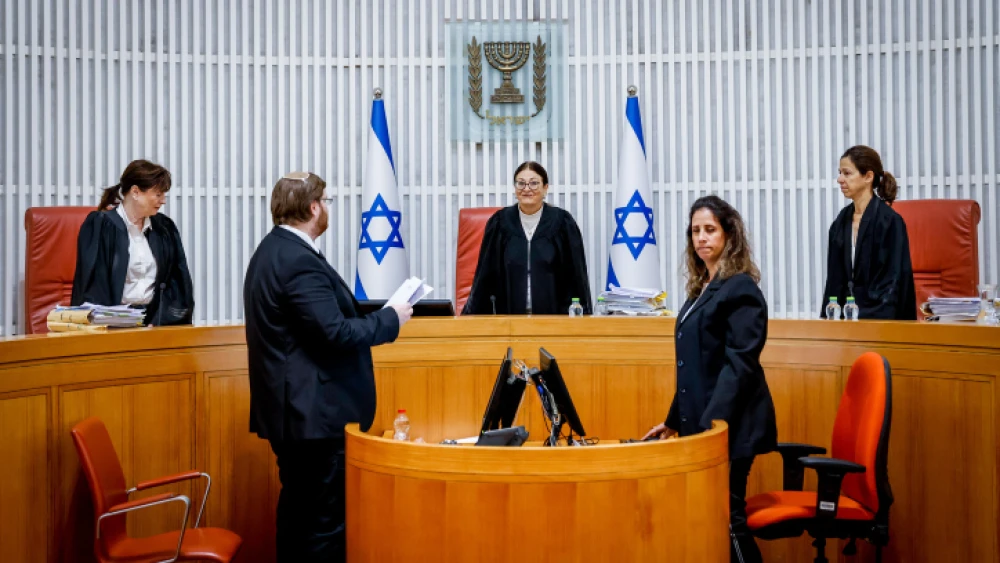
All 15 justices of Israel’s Supreme Court will hear the petitions asking them to cancel the “reasonableness law” that the Knesset passed last week, Supreme Court President Esther Hayut announced on Monday.
The hearing is scheduled for 10 a.m. on Sept. 12, three days before the start of the High Holidays. The government will have to file its response to the petitions 10 days earlier.
It will be the first time in the court’s 75-year history that a panel of 15 justices will preside over a case.
On July 24, all 64 lawmakers in the governing coalition voted into law a bill to restrict judges’ use of the “reasonableness” standard. The amendment to Basic Law: The Judiciary bars “reasonableness” as a justification for judges to reverse decisions made by the Cabinet, ministers and “other elected officials as set by law.”
NGOs immediately filed petitions asking the Supreme Court, sitting as the High Court of Justice, to strike down the law. While the court scheduled a hearing, it has not gone as far as to issue an emergency injunction against the law, as several of the seven petitioners had requested.
“We are ready. We will appear at the Supreme Court to defend Israeli democracy and do everything we can to stop the judicial coup,” the Movement for Quality Government’s Chairman Eliad Shraga said last week. “We will continue to protest and fight everywhere and from every podium until the threat is removed.”
Separate from the petitions against the “reasonableness law,” opposition leader Yair Lapid of the Yesh Atid Party asked the court to order Justice Minister Yariv Levin to convene the Judicial Selection Committee, which is responsible for appointing new judges to the courts. Lapid’s petition will also be heard after the summer recess.
Defense Minister Yoav Gallant has gone on the record as saying that the government would accept the Supreme Court’s decisions. “Israel is a democratic, law-abiding country. We’ll act according to the law,” Gallant told journalists ahead of the weekly Cabinet meeting on Sunday.
Prime Minister Benjamin Netanyahu has said that his government will seek an agreement with the opposition on the rest of the judicial reform package during the Knesset’s summer recess, which started on Sunday.
In an interview with Fox News, the prime minister denied that the reform push was weakening Israel’s democracy, as its opponents claim, stating that it was in fact “strengthening democracy. We’re bringing it back in line to where most democracies are. Where Israel was in its first five decades and where it should be now in the coming decades.”
On Sunday, Netanyahu’s Likud Party rejected a demand by the opposition to freeze all judicial reform legislation until 2025. “Yair Lapid is ready to talk with Abu Mazen [Palestinian Authority head Mahmoud Abbas] without preconditions, but for Likud he is setting out a list of preconditions for talks,” the party said.
“As long as there is no legislative freeze, there is no point and no sense to talk about other laws or agreements, because it is quite clear that the government will run away again at the last minute,” Lapid told Knesset members gathered in the plenum on Sunday.