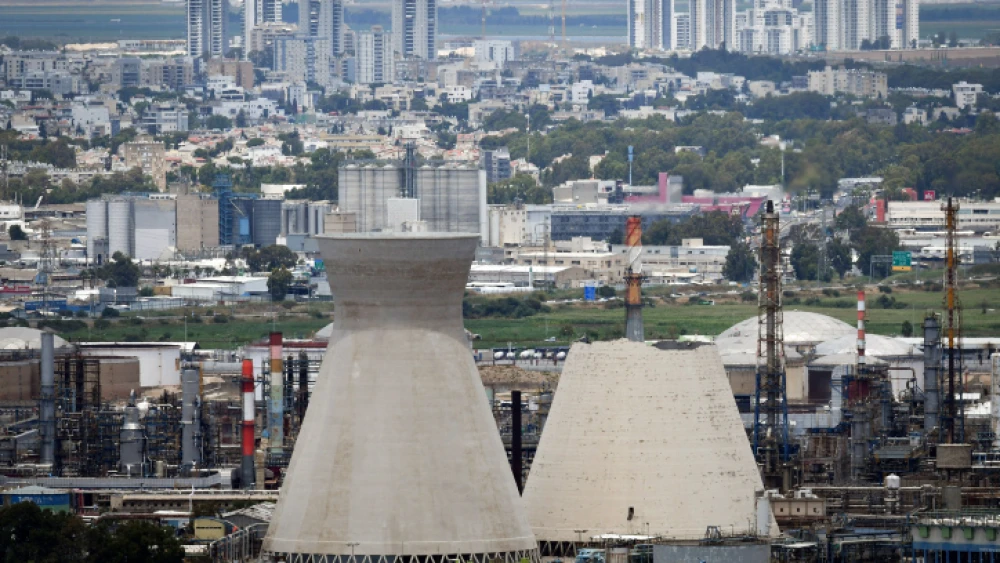
The explosion in Beirut on Tuesday that killed at least 100 people and injured thousands, revived concern among residents of the greater Haifa area that a similar fate could befall them if the petrochemical facilities in their area were to explode accidentally or be attacked.
Revital Goldschmidt of the Environmental Research Center in Haifa said, “The event in Lebanon illustrates the danger of having concentrations of hazardous materials near a dense population center and underscores the urgent need to close the flammable, volatile industries.”
She further stated that “people claim that what exploded [in Beirut] was ammonium nitrate. The ammonium storage facility [in Haifa] has been emptied, but Haifa Bay is still at risk from ammonia, with the tankers carrying it docked not far from the population, and a fertilizer factory that manufactures fertilizer and explosives, which have 15-ton holding vats that are unprotected, in the middle of the city.”
“We call on the government to submit a plan to the Cabinet to close these dangerous factories urgently,” she said.
Goldschmidt went on to say that Israel was not prepared to handle a mass-casualty event of the magnitude that would result from an explosion at the Haifa facilities.
“An event on the scale of what happened in Lebanon [with thousands of injured] could put Israel’s national strength at risk,” added the scientist.
‘Oust petrochemical industry from Haifa Bay’
Attorney Jameela Hardal Wakim, director of the Citizens for the Environment nonprofit organization, said “what happened in Beirut could happen in Haifa Bay, as well, or in Ashdod, or anywhere else where there are large stores of hazardous material. According to the latest [and incomplete] risk assessment, there are 1,500 risk points and 800 hazardous materials in Haifa Bay, and we also know that the necessary safety measures have not been taken.”
The attorney said that steps have not been taken to reduce the amount of hazardous materials located at Haifa Bay. She also noted that there were no preparations to handle an accident involving more than one site or a chain event.
“Small-scale, hazardous-materials events in Haifa Bay are routine, and we must not wait until a major disaster happens before we act on recommendations to reduce the risks,” said Hardel-Wakim.
Haifa Mayor Einat Kalisch-Rotem said “a major disaster occurred at the Port of Beirut. Haifa sends its condolences to the families who lost loved ones. For years, even before I was elected mayor, I have led a fight to stop the expansion of the polluting industries at Haifa Bay. Today, it’s clear to us all that it isn’t enough to stop them from growing—they also need to leave.”
“Our concern, which is based on experts in the field, is about the exact scenario that took place to the north of Israel” on Tuesday, he said.
The Haifa mayor noted that Environmental Protection Minister Gila Gamliel had announced that the Bazan Group’s petrochemical facilities would be moved out of Haifa Bay within a few years.
Kiryat Bialik Mayor Eli Dokorsky said “the deathly blast in Beirut echoes and demands that we oust the petrochemical industry from Haifa Bay. Hazardous materials and polluting factories have no place in the urban space amid the population. Having been horrified at the sights from Lebanon, this is the time to take action, and sooner rather than later.”
This article first appeared in Israel Hayom.