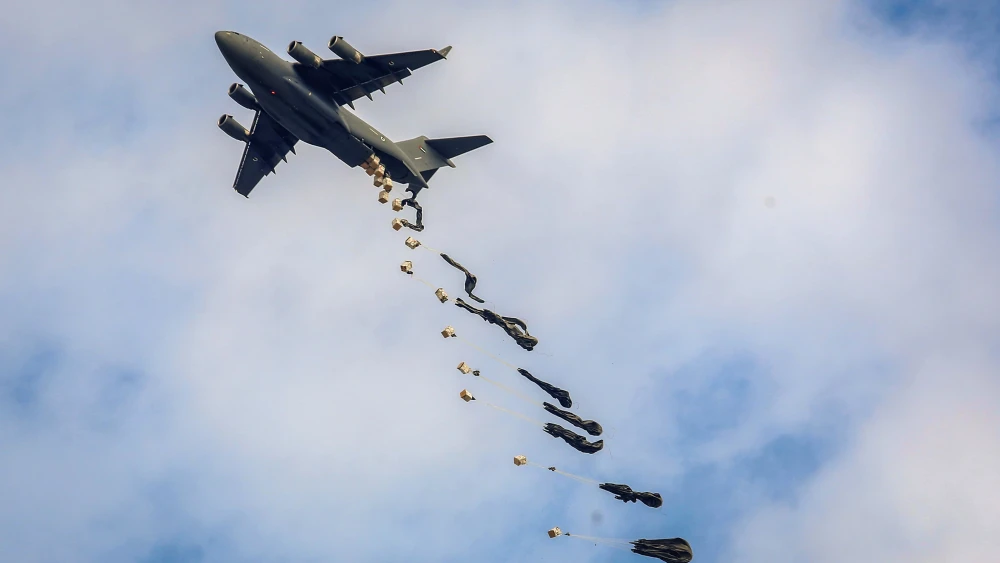
The Israel Defense Forces on Sunday continued to deliver humanitarian goods to the Gaza Strip—including airdrops of aid—in coordination with a consortium of Arab and European nations.
As part of the ongoing cooperation between Jerusalem, the United Arab Emirates, Jordan, Egypt, France, Germany and Belgium, the IDF “is continuing the series of actions aimed at improving the humanitarian response in the Gaza Strip,” the military said.
“Over the past few hours, 136 aid packages, containing food for the residents of both the southern and northern Gaza Strip, were airdropped by six different countries,” it continued.
The army said it would continue to work to “improve the humanitarian response in the Gaza Strip along with the international community, while refuting the false claims of deliberate starvation in Gaza.”
Earlier on Sunday, the Defense Ministry’s Coordinator of Government Activities in the Territories (COGAT) unit announced that more than 23,000 tons of aid had entered the enclave over the past week, with 1,200 trucks having been “successfully collected by the U.N. and international organizations.
“Despite this progress, hundreds of trucks remain inside Gaza, waiting to be picked up and distributed,” COGAT said. “Additionally, hundreds of pallets of humanitarian supplies were airdropped by international partners to help address urgent needs on the ground.”
The statement emphasized the Jewish state’s commitment to providing humanitarian aid for Gaza’s noncombatants, “not Hamas.”
Over the past week, over 23,000 tons of humanitarian aid, 1,200 trucks, entered Gaza and 1,200 trucks were successfully collected by the UN and international organizations.
— COGAT (@cogatonline) August 3, 2025
Despite this progress, hundreds of trucks remain inside Gaza, waiting to be picked up and distributed by… pic.twitter.com/i8LNgdJUuT
The IDF on July 27 announced a series of humanitarian measures aimed at refuting “the false claim of deliberate starvation” in the coastal enclave, including “tactical pauses” in the war on Hamas.
While emphasizing that “combat operations have not ceased” across the Strip, the IDF said pauses in military activities between 10 a.m. and 8 p.m. would be instituted in Al-Mawasi, Deir al-Balah and Gaza City “every day until further notice.”
Humanitarian corridors will be established to enable the movement of U.N. convoys delivering food and medicine to Gazans. The secure aid routes will remain in place permanently between 6 a.m. and 11 p.m.
The IDF added that it was prepared to expand the scale of its humanitarian response “as required.”