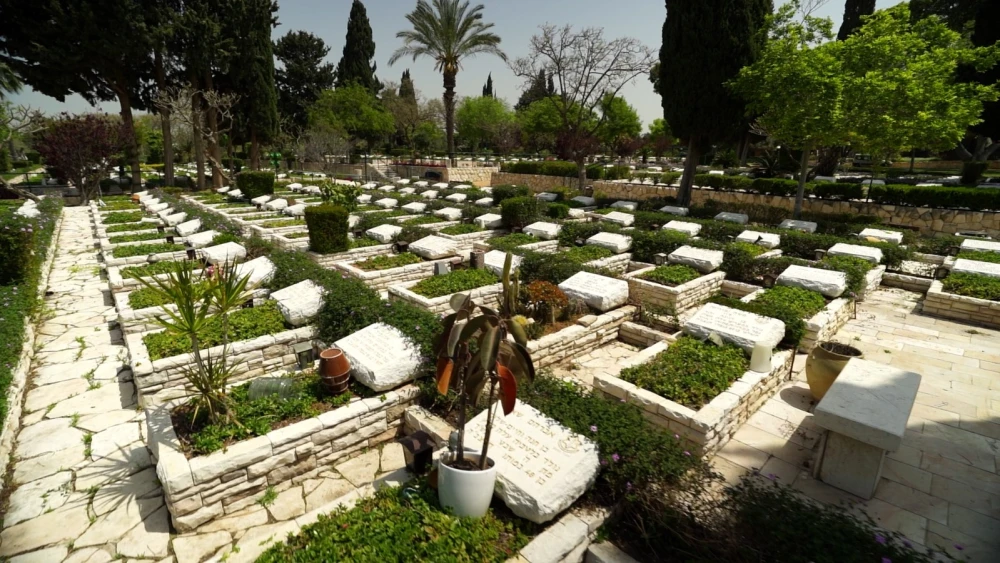
Israel is mourning its 23,816 fallen soldiers as Remembrance Day for Fallen Soldiers and Victims of Terrorism (Yom Hazikaron) is held, for the first time, without visitors at military cemeteries across the country due to restrictions in place during the coronavirus pandemic.
The Defense Ministry’s Families and Commemoration Department said that in the past year, 42 people have been recognized as fallen soldiers. In addition, 33 wounded Israel Defense Forces’ veterans have died as a result of their injuries.
A siren blared out across Israel at 8 p.m. on Monday evening, and a second siren will sound at 11 a.m. on Tuesday morning.
Across 52 military cemeteries located around the country and at the memorial site for fallen Bedouin soldiers in the lower Galilee, the IDF deployed honor guards who stood next to a memorial torch. A senior officer saluted the fallen.
A prayer for the fallen was delivered by IDF Chief Rabbi Eyal Moshe Karim and other senior defense-establishment representatives.
The Defense Ministry’s Families and Commemoration Department placed a flag at half-mast, with a “Remember” ribbon tied around it at the grave of every fallen soldier, as well as flowers and a memorial candle.
The central Remembrance Day ceremony was held at the Western Wall with limitations on number of participants that could attend.
In prior years, as many as 1.5 million visitors flooded cemeteries to pay respects to Israel’s fallen soldiers and citizens.
Last week, Defense Minister Naftali Bennett ordered the defense establishment to prepare a different kind of program to mark the day in the shadow of the coronavirus pandemic and its restrictions.
Bennett arranged for a number of IDF soldiers to be stationed in shifts at Mount Herzl National Hall for the Fallen and to read the names of all of the fallen since the establishment of the state.
In a message sent to bereaved families, he stated in recent days, “This is a holy day in the State of Israel, a day in which the entire nation connects with the memory of the fallen. Every year, around a million-and-a-half Israelis gather at the cemeteries during the time that the siren sounds. This mighty participation is testimony to the mutual solidarity that exists in the Israeli public and to the respect the public feels for those who have sacrificed themselves for the country.”
He noted, however, that in the shadow of the corona pandemic, “gathering a million-and-a-half people in the space of a minute, or an hour, represents a real danger to life. Therefore, we are forced this year, with great sorrow, to prevent the public and the families from coming to the cemeteries on Remembrance Day itself,” he said.
In the days preceding Yom Hazikaron, immediate relatives of the fallen were able to visit the cemeteries. Bennett described the decision as “unbearably difficult,” though added that “it is necessary.”