


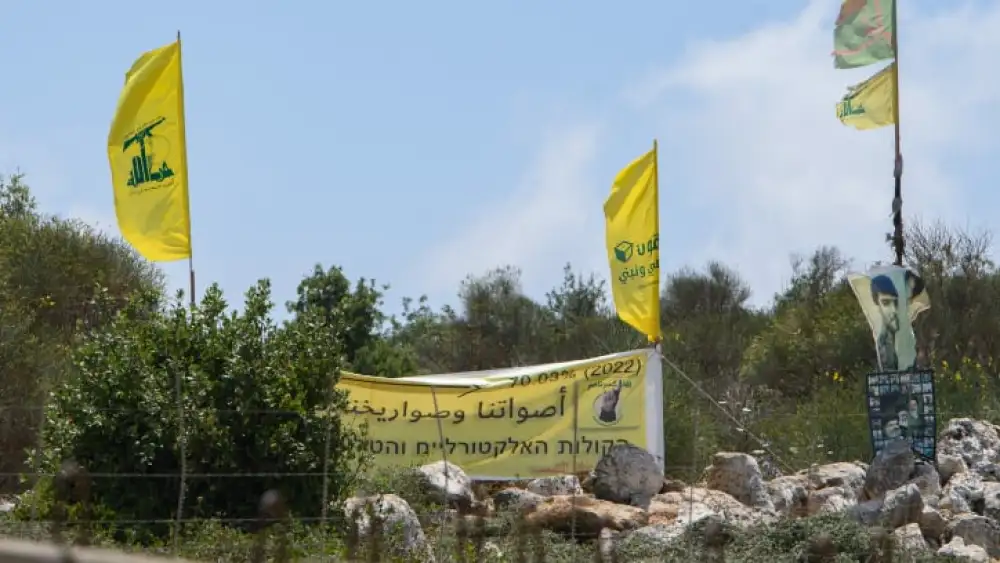
A regional war might break out if U.N. Security Council Resolution 1701, which called for the disarming of Hezbollah, is not fully implemented, Israeli Foreign Minister Eli Cohen wrote in a letter this week to the United Nations.
“For the good of regional stability and to avoid further escalation, the next session of the U.N. Security Council must adopt a totally different approach in order to end the dangerous violations by Hezbollah,” wrote Cohen, Israel’s Channel 12 News reported on Tuesday.
Resolution 1701, which was passed after the 2006 Second Lebanon War between Israel and Hezbollah, called for disarming the Iran-backed terrorist group. The resolution also states that Hezbollah is forbidden to operate anywhere near the border with Israel.
Hezbollah has been testing the waters in the wake of the Oct. 7 cross-border attacks in southern Israel, initiating a series of fire exchanges from Lebanon as the Jewish state fights Hamas terrorists to the south.
At the same time, Iran’s terrorist proxies across the region have upped their attacks on American and Coalition forces in Syria and Iraq.
On Wednesday, Iranian Foreign Minister Hossein Amir-Abdollahian touched down in Lebanon for meetings with leaders of terrorist proxies supported by Tehran.
“Without a doubt, the past six weeks of heroic resistance have proven that time is not on the side of the artificial Israeli entity,” Iran’s top diplomat stated at a press conference at Beirut International Airport.
“We heard from the resistance leaders in the region that their fingers will be on the trigger until the full rights of the Palestinian people are fulfilled and until the struggle in the region reaches a result,” Amir-Abdollahian said.
Meanwhile, U.S. National Security Council Spokesman John Kirby warned that Washington’s intelligence community has identified an uptick in cooperation between Tehran and Moscow against Israel.
“Our information further indicates that Wagner, at the direction of the Russian government, was preparing to provide an air defense capability to either Hezbollah or Iran,” Kirby stated during a briefing on Tuesday.
In return, Iran was considering providing Russia with ballistic missiles, Kirby said.
The United States has designated the Wagner Group, which is funded by the Kremlin, as a transnational criminal organization.
“We are certainly prepared to use our counterterrorism sanctions authorities against Russian individuals or entities that might make these destabilizing transfers,” said Kirby.


