Newsletter
Newsletter Support JNS

Jerusalem court orders PA to pay $37.5 million to Israeli terror victims

The president of the Shurat HaDin NGO, whose attorneys represented the families in the case, hails “another huge victory of ours over terror.”

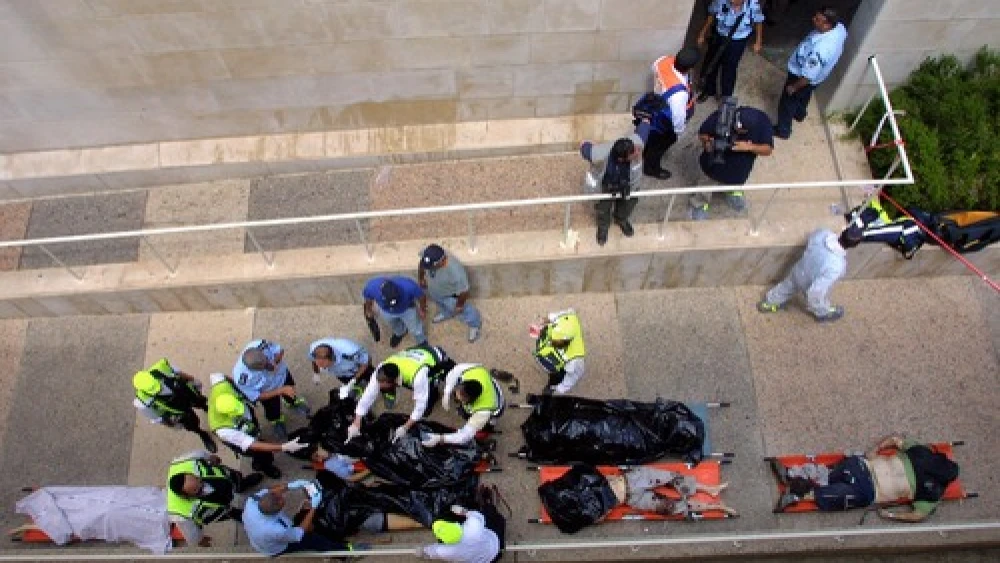
Bodies are taken away following an explosion at the cafeteria of Jerusalem's Hebrew University on July 31, 2002, during the years of the Second Intifada. Hamas took responsibility for the bombing, which killed seven people and wounded 70. Photo by Flash90.
Bodies are taken away following an explosion at the cafeteria of Jerusalem’s Hebrew University on July 31, 2002, during the years of the Second Intifada. Hamas took responsibility for the bombing, which killed seven people and wounded 70. Photo by Flash90.

The Jerusalem District Court ordered the Palestinian Authority to pay 130 million shekels ($37.5 million) in compensation to 32 Israeli families that lost members to terror attacks during the Second Intifada (2000 to 2005), according to a report by Ynet.

Tuesday’s ruling comes after the Israeli Supreme Court ruled in April that the P.A.’s practice of paying security prisoners and their families constituted “approval” of terror attacks against Israelis, meaning that the P.A. can be legally sued for compensation.

Attorneys from the Shurat HaDin NGO who represented the families thanked the court for the ruling, which they said provided justice for the families of the victims, but added that they intend to appeal the ruling to seek greater compensation, the report stated.

Nitsana Darshan-Leitner, president of Shurat HaDin, tweeted on Wednesday: “Another huge victory of ours over terror.”

The ruling, she said, “forms a precedent, and it is the highest that a court has ruled on in a lawsuit ruling against the Palestinian Authority.”
“If Michigan Hillel wants to remain the center of Jewish life on campus, it cannot retreat from one of the central and challenging parts of being Jewish there,” Seth Mendel, of CAMERA, told JNS.
Three other soldiers were lightly wounded when the military vehicle overturned.
The matter now goes to the European Council, which determines political matters for the European Union.
“This year, instead of finding a decline since last year, there was a leveling off or new normal of engagement in Jewish life,” Mimi Kravetz of the Federation, which commissioned the study, told JNS.