
Hassan al-Nasasra, fourth on the Arab Balad Party’s slate for the Oct. 27 Israeli elections, recently traveled to Israel’s Negev desert and explained to his voters what the Negev actually is. It is not, apparently, the southern two-thirds of the State of Israel. It is “the first line of defense and the first confrontation in the homeland” and 60% of the territory of “Palestine.”
Read that brazen confession slowly and parse the vocabulary. A “line of defense” is a military position. A “confrontation” is a fight. Al-Nasasra did not tell his voters that Arab citizens in the south are underserved by planning authorities. He told them where the battlefront lies.
The ground he was standing on was not Judea, Samaria or Gaza, the territories the Palestinians claim to want for their state. It is land that has been sovereign Israeli territory since the day the State of Israel was declared. Al-Nasasra was saying that the entirety of Israel is the Palestinian “homeland,” and Israeli Arabs in the Negev should prepare for an uncivil holy war.
This should have serious legal and political implications.
Section 7A of Israel’s Basic Law: The Knesset bars a party list or a candidate on three grounds: 1) negating the existence of Israel as a Jewish and democratic state; 2) incitement to racism; and 3) support for armed struggle against Israel.
In theory, this law is equally applied to every Israeli.
In practice, this is not the case. Israel’s Central Elections Committee has disqualified Balad twice—in 2019 and 2022—for rejecting Israel’s existence as a Jewish state. There can be no reasonable argument against this. Indeed, Balad’s platform demands a “state of all its citizens” in place of the Jewish state and the so-called “right of return” for millions of descendants of 1948 Arab refugees, which every serious analyst understands to be demographic liquidation.
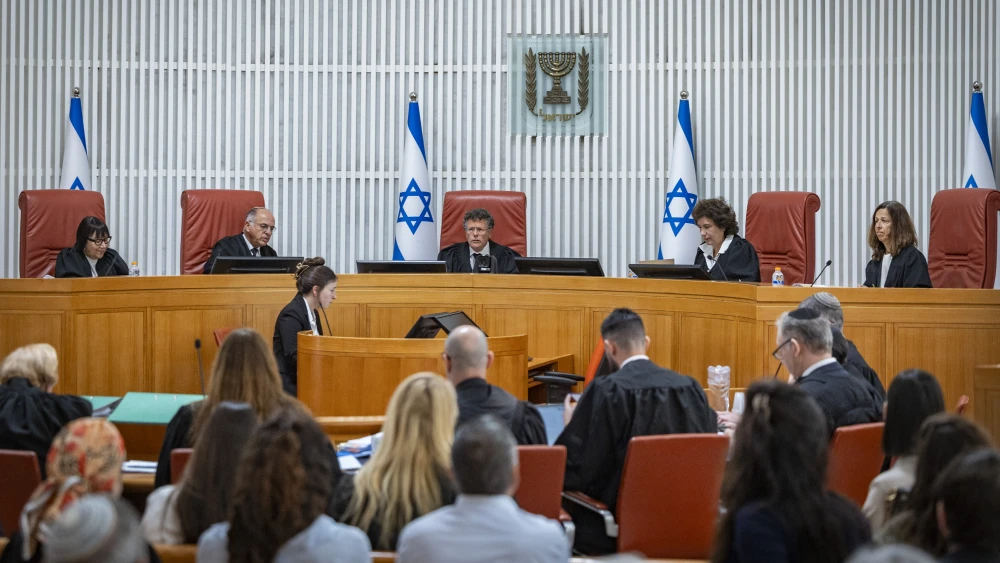
Both times, however, the Supreme Court reinstated Balad, the second time unanimously.
No one, strangely, has ever applied the third clause of Section 7A of the Basic Law. They should, because Al-Nasasra recently eulogized Maher Younes, who, with his cousin, kidnapped and murdered Avraham Bromberg, a 20-year-old IDF soldier, on the Golan Heights in 1980. Al-Nasasra called Younes a great national and humanitarian figure and a symbol of sacrifice.
If the Supreme Court intends to keep nullifying Section 7A, let it do so honestly.
Clearly, a candidate who calls the Negev the front line of “Palestine” and the murderer of an Israeli soldier a symbol of sacrifice has violated two clauses of Section 7A in one week of campaigning. Yet he is fourth on a slate that expects to sit in the Knesset.
Now consider the only individual candidate ever disqualified under Section 7A: Dr. Michael Ben-Ari, a Jew, was barred by the Supreme Court in March 2019 by eight votes to one under the second clause: incitement to racism. This was the first use of that power against a single candidate since the Knesset created it in 2002. A generation earlier, the Kach Party was outlawed under the same clause.
It is obvious that, when applied to Jews, the racism clause is a functioning instrument with a standard of proof. But when applied to Balad, the first and third clauses have not produced a disqualification in four decades. In other words, Section 7A is enforced for some; for others, it is not.
Keep in mind who sets these thresholds: the same uber-activist Supreme Court that has spent 40 years voiding government and Knesset decisions it found unreasonable, instructing prime ministers whom to dismiss and declining to find any question beyond its competence. Restraint has never been its problem. But when it comes to Balad, this Court of unlimited appetite discovers a highly selective evidentiary standard that no transgression in 40 years has satisfied.
This amounts to the repeal of a section of a Basic Law by non-enforcement, the one power no court anywhere is granted. Supreme Court justices did not strike the clause down. They declined to allow it to mean anything.
This insidious process has physical consequences. The NGO Regavim documented 10,111 new illegal structures in the Bedouin sector—concentrated in the Negev—between March 2021 and April 2023; roughly 13 built every single day. Some 8,359 were built in 2024 and 2025. There have been 2,007 demolitions of these illegal structures, a net gain of 6,352. Al-Nasasra has denounced the demolitions, and he has told us why: He sees the area as 60% of historic Palestine and wants a civilizational confrontation to seize it.
I don’t want Balad silenced because its members are Arabs. I want the law applied as it is written. A slate that seeks the dissolution of the Jewish state, with a fourth-ranked candidate who honors the murderers of Jewish soldiers and calls the Negev Desert a battlefront for “Palestine,” is exactly the kind of case Section 7A was drafted to address.
If the Supreme Court intends to keep nullifying Section 7A, let it do so honestly: Lift the ban on Kach, restore Ben-Ari’s rights, and let every Israeli argue every position before the voters. What cannot stand is the present arrangement in which the law becomes a weapon when pointed against Jews and a dead letter when pointed the other way.
Hopefully, one of Israel’s political parties will put forward another disqualification petition against Balad, though it will surely be rejected again. Regardless of failure, the attempt is worth putting on the record because a state whose highest court fails to distinguish between a Jewish citizen who criticizes it and an Arab citizen who designates a portion of its territory as a front for an internal attack has already begun to acknowledge the legitimacy of such a front.
When it blows up in all our faces, at least we will be able to say we told them so.