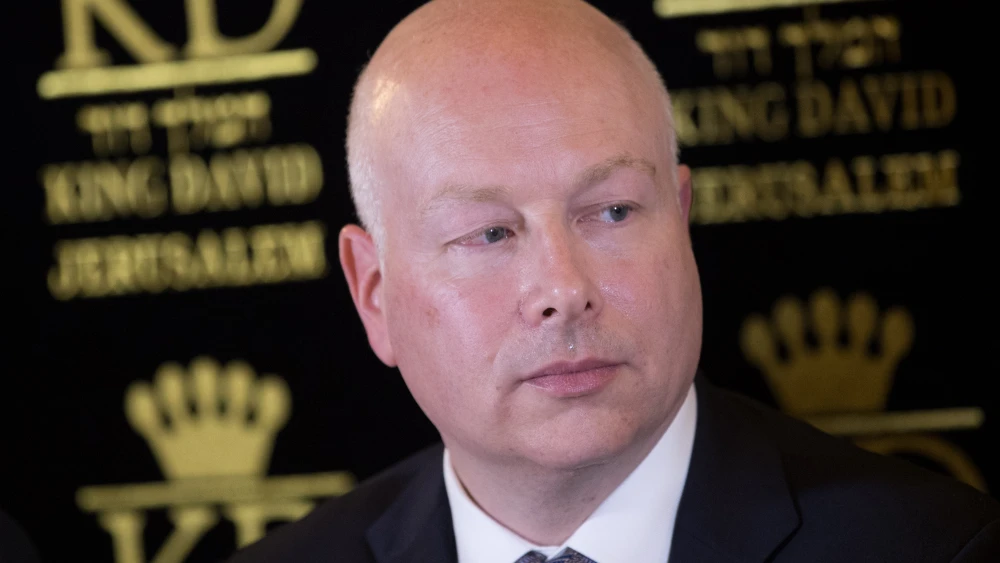
U.S. special envoy for Mideast peace negotiations Jason Greenblatt said on Monday that the Trump administration is not seeking “regime change” within the Palestinian Authority.
“Our plan right now is with President [Mahmoud] Abbas,” he said at the annual summit by the organization Christians United for Israel. “We’re not looking for any type of regime change.”
Greenblatt said there is a Palestinian government each in the West Bank, controlled by the Palestinian Authority, and Gaza, which is run by the terrorist group Hamas.
“We have to deal with everybody to make this work,” he said. “We cannot make a comprehensive peace unless we make sure that we are dealing with the representatives of all the Palestinian people.”
Greenblatt did not give a specific timeline regarding when the political component of the administration’s Mideast peace plan will be released.
Senior White House official and presidential son-in-law Jared Kushner, who has worked alongside Greenblatt in the administration’s Mideast peace effort, told reporters last week that U.S. President Donald Trump remains “very fond” of Palestinian Authority leader Mahmoud Abbas, despite a breakdown in ties between Ramallah and Washington.
Two weeks ago, Greenblatt and Kushner were in Bahrain as part of the first part of the peace plan release, dealing with economic issues surrounding the conflict.
“There’s no political plan without an economic plan, and there’s no economic plan without a political plan,” insisted Greenblatt.
In his remarks at CUFI, Greenblatt blasted the Palestinian Authority for boycotting the economic summit.
However, Greenblatt added that the dispute between the Israelis and the Palestinians is a “small conflict in the region” as Iran is the “real threat” to Mideast peace.
“It’s not the Israeli-Palestinian conflict. I know people like to say that that’s the core conflict of the region. That’s a small conflict in the region,” he said. “The real issue is Iran, and every leader there believes that under President Trump we have a chance of potentially solving the Iran issue.”
Finally, Greenblatt criticized the Palestinian Authority for rebuking his attendance at the festive unveiling of, in Jerusalem’s City of David, a section of the ancient road that served as the main thoroughfare between the Shiloah Pool, where pilgrims would ritually purify themselves, and the Second Temple.
“We were accused of Judaizing the city. We will not tolerate that kind of language,” said Greenblatt. “I know that’s been tolerated before. But under President Trump, we will push back. … No matter the criticism leveled against us, we will push back on it time and time again. You cannot possibly build peace without a foundation of truth. And for somebody to suggest that this tunnel is not truth, they need to be corrected.”