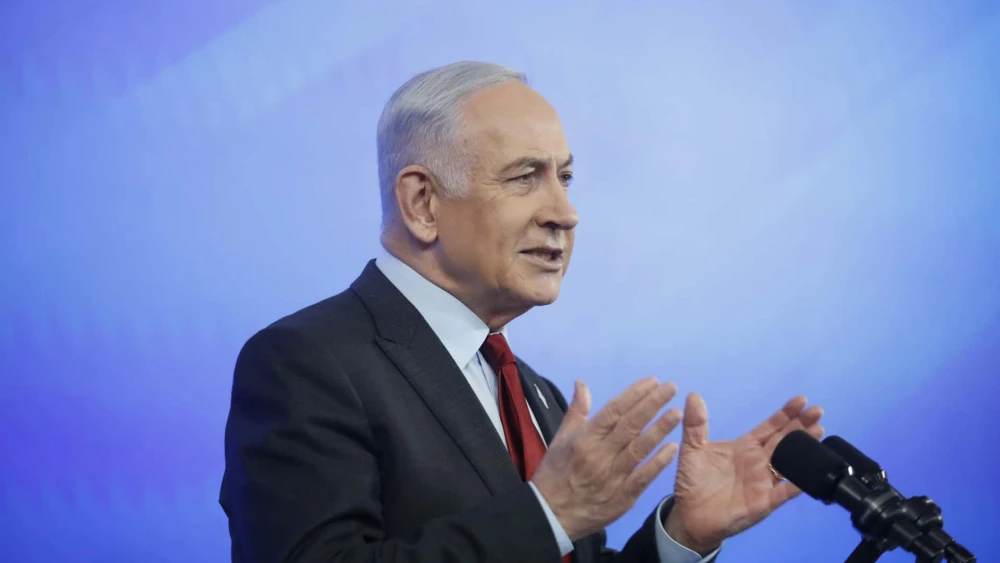
Israeli Prime Minister Benjamin Netanyahu on Thursday night pushed back strongly against the prospect of the Biden administration unilaterally recognizing a Palestinian state in the wake of Hamas’s Oct. 7 massacre.
“Israel categorically rejects international dictates regarding a permanent settlement with the Palestinians. Such an arrangement will be reached only through direct negotiations between the parties, without preconditions,” said Netanyahu.
“Israel will continue to oppose the unilateral recognition of a Palestinian state. Such recognition in the wake of the Oct. 7 massacre would give a huge reward to unprecedented terrorism and prevent any future peace settlement,” he added.
The comments came after The Washington Post reported that the Biden administration was preparing to make a major push for Palestinian statehood if a Gaza ceasefire agreement being negotiated in Cairo this week takes effect.
According to the report, the U.S. and Arab partners are “rushing” to finalize the plan to establish a Palestinian state, which could be announced in the next few weeks if a prospective deal to release the remaining 134 hostages held by Hamas terrorists in Gaza in exchange for a six-week pause in the war takes effect before Ramadan next month.
Netanyahu spoke for 40 minutes on Thursday with U.S. President Joe Biden, who “reaffirmed his commitment to working tirelessly to support the release of all hostages as soon as possible, recognizing their appalling situation after 132 days in Hamas captivity,” according to a White House readout of the call.
The two leaders also “discussed the situation in Gaza and the urgency of ensuring that humanitarian assistance is able to get to Palestinian civilians in desperate need. [Biden] also raised the situation in Rafah, and reiterated his view that a military operation should not proceed without a credible and executable plan for ensuring the safety of and support for the civilians,” per the statement.
Earlier this week, Netanyahu stressed that conquering Rafah in southernmost Gaza was essential to defeating Hamas, amid intense international pressure against the pending operation.
According to Israel, there are four Hamas battalions positioned in the city along the Egyptian border, the population of which has swelled to some 1.5 million, more than half of Gaza’s total of 2.3 million, after the Israel Defense Forces directed northern Gazans to a humanitarian zone there when fighting began in October.
The massive civilian population relocated there since the start of the ground war almost four months ago has alarmed Washington and Brussels, with Netanyahu attempting to allay concerns about noncombatants getting caught in the crossfire.
“We are going to do it [invade Rafah] while providing safe passage for the civilian population so they can leave,” Netanyahu said in an interview this week.
“We have worked out a detailed plan to do so. And that’s what we have done up to now. We are not cavalier about this. This is part of our war effort, to get civilians out of harm’s way. It’s part of Hamas’s effort to keep them in harm’s way. But we’ve so far succeeded and we are going to succeed again.”
Thursday’s call with Biden followed Netanyahu’s meeting with CIA director William Burns, who made an unannounced trip to Israel after participating in the hostage talks in Egypt.
Earlier this month, Axios reported that Biden was bucking decades of U.S. foreign policy by considering a plan to unilaterally recognize a Palestinian state and that Secretary of State Antony Blinken had requested a review of policy options for such an eventuality.
Last month, Blinken expressed support for “tangible steps” towards the creation of a Palestinian state in Judea, Samaria and Gaza during a meeting with Palestinian Authority chief Mahmoud Abbas in Ramallah.
This goes against the doctrine of Netanyahu, who sees increasing relations with the wider Arab world as the key to solving the Palestinian issue, as exemplified by the 2020 Abraham Accords, which saw Israel establish diplomatic ties with the United Arab Emirates, Bahrain, Morocco and Sudan in a deal brokered by the Trump administration.
Netanyahu’s right-wing and religious coalition is firmly against establishing a Palestinian state, and there is also widespread opposition among the Israeli public to such a development.
According to the most recent “Peace Index” survey released by Tel Aviv University, when asked whether they supported the creation of a “Palestinian” state alongside Israel, 66% of Jewish respondents said they opposed such a move while 27% expressed support for the creation of a “Palestine.”