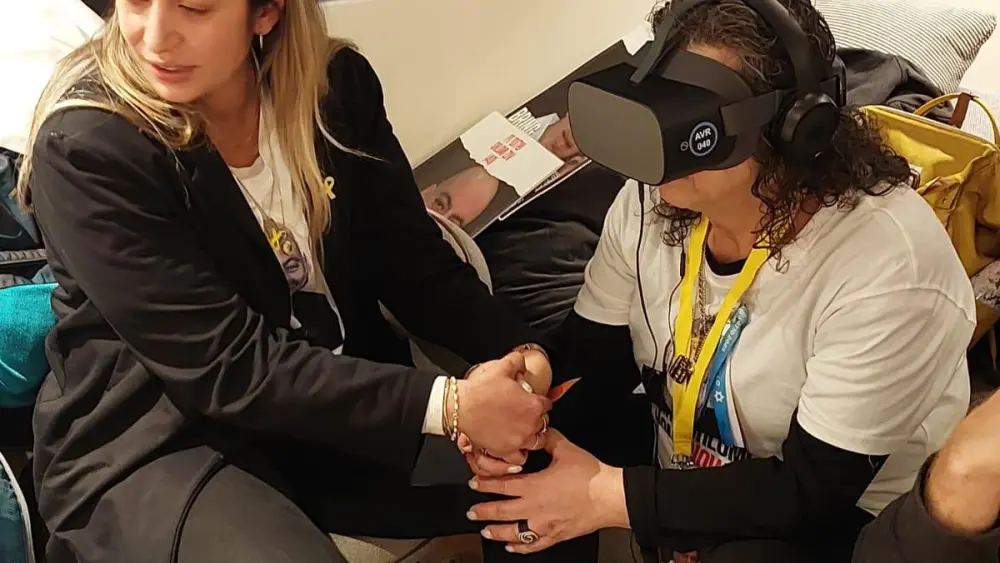
A doctoral student from the School of Education at Hebrew University whose cousin was abducted by Hamas terrorists on Oct. 7 has created a virtual reality tool that simulates the experience of being held in Gaza.
“I decided to create ‘Shlomi’s Glasses’ to show the world what it’s like to be at a festival similar to Burning Man in America or others in Europe and find yourself under attack,” Liat Ariel told JNS on Wednesday.
“We wanted people to identify with the revelers and understand that when terrorists infiltrate a peace party and massacred people, it’s not just our problem, it’s the world’s problem,” she added.
Hamas’s assault on the Nova festival at Kibbutz Re’im left 364 people dead. Despite the carnage, Shlomi Ziv, 40, a member of the security team, stayed to fend off the terrorists and help evacuate people from the site. He was kidnapped along with more than three dozen others.
Two of his friends, Jake Marlowe and Aviv Eliyahu, were killed.
Two months later, Ariel began realizing that it would be harder than she first thought to get all the hostages back. She set out to create an intense experience to help decision-makers and the general public empathize with the captives, understand the urgency of the situation and actively work toward their release.
Affect Theory, Ariel explained, suggests that what people actually experience leaves a stronger impression than experiences they only hear about, and motivates them to act.
“We believe that if decision-makers ‘experience’ captivity using ‘Shlomi’s Glasses’, they will internalize that the hostages can no longer endure any more suffering, and this will hopefully lead to an immediate deal,” she said.
Ariel first presented her idea to the Hostage and Missing Families Forum, which, in turn, asked Daniel Landau, CEO of tech company Avris, to develop the product.
The latest version, which involved major changes, was financed through fundraising and is now ready to be brought to world leaders.
“I was planning to present it here,” Ariel told JNS during her trip back from the United States to Israel. “I was looking forward to bringing it to shows like ‘Good Morning America.’ Unfortunately, no one wanted it. I am quite disappointed,” she added.
Ariel said the situation in the United States today is different than it was five months ago, with Americans losing interest in the hostage issue and the war against Hamas in general.
“While we can’t exactly walk into U.S. President Joe Biden’s office and ask him to wear ‘Shlomi’s Glasses,’ we still need to remind the world that over a hundred hostages are still held in Gaza and we can’t close our eyes, we need to bring them home,” she concluded.
Indeed, Ariel believes her invention can be used more widely as a tool to raise awareness about Hamas’s atrocities among the general public, both in Israel and abroad.
“It’s an eight-minute movie that shows in a vivid and memorable way what happened on Oct. 7,” she said.