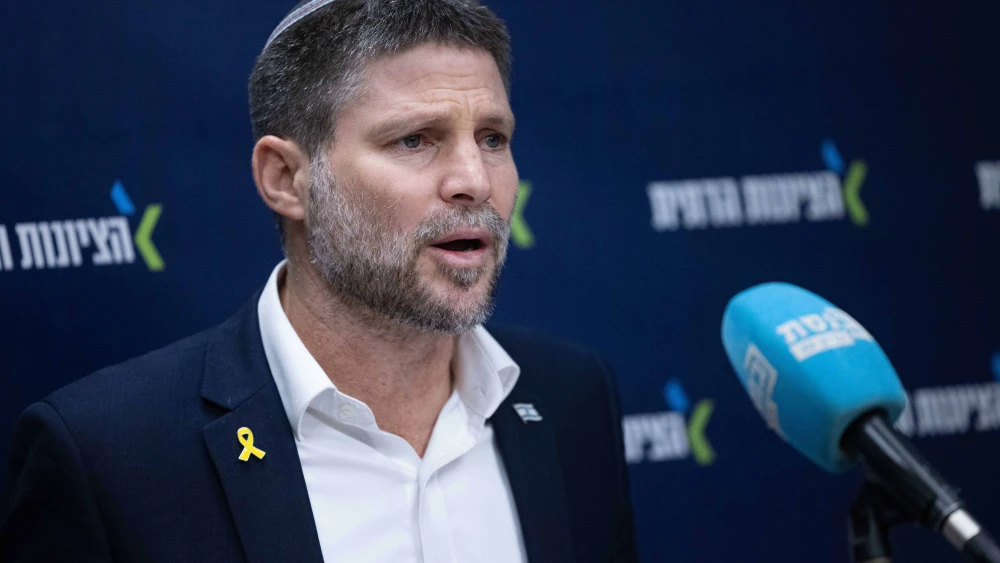
The U.S. has provided Israel with a written guarantee that Jerusalem can resume its war against Hamas in the Gaza Strip if negotiations for the second and third phases of the ceasefire agreement fail, Israeli Finance Minister Bezalel Smotrich told JNS on Tuesday.
U.S. President Donald Trump and former President Joe Biden have provided Israeli Prime Minister Benjamin Netanyahu with an official missive confirming that “the State of Israel will be able to return to the war on day 43" if talks fail during the 42-day first phase of the agreement, Smotrich said, speaking at a meeting of his Religious Zionism Party in the Knesset in Jerusalem.
This guarantee was also given to Netanyahu during phone calls with Trump and American government officials, the finance minister said, adding, “These two things together create an American guarantee allowing us to return to war.”
Commenting on the conditions for the agreement with Hamas to last through the second stage, Smotrich said that “our condition is that there is no Hamas.”
If the terrorist organization agrees, “great, we don’t want to fight. But if it doesn’t agree, we can return to the war,” he concluded.
While the Religious Zionism Party voted against the hostage deal with Hamas—which calls for the release of thousands of terrorists and an Israeli withdrawal from strategic areas in the Strip—it decided against leaving Netanyahu’s government over the deal to ensure that the war “does not end a moment before complete victory,” said Smotrich.
Smotrich had previously demanded that Netanyahu commit to resuming the war to dismantle Hamas terrorist infrastructure and secure the release through military pressure of all hostages following the deal’s first phase, which will only see 30 out of the 94 captives still held in Gaza freed.
This commitment was a condition for the party remaining in the coalition.
U.S. Special Envoy to the Middle East Steve Witkoff, whom President Donald Trump has credited with getting the deal over the finish line, refused to confirm the existence of formal guarantees in an interview with Israel’s Channel 12 News after the inauguration on Monday.
“I don’t want to discuss promises that were made; the agreement speaks for itself,” the U.S. envoy stated, adding: “I think that everyone is well-motivated to negotiate in a good-faith way and see if we can resolve all of this amicably and in a peaceful way and in a diplomatic way.”
On Sunday, three Israeli women taken hostage during the Oct. 7, 2023, massacre and held captive in Gaza for 471 days were freed as part of the first phase of the U.S.- and Qatar-brokered agreement with Hamas.
Trump told reporters at the White House on Monday he’s not confident that the ceasefire deal with Hamas will hold through all three phases.
“It’s not our war. It is their war. I am not confident. But I think they’re very weakened on the other side,” he said in response to a question in the Oval Office while signing orders in the first hours of his presidency.
Asked about the future governance of the Gaza Strip, the president said he believed “you certainly can’t have the people that were there,” in an apparent reference to the Iranian-backed Hamas terror organization.
Talks on the second phase of the deal are scheduled to commence in early February.