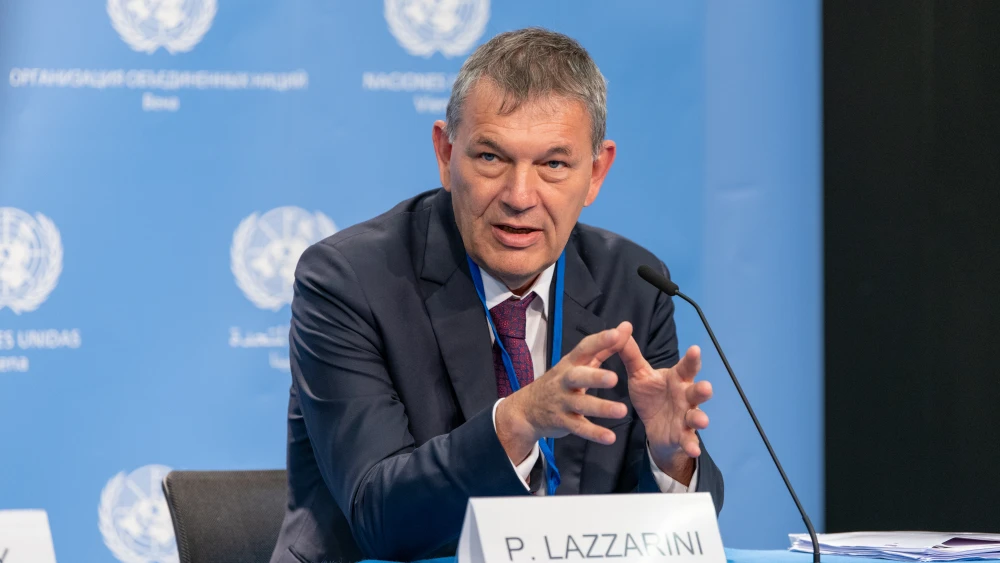
The head of the United Nations Relief and Works Agency (UNRWA) on Monday denied knowing that UNRWA employee Fateh Sherif Abu el-Amin, who was killed in an Israeli strike in Lebanon on Monday, was a Hamas commander.
“The specific allegation at the time was that [he was] a part of the local leadership ... I never heard the word commander before,” he said. “What’s obvious for you today, was not obvious yesterday,” Philippe Lazzarini told reporters in Geneva.
The revelation about Abu el-Amin, who Hamas confirmed was a senior commander, coincided with a series of discoveries after Oct. 7 about the terrorism ties of the controversial U.N. aid agency, which Israeli officials have said should be dismantled.
A Hamas spokesperson identified Abu el-Amin as “the head of Hamas’s Lebanon branch” in a statement on Monday announcing his death, along with that of several of his relatives, in an Israeli strike in southern Lebanon.
In July, Israel’s foreign ministry published a list of names and ID numbers of 108 UNRWA employees that Israel said were also Hamas terrorists. It was a “small fraction,” a Foreign Ministry official wrote in a letter to Lazzarini, of a much larger list including hundreds of Hamas and Palestinian Islamic Jihad members who also worked for UNRWA. The wider list could not be released due to security considerations.
“Israel has told donor countries that hundreds more of UNRWA’s 13,000 local staff are active Hamas terrorists, including school teachers,” Israeli government spokesman David Mencer told members of the press in July.
The NGO U.N. Watch earlier this year highlighted Abu el-Amin’s involvement with UNRWA, including his role as the principal of the UNRWA-run Deir Yassin Secondary School in El-Buss and head of the UNRWA teachers’ union in Lebanon, overseeing 39,000 students in 65 schools.
The Knesset in July passed a bill proposing to make it illegal for Israel to have any dealings with UNRWA, which would complicate the agency’s work as it depends on Israel for bringing goods, personnel and produce into the Gaza Strip. However, the bill did not advance to a second reading and may be replaced with a different bill proposing to ban UNRWA activity in Israeli territory.
Following the revelations, multiple Western countries suspended their funding for UNRWA, but many, including the United States, have resumed it following assurances that the agency is probing the allegations.
Lazzarini in August announced, following an internal probe, the dismissal of nine of the agency’s employees for their potential involvement in the Hamas-led massacre in southern Israel on Oct. 7. Gilad Erdan, the Israeli ambassador to the United Nations, as well as other Israeli and other officials, dismissed the probe as a “disgrace.”
It was “proven that the U.N. agency is not only an accomplice of terrorism, but that it also employs despicable terrorists,” said Erdan, calling for UNRWA’s dismantling.
Such calls predate the discoveries about the extent of UNRWA’s alleged ties to terrorism.
UNRWA uniquely affords refugee status not only to those who fled war, but to all of their descendants in perpetuity until a “just solution” emerges regarding their status. This means that the number of people defined as Palestinian refugees grows continuously.
The agency says it caters to “nearly five million Palestine refugees, mostly descendants of those who fled” pre-state Israel. All other refugees in the world, who lose refugee status after resettlement and cannot pass it on to their descendants, fall under the mandate of the United Nations High Commissioner for Refugees.
Critics of UNRWA and the United Nations argue that UNRWA’s premise is designed to perpetuate the so-called Palestinian refugee problem as part of a broader agenda at the United Nations focused on undoing Israel’s creation.