While the United Nations Security Council held its quarterly meeting to condemn Israeli “settlements,” Washington declared the sessions a waste of time.
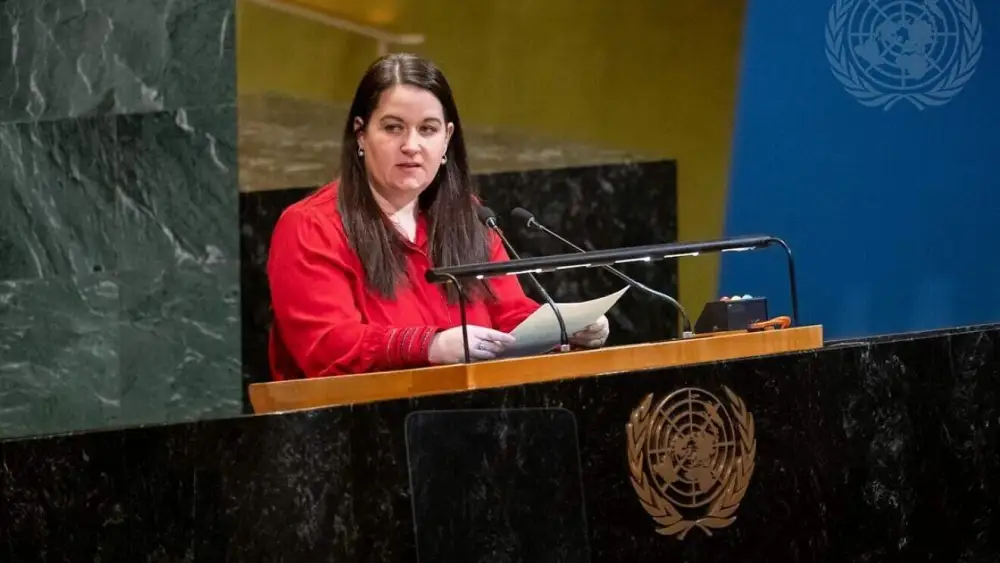
Jennifer Locetta, the U.S. alternative representative for special political affairs to the U.N., said the sessions focusing on Security Council Resolution 2334, which declared Jewish communities in Judea and Samaria and eastern Jerusalem illegal, “only distract from pressing threats to international peace and security.”
She said that, instead, it’s Resolution 2803—which the council passed unanimously last month to give lawful effect to U.S. President Donald Trump’s Israel-Hamas peace plan—that “charts the path toward a stable, safe and prosperous Middle East.
“We are working with partners to stand up the International Stabilization Force and train fully vetted Palestinian Police, not rehashing decades of failed policies,” Locetta said, referring to the force that is to keep the peace in Gaza during a transitional period while the Palestinian Authority prepares to govern. “This council should recognize and end its outsized focus on an outdated resolution.”
Locetta noted that Trump has taken a firm line on what is perceived to be increased violence by Jewish residents in Judea and Samaria, and on talk by Israeli government officials of applying Israeli sovereignty to Jewish communities there.
Trump “has been perfectly clear that the United States expects the violence in the West Bank to end, and that the United States will not allow the annexation of the West Bank,” said Locetta, using the international community’s name for the region.
Other council members largely disagreed with the American line.
Jérôme Bonnafont, France’s U.N. envoy, said, “We reiterate our condemnation of the expansion of settlements and our opposition to any form of annexation of the West Bank, whether it’s partial, total or de facto.”
Dmitry Polyanskiy, Russia’s deputy U.N. envoy, told the council that “the long-anticipated ceasefire in Gaza did not usher in alleviation of the plight of the residents of the West Bank.” He called for a two-state solution and the release of Palestinian Authority tax revenues withheld by Israel for the P.A.’s support of terrorism.
Several council members also took aim at Israel’s efforts to close down the U.N. Relief and Works Agency for Palestine Refugees, better known as UNRWA, for its ties to Hamas and other terrorist groups.
Locetta, though, said UNRWA “rejects any reasonable standards for accountability for the vetting of its staff or partners.”
Israel’s U.N. envoy chided the council for misplaced priorities.
“Looking back over the past year, it is clear what worked for our region and what did not,” Ambassador Danny Dano said. “What worked was a decisive leadership and moral clarity shown by Israel and its allies, especially the United States. Sustained diplomatic and military pressure, delivered real ceasefires and created leverage for change.”
Danon criticized the “hypocrisy and imbalance” in “obsessive debates” throughout the U.N. system over Israel’s right to defend itself.
He also focused attention on Sunday’s Islamist massacre at a Chanukah celebration in Sydney, Australia.
“This attack did not come out of nowhere. From the steps of the Opera House to the arches of the Harbour Bridge, incitement was visible. Hate was normalized,” said Danon of the antisemitic environment allowed to take hold in Australia.
“Inflammatory slogans were dismissed when calls to globalize the Intifada were shouted openly,” Danon said. “Also here in the city of New York, when hate speech is tolerated and when lies and media distortion are allowed to prevail, violence does not stay theoretical.”