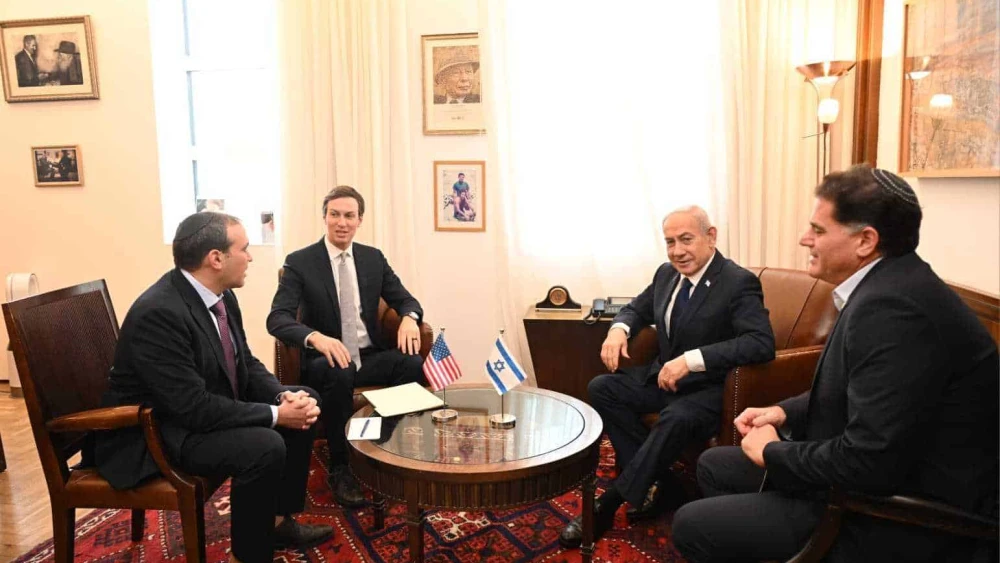
U.S. presidential adviser Jared Kushner’s recent visit to Israel has strengthened ties between the United States and Palestinian militias in Gaza that oppose Hamas. In conversations and meetings between militia leaders, Kushner’s team and U.S. officers from the task force stationed in Kiryat Gat, proposals were raised to establish a formal mechanism for communication and cooperation.
The Americans are attempting to assess the capabilities of these militias and determine the extent of their influence and control. Those operating in areas under Israeli control function with almost no interference and have managed to maintain relative order, including organizing food distribution.
Other militias remain in active conflict with Hamas terrorists. Their message to the Americans has been clear: they need assistance in this fight.
The American goal is to explore whether these militias can be transformed into a local force that maintains order and security in their respective areas, and potentially beyond.
The plan involves deploying them in the newly established humanitarian zones in both the southern and northern parts of the Strip, which are under Israeli control. This initiative is partly driven by the difficulty of assembling a multinational force, an issue discussed in a meeting between Israeli Prime Minister Benjamin Netanyahu and Kushner.
As reported Tuesday, the international task force headquartered in the facility known as the CMCC in Kiryat Gat has been maintaining regular contact with several militia and clan leaders in the Gaza Strip. The goal is to assist in organizing the humanitarian zones and help distribute food and aid to displaced Gazans in both the south and north of the enclave.
According to sources involved in these contacts, Israel is assisting in facilitating the coordination. The intention is to establish these militias as a stabilizing force, which, if successful, would be granted expanded authority over wider parts of the Strip.
Two of these militias are led by Husam al-Astal and Yasser Abu Shabab, clan-backed militias operating in southern Gaza that have been engaging in daily clashes with Hamas terrorists.
According to reports in Arab and Israeli media, al-Astal, formerly a member of the Palestinian Authority’s Preventive Security Service under the command of Mohammed Dahlan, joined forces with the militia established by Abu Shabab in eastern Rafah, and later set up his own “safe zone” in the Khan Younis area. In interviews, he claimed that his militia receives equipment and support from Israel, and that there is close coordination between him, Abu Shabab and Israel.
A volatile issue
As for the Hamas terrorists besieged in the Rafah area, several proposals are being floated. But Israel remains firm in its position: no deal will proceed until Hamas has returned all the bodies of hostages in its possession.
Hamas is demanding that the terrorists be allowed to return to its territory unharmed. The US is pushing for its disarmament. Israel has yet to make a final decision. The issue involves Nukhba terrorists who took part in the Oct. 7, 2023, massacre, as well as others responsible for the deaths of three IDF soldiers after the ceasefire was announced.
Furthermore, Israeli officials say that once this phase is completed, Hamas must publicly declare its consent to disarm. Only then will negotiations begin over the second stage of transferring governance.
This article was originally published in Israel Hayom.