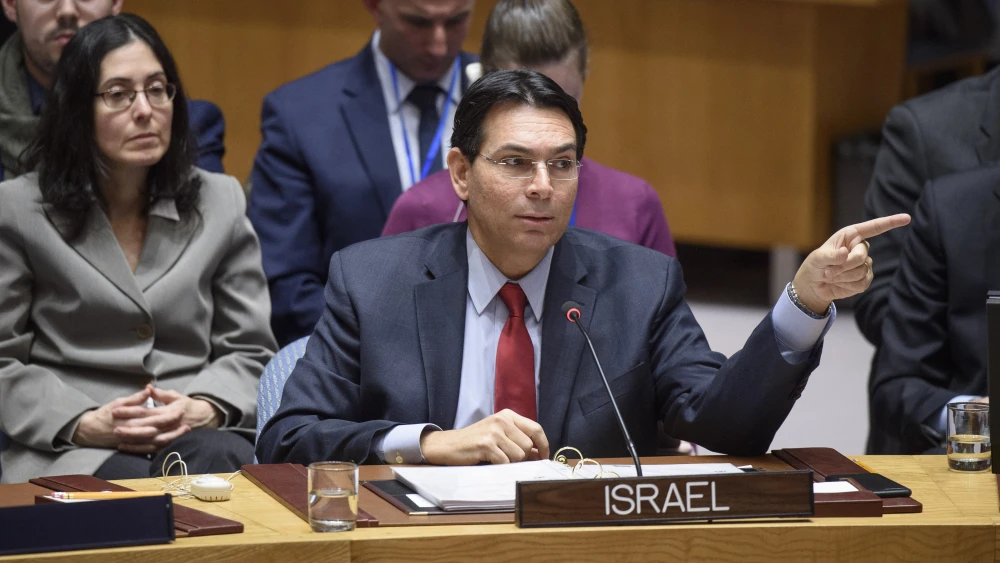
Following the IAF’s preemptive Sunday strike on thousands of Hezbollah rocket launchers, Israel’s ambassador to the United Nations wrote to the Security Council to “make it clear: The state of Lebanon and the Hezbollah terrorist organization, which is operating under the guidance of Iran, bear responsibility for the deterioration of the situation in the northern front.”
Guided by intelligence information showing the markings of a major imminent Hezbollah attack, the Israeli Air Force carried out its strikes in self-defense, following almost 11 months of bombardment by Hezbollah that included some 7,500 rockets and missiles and 200 explosive drones, which have displaced residents of much of northern Israel.
Ambassador Danny Danon wrote that Hezbollah’s planned attack over the weekend “unequivocally demonstrates the presence of illegal weapons in Southern Lebanon” in contravention of U.N. Security Council Resolution 1701, which called for, among other things, the disarming and disbandment of all non-state military actors in the Land of the Cedars following the 2006 Second Lebanon War.
Hezbollah, however, remains in control of Southern Lebanon, entrenched as an Iran proxy and dominant in Lebanese governmental affairs.
Danon wrote that Hezbollah’s actions are “part of a wider strategy by the Iranian axis aimed at the destruction of Israel through attacks from multiple fronts.”
He called on the Security Council to “condemn in the strongest terms” Hezbollah’s activities, along with those of Iran.
The ambassador noted in the letter that the mandate of the United Nations Interim Force in Lebanon, the peacekeeping mission in Southern Lebanon, is up for renewal this week, and called for the council to “ensure UNIFIL is effectively fulfilling its tasks and is adapted to meet current challenges.”
Following Israel’s preemptive strike and Hezbollah’s rocket barrage in response, which led to the death of Israeli Navy Petty Officer David Moshe Ben Shitrit, U.N. Secretary-General António Guterres wrote that “These actions put the Lebanese and Israeli populations at risk and they threaten regional security and stability.”