
Thank you, Mayor Mamdani. If it had not been for you, I would have missed this year’s Israel Day Parade.
As a child attending the Hillel School (now part of HAFTR), one of the highlights of the year was preparing for the annual Israel Day Parade. For weeks beforehand, we would practice marching in formation under the watchful eye of our teacher, Mar Melamed, whose drill sergeant whistle (he served in the Israel Defense Forces) could bring dozens of otherwise unruly students into formation within seconds.
As we marched, he would keep cadence with his familiar call of smol, smol, smol-yamin-smol—left, left, left-right-left—a rhythm that remains etched in my memory decades later. For a child, there was something magical about marching down Fifth Avenue carrying Israeli flags, singing songs and feeling part of something so much larger than yourself.
Like so many Jewish children growing up in New York, the parade was not simply an event. It was a celebration of identity, community and pride.
Over the years, life moved on. Careers, family, responsibilities and geography have a way of changing routines. Somewhere along the way, the parade became a memory rather than an annual tradition.
This year was different.
When it became clear that it would be the first time that New York City’s mayor would not participate in the parade since its inception in 1964, many viewed the decision as a snub to New York’s Jewish community. Ironically, that decision accomplished something remarkable. It reminded many of us why the parade matters in the first place.
What might otherwise have been just another parade suddenly felt like something that needed defending, not physically, but through presence. If others chose not to show up, then showing up mattered even more.
For me, it was enough to book a 6:25 a.m. flight from Florida, spend the day in New York, attend the parade and catch an 8:55 p.m. flight home that same evening. Less than 11 hours in New York. And worth every minute: Some opportunities are measured not in convenience, but in meaning.
Since Oct. 7, 2023, hundreds of thousands of Israelis have put their personal lives on hold to defend their nation. They left behind families, careers, businesses and universities. Many have served for months. Others have paid a far greater price.
Against that backdrop, was sacrificing half a day too much to ask? For me, the answer was obvious.
What I witnessed along Fifth Avenue was extraordinary.
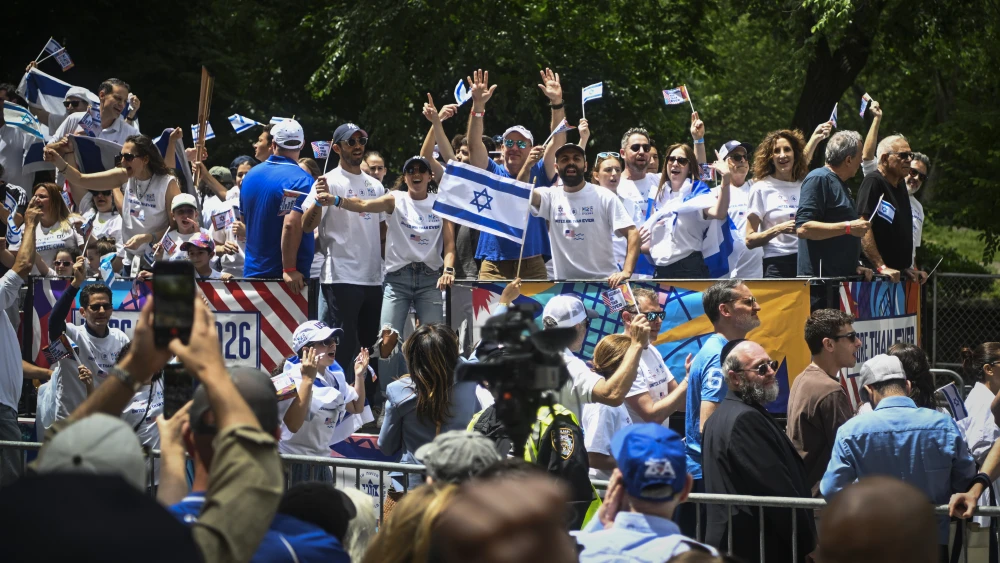
An estimated 50,000 people filled the route in a sea of blue and white. Families, students, Holocaust survivors, community leaders, elected officials, clergy, veterans and supporters of every background came together for a single purpose—to celebrate the enduring bond between the Jewish people, the State of Israel, the United States, as well as the values both nations share.
In the backdrop of beautiful weather, American flags waved beside Israeli flags. In the crowd, hybrid flags combining both nations’ colors fluttered proudly. The message was impossible to miss: proud Americans, proud Zionists.
Before boarding the float, I had the opportunity to spend time with several of the men and women of Brothers for Life, an organization that supports wounded Israeli veterans, and hear their stories firsthand. What struck me most were not their service records or the challenges they had faced, but what they had retained: their optimism, their resilience, their sense of humor, and their unwavering commitment to the people and future of Israel.
Later, I joined these remarkable men and women on the float making its way down Fifth Avenue. As the crowd cheered, chants of Am Yisrael Chai! (“The people of Israel live!”) echoed up and down the avenue. Again and again, spectators shouted Toda! (“Thank You”!) to the soldiers who had given so much.
Children waved. Adults applauded. Some simply stood silently, visibly moved by the moment.
Riding alongside them, I was reminded that the real superheroes among us rarely wear capes. They are the men and women who answer the call when their nation needs them, who place themselves in harm’s way for others and who continue to serve long after the battlefield has left its mark. Their strength is not found in supernatural powers, but in courage, sacrifice, resilience and purity of purpose.
It was impossible not to feel moved.
The parade itself reflected the remarkable diversity of the Jewish people. Religious and secular. Young and old. Native-born Americans and immigrants. Ashkenazi, Sephardi, Mizrahi, Ethiopian, Russian, Persian and countless others. For a few precious hours, the labels that so often divide us seemed far less important than the values that unite us.
Yet the parade was not only about Jews. Christians, Muslims and countless others marched and stood alongside the Jewish community, united by a belief in freedom and democracy. and Israel’s right to exist in peace and security.
The energy was palpable. Parents lifted children onto their shoulders to catch a glimpse of the marchers. School groups proudly carried banners representing communities from across the Jewish world. The concerns and divisions that so often dominate headlines seemed to fade into the background.
Former Israeli Prime Minister Menachem Begin once declared: “We are not Jews with trembling knees.”
Standing on Fifth Avenue—surrounded by tens of thousands of fellow Jews and friends of Israel—those words felt especially true. There was pride. There was resilience. There was gratitude. Most importantly, there was unity.
There is an old lesson in Jewish history. Time and again, those who sought to weaken the Jewish people often achieved the opposite.
Adversity has a curious way of reminding us who we are. Perhaps that is the unexpected lesson of this year’s parade.
A decision intended to create distance instead inspired many to draw closer. What many perceived as a snub became a rallying point. A moment of division produced a powerful display of unity.
So thank you, Mayor Mamdani.
Not for your absence. But for reminding tens of thousands of Jews, and at least one former Hillel School student, why showing up still matters.