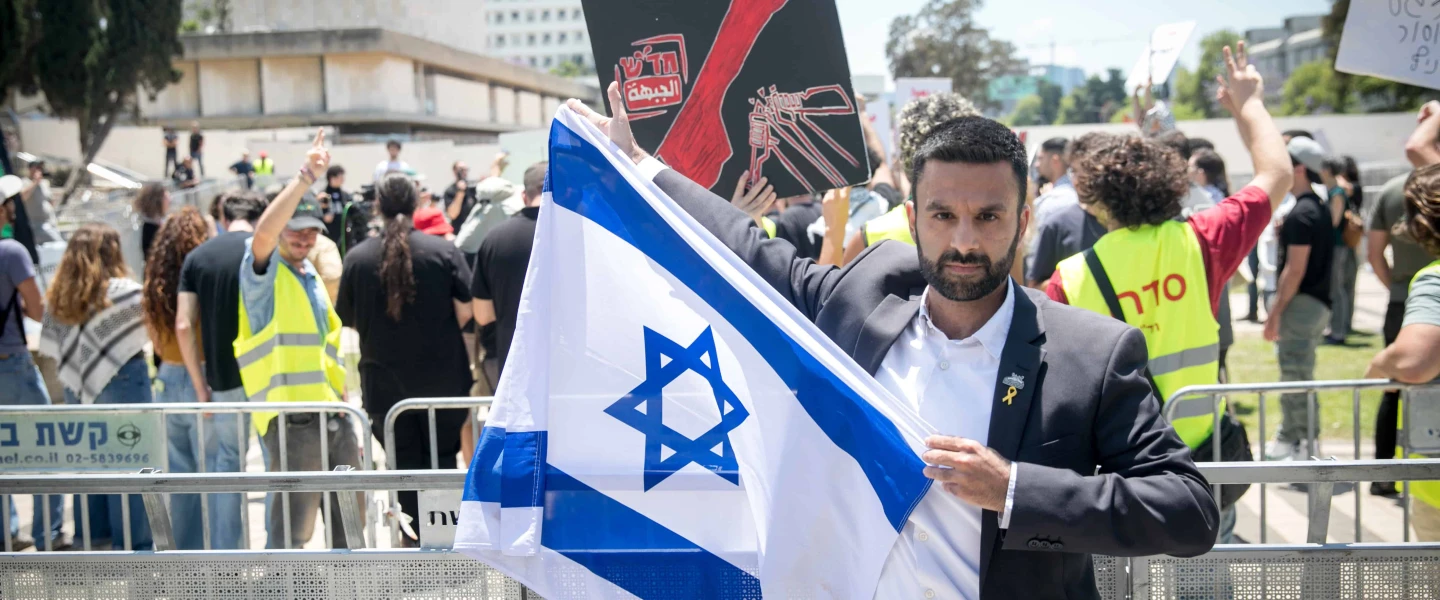
Failed Arab-Israeli political leaders have made poor decisions over the past decades that have not served their constituents, activist Yoseph Haddad, who is considering entering politics, told JNS on Monday.
“They focused on Ramallah, instead of Nazareth. They focused on Gaza, instead of Rahat. They cared more about the situation of people who don’t vote for them than those who do,” Haddad said.
“If you take any survey among Arab Israelis and ask what issues are at the top for them, you will find out that the Israeli-Palestinian conflict is last. Security within their own community, crime, illegal weapons are the issues that Arab-Israeli society cares about way more than the conflict, and every time we go to elections, Arab leaders make promises, intimidate us and sell us illusions,” he added.
While Arab leaders are often among the Knesset’s most active lawmakers, they rarely succeed in passing legislation because they remain in the opposition, Haddad said. In 2021, Mansour Abbas became the first Arab-Israeli leader to join a governing coalition, proving, Haddad argued, that Arab leaders had taken the wrong approach for 70 years.
“These Arab leaders destroyed my community because they wanted separation. They wanted the gap to get bigger. They wanted that differentiation because that is what gets them elected, since the elections are based on illusions and fear,” Haddad said.
“I will never cooperate with them. I’m here to replace them and make sure people understand the suffering we went through decade after decade because of their failure to make brave decisions and help society prosper,” he added.
Haddad said the partnership that occurs daily between Arab and Jewish Israelis is not getting the attention it deserves. Oct. 7, 2023, proved the strength of that partnership, he said, as Jews and Arabs were attacked together and saved one another.
Representing all Israelis
Haddad, a prominent pro-Israel advocate and international speaker, is the CEO of Together-Vouch for Each Other, an organization dedicated to strengthening ties between Arab Israelis and broader Israeli society. He said any political party he leads would not be sectarian.
As a political leader, he said, he would represent all Israelis equally, “whether they are named Mustafa or David, Sanae or Shlomit.”
“My point of view is very simple: We are a party in which we have Arabs and Jews, in which Arabs are proud to be Arab and Jews are proud to be Jews, and both are proud to be Israelis. All of us are working for our country, working for our society, maintaining security and finding the right path to fight all our enemies,” he said.
“I am a true believer of the fact that we need to balance between our Western values and the fact that our territory is located in the Middle East,” he added.
Failing to strike that balance, Haddad said, would threaten the country’s future.
“It doesn’t mean that I want to give up on my Western values. In fact, as an Arab who grew up in Haifa and Nazareth, I was raised on Western values and that is what differentiates us from our enemies. We sanctify life, not death; we want peace, not war. But at the same time, while I want peace, I understand that in the Middle East, the only way to achieve peace is through strength and power against our enemies,” he said.
Potential partners
According to a recent survey by the Midgam Institute, led by Israeli statistician Mano Geva, a Haddad-led party would win five Knesset seats, drawing support primarily from center-right voters.
Another political figure Haddad said he would not partner with is Democrats Party leader Yair Golan. In May 2025, Golan sparked controversy when he told Kan News that Israel Defense Forces soldiers fighting Hamas in Gaza “kill babies as a hobby,” prompting widespread criticism.
“I will not partner with him, at least until he goes on national TV in English and Hebrew and says he apologizes for using the status he had to push his political agenda at the expense of brave IDF soldiers that were and still are fighting against an enemy that wants to destroy all of us,” he said.
“I see it as a betrayal. Saying something like this deeply harms our IDF soldiers who are courageously battling on multiple fronts for the future of the nation, and making such a statement at a time of war is absolutely irresponsible and added to the tsunami of unfounded libels and attacks already going on. Let him apologize and we will talk,” he added.
Haddad believes the dividing line in Israeli politics is between those who are pro-Israel and those who are anti-Israel—a distinction he stressed is separate from legitimate criticism of government policies.
“If you work for the state, if you support our IDF soldiers, if you understand that our enemies are focused on finding ways to destroy us and therefore we need to be on the alert, and if you are a patriot who wants to fight for your country, I am your address,” he said.
“My party would represent every Israeli, Arab or Jewish, secular or religious, anyone who is proud of our country,” he added.
Haddad said his party’s mission would be to continue the work he has been doing outside politics and bring it into the political arena.
“I’ve been touring Israel for the past nine years and met with tens of thousands of people, if not more, and the toxic talk that we hear on TV does not reflect most Israelis. The majority of people are aligned far more than they think when it comes to security, and if we manage to bring all those voices together, our enemies don’t stand a chance,” he continued.
He added, “On Oct. 8, when I was asked whether we’d win or lose and I heard of the 130% reservist response rate, I predicted that we would rise up and beat our enemies because of Israeli unity—and that unity is my mission.”