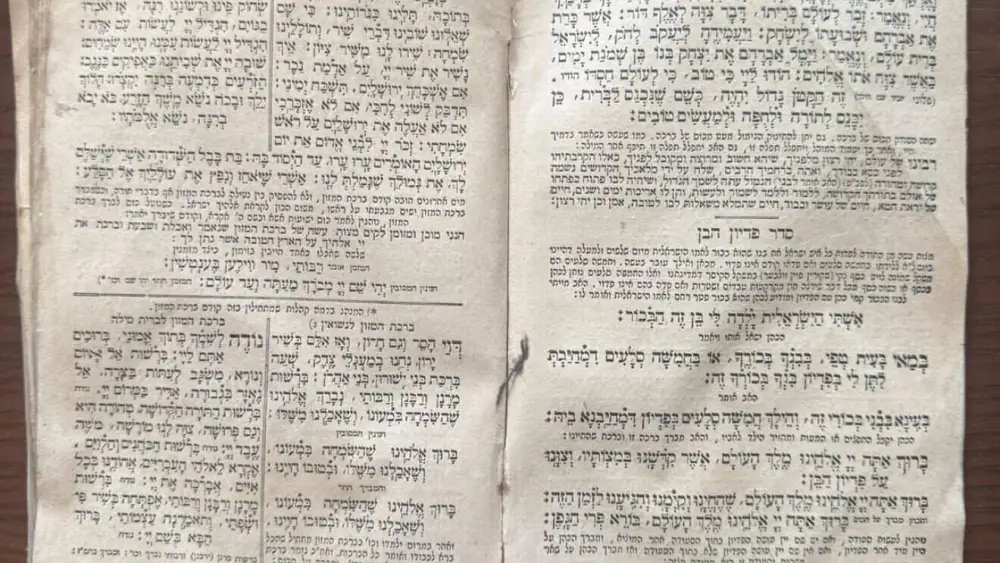
During preservation work this month on a rare wooden synagogue in Siberia—originally built nearly 120 years ago—workers uncovered a century-old prayer book that had remained hidden in the attic since the Communists closed the building in 1930.
The scripture, found at the Soldiers’ Synagogue in Tomsk, is an annotated siddur, a prayer book containing a set order of daily, weekly and special prayers, Levy Kaminetsky, a Chabad emissary who in 2004 moved to the Russian city with his wife Gitty, told JNS.
The Soldiers’ Synagogue is one of just a few dozen wooden synagogues that dot Eastern Europe and Russia, many of which are falling into disrepair. The Russian government this year allocated tens of thousands of dollars toward renovating the building, which it gifted to the Jewish community in 2018. It has not served as a synagogue since 1930.
Beyond its architecture, which features elaborate Jewish-themed wooden reliefs in the exterior and interior spaces, the Soldiers’ Synagogue has historical and symbolic significance because it’s a testament to the determination of Russian Jews to retain their identity and faith despite persecution.
Jewish army veterans built the synagogue in 1906, including ones who were conscripted by force as children, some of them as young as eight. Known as Jewish Cantonists, they fell victim to a policy from 1827 to 1856, which forced Jewish communities to give up 10 children older than 12 for every 1,000 members.
The children were placed in military boarding houses and drafted for 20 years when they matured. Czarist Russia had some 75,000 Jewish Cantonists, as well as some 300,000 non-Jewish soldiers who’d been abducted as children.
Many Jewish Cantonists were converted to Christianity, but some, including the founders of the Tomsk synagogue, resisted considerable pressure by their commanders to convert, according to a book on the subject by Rabbi Yosef Mendelevitch, a former Soviet refusenik, now living in Jerusalem.
The renovations are to turn the Soldiers’ Synagogue into a museum, said Kaminetsky. The siddur discovered during the renovations will go on display there, he added.