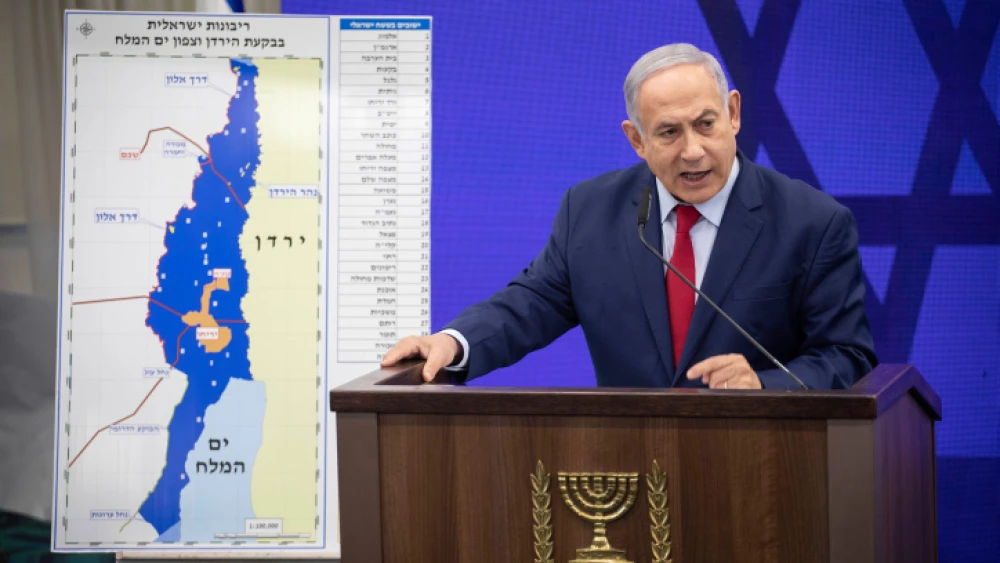
It seems this election campaign, which began in earnest only a few weeks ago, was dominated mostly by Israeli Prime Minister Benjamin Netanyahu, with occasional shouts heard from Israel Democratic Party leader Ehud Barak and barely a whisper from Blue and White Party leader Benny Gantz. Few candidates, if any, made as clear policy declarations as did Netanyahu and his Likud Party, especially when he announced that, if re-elected, he would apply Israeli sovereignty to the Jordan Valley and Jewish settlements there.
Naturally, Netanyahu’s declaration set off a firestorm of reactions across the board; however, international law professor Eugene Kontorovich reassuringly told JNS that the Jordan Valley issue is part of a “longstanding and nonpartisan consensus in Israel. The prime minister’s announcement is fully in line with Israel’s international legal rights,” he said.
The area has been a largely consensus issue for many years already. Former Prime Minister Yitzhak Rabin, not known to be a hawk, was adamant that the Jordan Valley remain under Israeli control in any future peace deal.
“There is no change in United States policy at this time,” a U.S. official said when asked whether the White House supported Netanyahu’s move.
Palestinian Authority leader Mahmoud Abbas threatened that “all signed agreements with Israel and the obligations resulting from them would end” if Netanyahu went through with the move.
Oded Eran, a senior research fellow at the Institute for National Security Studies, told JNS that much depends on the outcome of the elections and the kind of coalition that emerges.
“If and when the idea is pushed forward,” he said, “there are various questions.”
“For example,” he continued, “is it going to be annexation? Or application of Israeli law?”
According to Eran, the latter terminology would be “less contentious” for some countries like the United States, Europe, Russia and China.
‘Complicate relations between Amman and Washington’
As Sept. 17 drew closer, there was a clear incremental element to Netanyahu’s announcements as he went from applying Israeli law in the Jordan Valley to full annexation of the Jewish section of Hebron.
His announcement drew the expected condemnations from the left, yet while many on the right applauded the announcement, there were those who criticized Netanyahu for waiting until now, when he had more than 10 years to implement this move with ease. By announcing his intention to wait until after the elections to apply sovereignty over the Jordan Valley, Netanyahu gave off the perception that he was simply attempting to sway voters and steal votes from other right-wing parties.
Yamina leader Ayelet Shaked and her No. 2, Naftali Bennett, generated significant publicity this week when they produced a map showing what they believe proves how much of Judea and Samaria may be given to the Palestinians under U.S. President Donald Trump’s soon-to-be-released Mideast peace plan. This, they said, was reason enough to vote for their party and not for Likud.
While the Likud and the White House both called the map “fake news,” Eran said that as long as the president holds the same views as Netanyahu, “he may react in a way which may not be or may be seen as supporting the Israeli move.”
Which leads to the next question: To what extent did Netanyahu consult with the Trump administration before making his announcement?
“Was he given to understand that the idea is not in conflict with the [peace initiative]?” asked Eran. “Because if he did, that may exacerbate or complicate the issue of Jordan. If the U.S. administration does not object or remain silent or react in a way which does not negate or oppose the Israeli initiative to annex/apply the law, that is certainly going to complicate relations between Amman and Washington.”
Abdullah Swalha, founder and director of the Center for Israel Studies in Jordan, was less worried about relations between Jordan and America. He told JNS that no one in Jordan takes Netanyahu’s statements seriously, “except the Jordanian government,” he said. “Netanyahu was prime minister for 13 years, and he didn’t take action, so why now? It is very obvious to all of us in Jordan and even in the region, including Israel, that this is a part of the election campaign.”
“Certainly,” acknowledged Eran, “Netanyahu introduced a new element into the whole question of Israel’s relations with the West Bank.”