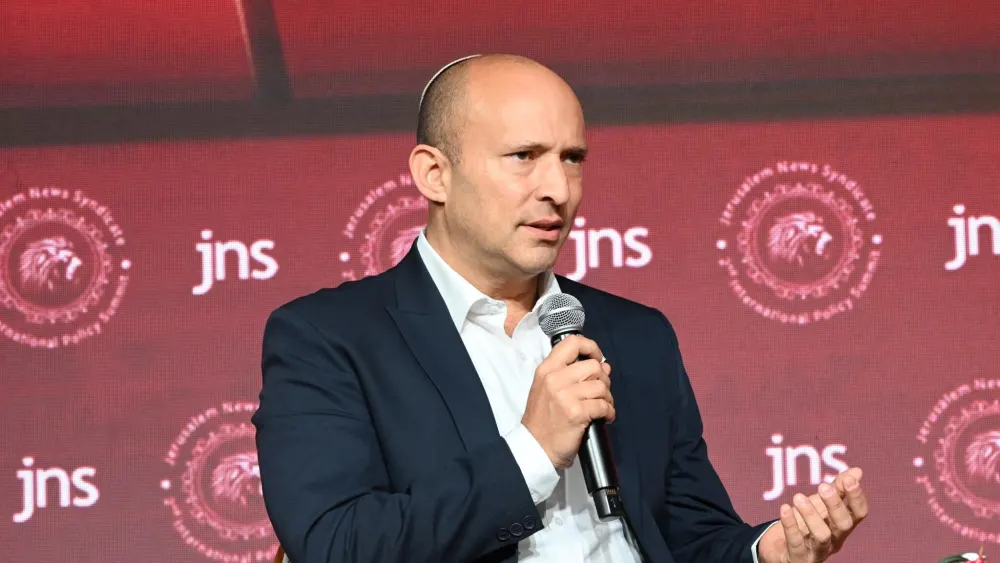
The Israeli-American alliance is at a “precarious moment,” former Israeli Prime Minister Naftali Bennett warned on Tuesday, arguing that negative public opinion of the Jewish state is influencing the relationship between Jerusalem and Washington.
For the first time since Israel’s establishment, “Brand Israel” is viewed negatively in the United States, “and that’s a disaster,” the chairman of the Together (Beyachad) Party, who is challenging Prime Minister Benjamin Netanyahu in the upcoming Israeli elections, said on the third and final day of the JNS International Policy Summit in Jerusalem.
Bennett said that this situation “totally distorts good and bad, right and wrong, but that’s a fact right now.”
In a conversation with Jennifer Sutton, executive director of the Council for a Secure America, he criticized the current government, saying that while U.S. President Donald Trump is a “huge friend” of Israel, that friendship is primarily based on his personal sympathy, and a “nation cannot base its long-term strategy on a president who currently supports Israel.”

Repairing Israel’s public image in the United States requires replacing Cabinet ministers whom Bennett described as delivering irresponsible messaging, along with a commitment to “fix and build a national public diplomacy apparatus to fight back.” Bennett used Qatar as an example to emulate, “but for the sake of good, not bad.”
The high-tech entrepreneur-turned-politician asserted that Israel must do a much better job at public relations, saying that if the country were a P.R. firm, he would not hire it.
A 54-year-old son of immigrants from the United States who was born in Haifa, Bennett also lamented rising antisemitism, saying it was “manifesting itself in ways that I could not imagine.”
To reverse the Jewish state’s fortunes, a “big, broad, Zionist, bipartisan government” must be built, “led by me hopefully,” Bennett said.
Pivoting to Israel’s security situation post-Oct. 7, he said that a “terror monster” cannot be allowed to build up at the border, referring to Hamas in Gaza. “You have to prevent the monster from being built to begin with,” he said, arguing that posting guards at the frontier is not enough. “We can’t allow huge terror empires to be built in Lebanon, in Gaza or along any of our borders.”
Previewing a return to the premiership, Bennett said that he will “work great together” with Trump; “both of us are businessmen who look for solutions, get stuff done pragmatically.”
He then discussed current American restrictions on Israeli freedom of action in Lebanon against Hezbollah. “But Israel is not a client state or a vassal state, Israel is a friend, an ally of the United States of America for a long, long time, and Israel must right now in Lebanon exercise our right and duty to defend ourselves, and that’s what we have to do right now this very minute and never tell soldiers that they can’t shoot terrorists.”
On the Islamic Republic and its threat to Israel and the broader region as well as the status of the Abraham Accords, Bennett said that recent conflicts have “have shown to everyone that Iran is a bully,” and “everyone in the Middle East understands that we need to join forces to repel and ultimately topple” the regime in Tehran. “Let me be very clear, it’s a rotten, old, disconnected, incompetent regime and it will fall like the Soviet Union fell.”
Middle Eastern countries “need to join forces to accelerate the collapse of this regime,” similar to the actions U.S. President Ronald Reagan took to speed up the demise of the Soviet Union. Bennett used as an example a process he said he started and that was subsequently stopped to give the Iranian people protesting against the regime access to the internet via Starlink.
He said he is a “huge supporter of the Abraham Accords” and that Israel and the moderate Arab states must work together to “repel radical Islamistic terror states, and it’s going to happen.”
Bennett said he is a “right-wing guy but I’m not a schmuck,” elaborating that “being right-wing means you stand on our national interests; you don’t give up land, you don’t allow a Palestinian state to be formed, you stand strong ..., it means you run a sharp government that focuses on getting stuff done, on building Israel.”