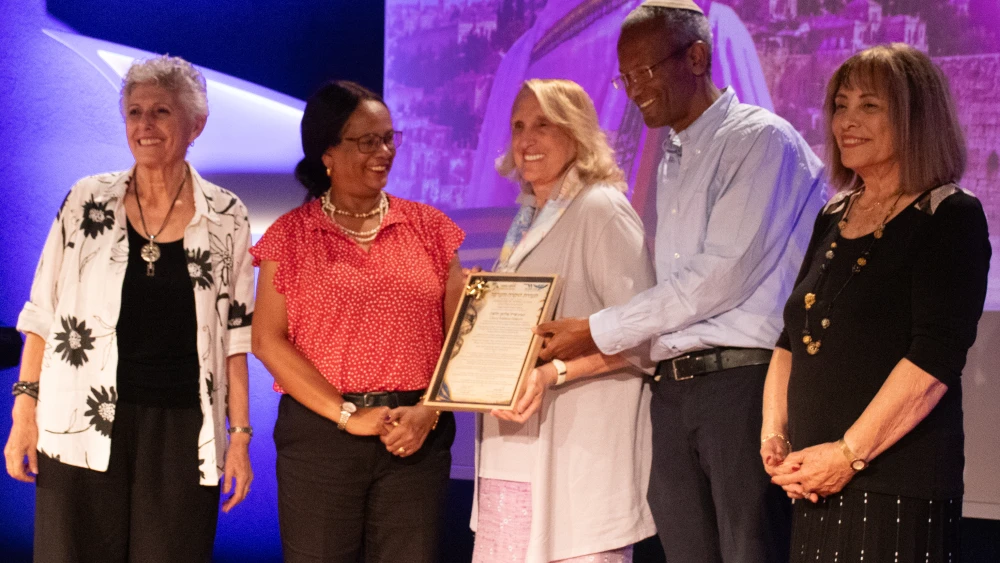
A special event celebrating Ethiopian Jewish history and culture took place at the Yemenite Jewry and Israel’s Communities Heritage Center in the city of Rehovot on Tuesday evening.
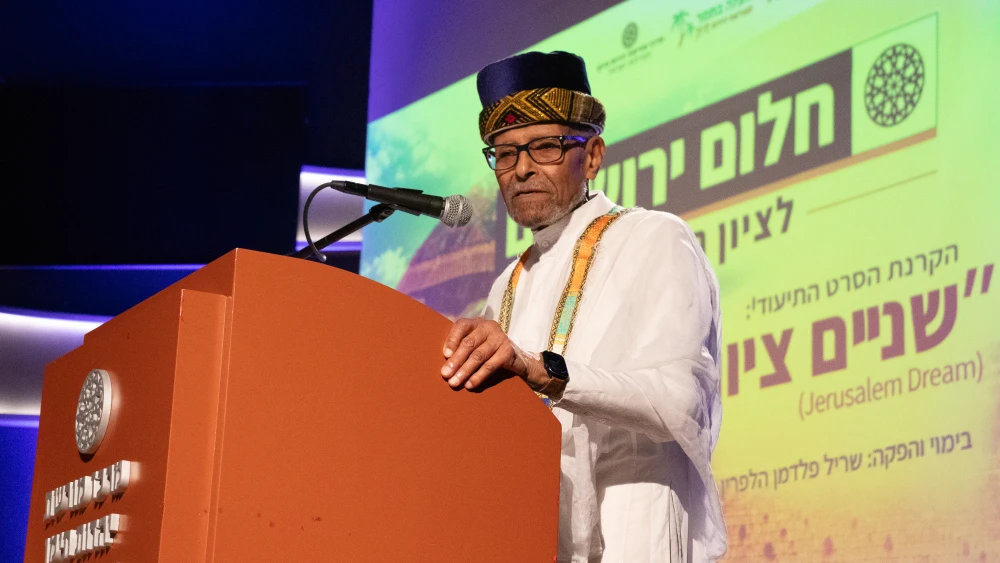
The event, “Jerusalem Dream: Toward the Sigd Holiday,” honored two special guests from the United States. The first, Ephraim Isaac, 90, a world-renowned expert on Semitic languages, particularly the ancient Ethiopian language Ge’ez, in 1969 became the first faculty member appointed to Harvard’s Department of Afro-American Studies. He was also a founding member of the Institute of Semitic Studies at Princeton.
The second, Cheryl Feldman Halpern, a filmmaker and philanthropist, served as chairwoman of the Corporation for Public Broadcasting (2005-2007), director of Radio Free Europe/Radio Liberty (RFE/RL), and produced and directed numerous documentaries, including several on Ethiopia.
Both received certificates of appreciation from the center for their contributions to the study of Ethiopian Jewry, also known as Beta Israel.

The event was timed within a week of the Sigd holiday. Sigd, unique to the Ethiopian Jewish community, marks the renewal of the covenant between God and his people and their longing for Jerusalem. It falls 50 days after Yom Kippur. In 2008, the Knesset recognized it as an official holiday.
Isaac, dressed in finery typically worn on the holiday, told the audience that he had recently read an article in which the author said that the Jews of Ethiopia didn’t know where they came from. He disputed this assertion, saying that Ethiopians boast among the strongest links to the Jewish people. “Once I was standing outside a synagogue in America and someone on the street out front asked if I was Jewish. I answered, ‘Yes,’ and he said, ‘You don’t look Jewish.’ But the Bible tells us that Moses married a Cushite [Ethiopian] woman. Then do I not resemble Moses’s son?”
Isaac stressed that Judaism is not about color or race. As evidence, he pointed to a famous letter from Maimonides, the 12th-century Jewish sage, to Obadiah the Proselyte, a convert to Judaism, telling him that he was equal to a Jew born into the faith.
“Whoever adopts Judaism and confesses the unity of the Divine Name, as it is prescribed in the Torah, is counted among the disciples of Abraham our Father, peace be with him,” Maimonides wrote. “Do not consider your origin as inferior. While we are the descendants of Abraham, Isaac, and Jacob, you derive from Him through whose word the world was created. As is said by Isaiah: ‘One shall say, I am the Lord’s, and another shall call himself by the name of Jacob.’ ”
Isaac concluded: “We are one nation. We are lovers of Torah, seekers of Torah. We are brothers.”
The audience viewed a screening of Halpern’s 2016 film, “Two Zions: The Living Legacy of the Queen of Sheba and King Solomon.”
At the heart of the documentary is the idea of two Zions: Jerusalem, the spiritual center of Judaism, and Ethiopia, which has its own profound connection to the biblical narrative and the heritage of the Ethiopian Jewish community, starting with the legendary relationship of the Queen of Sheba and King Solomon.
The Bible speaks of their meeting in the Book of Kings and Chronicles. Queen Sheba came to Jerusalem “with a very great retinue.” She poured out her heart to the king. “Solomon answered all her questions; there was nothing so difficult for the king that he could not explain it to her,” the Bible relates.
Ethiopian tradition continues the story. The Queen of Sheba returned to Ethiopia with a son, Menelik I, whom she bore to Solomon.
The “Kebra Nagast” (“Glory of the Kings”), a sacred and historical text in Ethiopia, presents Menelik as the founder of the Ethiopian royal dynasty. It is an important text in Ethiopian Orthodox Christianity, the film reveals.
Halpern, who is currently completing a documentary on the Druze, told JNS that one of her goals is to expose Israelis to the beautiful cultures that exist within and around them. “Ve’ahavta le’reyakha kamokha [‘You shall love your neighbor as yourself’],” she said. “That’s every neighbor. We all have to respect each other.”
Halpern’s 2024 documentary, “The Golden Rule: Do Unto Others,” explores the principle of reciprocity, which teaches individuals to treat others as they wish to be treated, and reveals that it appears across many religions.
The theme of ‘doing unto others,’ and the importance of understanding different cultures, was present in the film screened on Tuesday.
Halpern said she was motivated to make “Two Zions” because “Ethiopian Jews and Ethiopian Christians did really not know enough about each other. And yet they were celebrating the same traditions, just separately. That’s what was in the film—Shabbat, circumcision, respect for the Torah. You have two cultures, two religious cultures, celebrating similarly. They needed to be seen together by a broader audience to really be respected and understood.”
Halpern became aware of the parallels when Ephraim Isaac introduced her to then-Prime Minister of Ethiopia Meles Zenawi and his wife Azeb Mesfin. “Together, we would sit and talk about the similarities of Judaism and the Orthodox Church, and the similarities of the language,” Halpern said. “And yet I never knew about the similarities. Prime Minister Melles said, ‘Hey, we really are sisters and brothers,’ and so from that grew the personal desire to tell the story.”