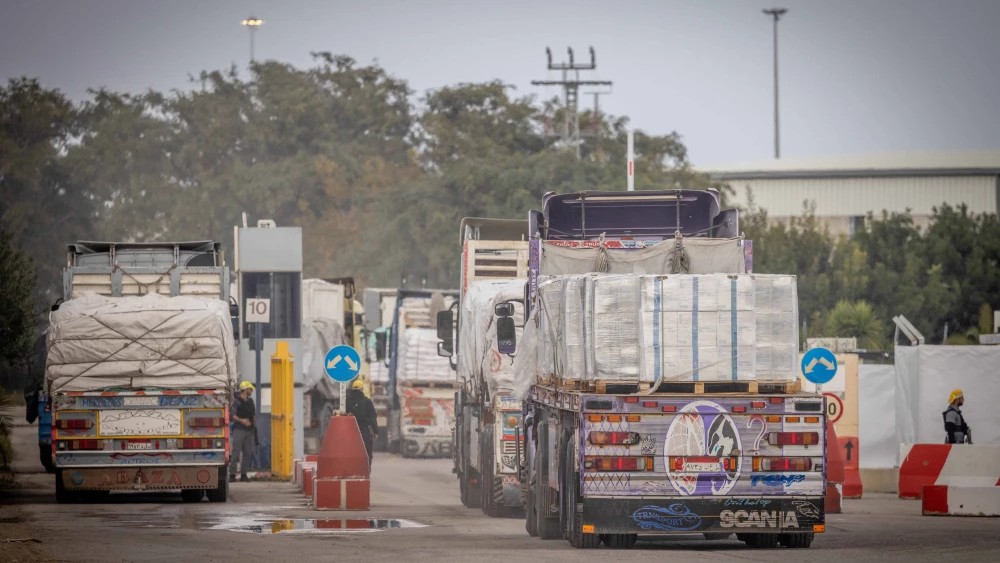
The Israeli government issued a clarification on Thursday, hours after the U.S.-backed Board of Peace said the Jewish state had suspended private-sector goods coordination into Gaza.
Nickolay Mladenov, the board’s high representative for Gaza, wrote on Thursday morning that he received a letter from the Coordinator of Government Activities in the Territories, or COGAT, an Israeli Defense Ministry that implements civilian policy and manages logistics in the Gaza Strip and in Judea and Samaria.
He said the letter referred to “the suspension of private-sector goods coordination into Gaza as a result of reports of threats and coercion by Hamas.”
“As I have warned repeatedly, such practices are unacceptable and must end immediately,” Mladenov said. “The intimidation of merchants and interference in the supply chain only deepen the suffering of Gaza’s civilians.”
Israeli officials said later in the day that it is true that private-sector goods are no longer flowing into Gaza due to Hamas threats and coercion of Gazan businesses; it was the merchants, and not the Israeli government, that made the decision to halt the flow.
“Contrary to recent reports echoed by Hamas, Israel did not initiate the suspension of private-sector operations for the entry of goods into the Gaza Strip,” COGAT said.
“In recent days, private-sector merchants informed COGAT that, due to Hamas’s forced taxation mechanism and threats against merchants who refuse to comply with its demands, they had decided to suspend the coordination of trucks carrying goods into the Gaza Strip until further notice, out of genuine fear for their lives and safety,” the Israeli government said.
Merchants reported to COGAT that Hamas is demanding about $3,200 for each truck carrying goods into Gaza.
The U.S.-designated terror group “is also requiring merchants to sell approximately 30% of their goods in cash, in an effort to gain control over the proceeds,” COGAT said.
Hamas security personnel reportedly arrested a son of one of those merchants and is holding him in prison until the father complies with the monetary demands.
“This incident, along with the threats and pressure exerted on the merchants, led them to suspend coordination activities out of fear for their lives,” COGAT said of the merchants.
“It should be emphasized that humanitarian aid continues to enter the Gaza Strip through the U.N., international organizations and donor countries,” it said.
It added that according to available data, “the volume of aid entering through these channels is sufficient to adequately meet the needs of the population in Gaza, even without private-sector operations.”
Mladenov wrote that Hamas’s latest actions “demonstrate why the rapid deployment” of Board of Peace entities such as a Palestinian technocratic transitional government, supported by the International Stabilization Force, “is urgently needed.”
“Civilian supplies, humanitarian assistance and commercial activity must be protected from coercion, exploitation and interference,” he wrote.
Hamas is supposed to disarm as part of a U.S.-brokered peace plan, to which both Israel and Hamas agreed. Thus far, the terror group has refused to do so, which requires Israeli troops to remain deep within Gaza to maintain a defensive barrier.