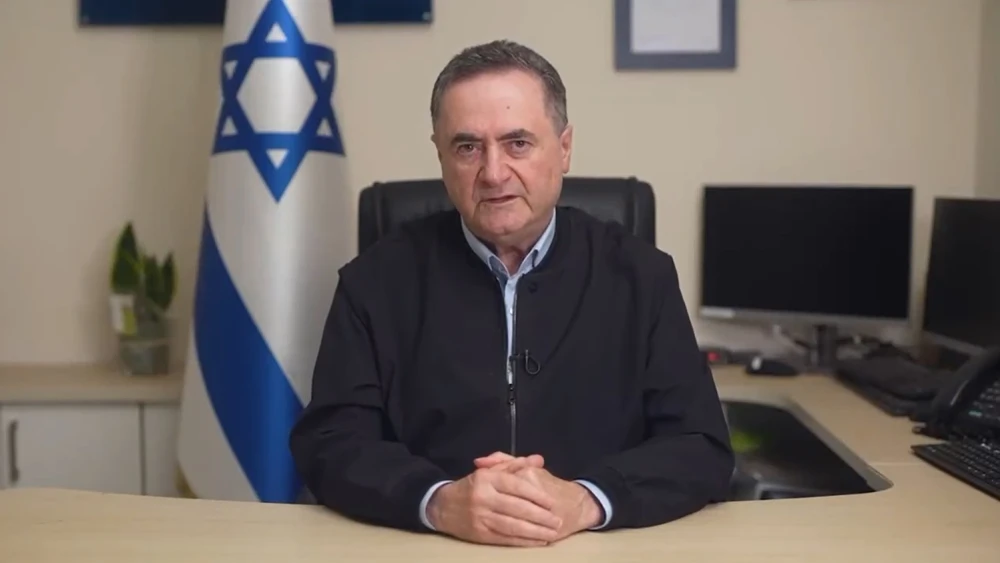
Israeli Defense Minister Israel Katz on Thursday outlined four IDF deployments in Lebanon that he said serve as “the foundations of the plan” for military action against Hezbollah.
Katz published the plan in a statement shortly before Israeli Prime Minister Benjamin Netanyahu announced that he had instructed the government to negotiate with the Lebanese government on dismantling Hezbollah and on a peace deal, noting that the military action against the terrorist group was made possible by “the agreement on separating the fighting arenas.”
This was a reference to the Israeli and U.S. position that the April 8 ceasefire with Iran does not extend to the terrorist group in Lebanon. Katz called this “a major achievement led by the prime minister.”
The Israeli action plan in Lebanon “is based on four lines: The border line, which includes demolition of buildings in border adjacent villages in Lebanon,” and second, “The defensive line in Lebanon, which was extended from five outposts to 15,” Katz said.
He called the third line the “anti-tank line,” a reference to areas from where Hezbollah is able to directly fire, often with missiles intended for destroying tanks, at Israeli forces, civilians and infrastructure. A ground incursion led to the seizure of the so-called anti-tank line, Katz said, “and we are extending it in additional locations.”
The fourth line, he said, is the Litani line, a reference to the river in Southern Lebanon. The Israel Defense Forces “will control the Litani line as part of its control of the Litani area and prevent the penetration of additional terrorists southward and the return of residents,” Katz said.
Hezbollah has amassed its military power south of the Litani. The terrorist group had agreed to end its presence south of the river in the terms of the Israel-Lebanon ceasefire that went into effect in November 2024, but the group broke the ceasefire on March 2, joining the fighting against Israel alongside Iran.
Independent of the four deployments, Katz said that “the IDF will strike forcefully from the air, in accordance with the model employed in Iran, targeting terrorists and launchers in the Litani area and launch sites beyond it.”
The defense minister also said that Israel had killed 200 Hezbollah terrorists in strikes on Thursday, bringing the death toll up to 1,400 in Hezbollah’s ranks since fighting with the group resumed on March 2.
His vow to keep attacking came amid international pressure on Israel to halt strikes on Hezbollah in the framework of the April 8 ceasefire in the separate military operation by the United States and Israel in Iran.
‘Unlikely to give up easily’
The regime in Tehran initially said that it would block the Strait of Hormuz despite the April 8 ceasefire understandings after Israel struck over 100 targets in Lebanon in an operation titled “Eternal Darkness” that Katz said killed 200 terrorists.
However, the regime later told vessels to sail through Iranian waters in the strait around Larak Island, to avoid the naval mines in the usual route, Iran’s semi-official Tasnim news agency reported on Thursday. Traffic is at 10% the usual volume as shipping companies assess the risks associated with navigating the bottleneck and sailing in Iranian waters, Reuters reported.
Israel continued to attack in Lebanon on Friday, according to the Al-Manar television station, including in Nabatieh and Kfar Reman. Hezbollah terrorists continued to fire rockets into Israel on Friday, including on Kiryat Shmona.
Hezbollah is “vying for a ceasefire agreement, and its Iranian patrons are also applying pressure and threatening out of fear that Israel would crush Hezbollah,” Katz noted in his statement Thursday.
The strikes on Thursday “left Hezbollah stunned from the depth of the penetration and the extent of the blow,” he added.
Orna Mizrahi, a senior researcher and head of the Lebanon program at Tel Aviv University’s Institute for National Security Studies, wrote on Thursday in an analysis that Hezbollah “emerged from this phase with mixed results.”
Hezbollah fulfilled its role for Iran, she said, “drawing Israel into an additional front, demonstrating continued relevance and a capacity for rapid recovery.” The group “remains a threatening and deterrent force in Lebanon,” she added, but it has also “paid dearly in casualties and damage to its infrastructure; failed to halt the IDF in Southern Lebanon or establish new deterrence equations, and has deepened public criticism against it.”
Yet “even if the current campaign continues, Hezbollah is unlikely to give up easily. With Iranian support, it will seek to rebuild and reinforce its position, and will act resolutely to prevent the implementation of President Michel Aoun’s proposal to conduct direct negotiations with Israel,” Mizrahi added.