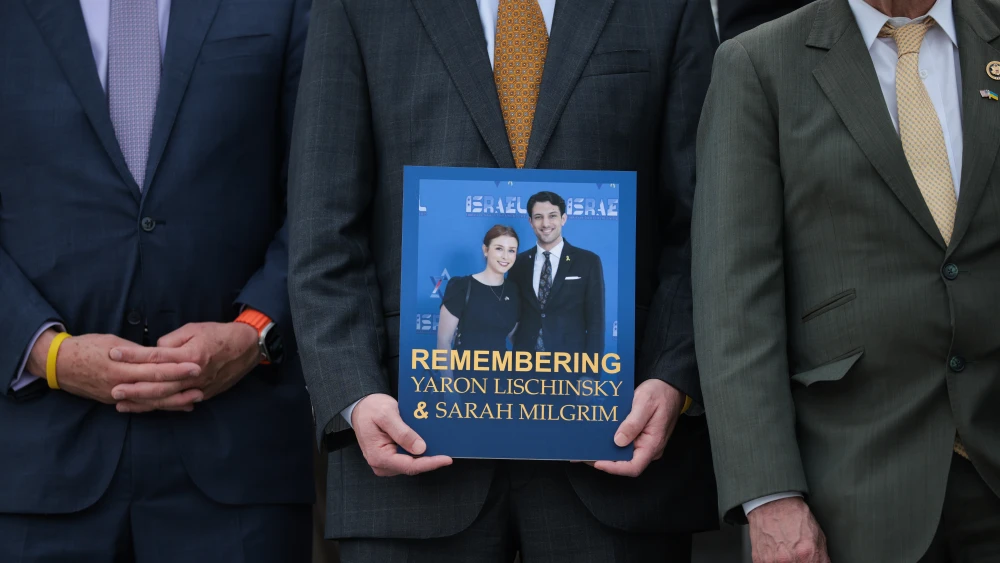
Dozens of people gathered at the Israeli embassy in Washington on Monday to mark the one-year anniversary of the murder of Yaron Lischinsky and Sarah Milgrim, embassy staffers who were shot to death outside an American Jewish Committee event in Washington on May 21, 2025.
The two, who planned to get engaged, had attended a young diplomats event at the Capital Jewish Museum, about a mile from the White House, when Elias Rodriguez allegedly shot them as they left the building.
Rodriguez reportedly screamed “free Palestine” at the scene, and his writings allegedly sought to justify armed violence to support Gazans. Prosecutors have said that they plan to seek the death penalty and added terror charges recently.
Lischinsky and Milgrim had shared a photograph of themselves, smiling, at the event with co-workers. Some eight minutes later, they were killed.
“A single photograph became a final goodbye none of us knew we were receiving,” Sawsan Hasson, minister for public diplomacy at the embassy, told attendees.
Co-workers of the couple gathered with relatives of Lischinsky and Milgrim, Israeli officials and others on Monday to mark the first yahrzeit (anniversary) of their deaths.
“The mourning continues, but we have the greatest generation of Jewish youth in the history of the Jewish people,” Yechiel Leiter, the Israeli ambassador to the United States, told JNS.
“Sarah and Yaron died on the front in the war for the preservation of the Jewish people and the security and defense of Israel,” the envoy said. “In that, we find comfort in the fact that because of them and through them, we’re going to continue to be strong and solidify our position and our security.”
Robert Milgrim, Sarah’s father, told attendees that “we should intentionally remember what Sarah tried to accomplish in her short life.”
“It is very easy to lose hope, and even when you have hope, it requires more,” he said. “I see Sarah’s legacy at the embassy as inspiring other people to continue her work, to continue the dialogue, to bring people together.”
Sarah’s mother, Nancy Milgrim, told attendees that hundreds of trees have been planted in Sarah’s honor and that three scholarships have been established, “which will allow students to continue in Sarah’s footsteps to promote peacebuilding and environmental initiatives.”
“Sarah and Yaron embodied the very best of public service, kindness, humility, dedication and a genuine care for others,” Efrat Hochstetler, counselor for public diplomacy at the embassy, told attendees.
“They were colleagues, friends and cherished members of our embassy family,” she said.
Lischinsky’s and Milgrim’s absence is “deeply felt,” Hochstetler said. “So too is the enduring impact of who they were and what they brought into the lives of those around them.”
‘Unspeakably tragic’
Some struggled to reconcile the nature of Lischinsky and Milgrim and other peacemakers and bridge builders with the manner in which they died.
“It is unspeakably tragic that the convictions which drew them” to their work “turned them into targets for blind hatred and murderous violence,” said Israeli President Isaac Herzog in a prerecorded message.
“In the way of blind hatred, they were not targeted as Sarah and Yaron,” he said in the recording. “They were reduced to blank symbols guilty by association, stripped of their individuality and humanity, because of the connection to Israel and the Jewish people.”
Leo Terrell, chair of the U.S. Justice Department’s task force on fighting Jew-hatred, broke down in tears as he recalled being on the scene in the aftermath of the murders.
“The monster who took their lives didn’t win. We are now more committed than ever to fighting antisemitism,” Terrell said. “To the family members, I will never say ‘No’ to you, ever. To the members of this group, you have a friend who’s committed 24-7 to fight hate.”
Lischinsky worked under the supervision of Noa Ginosar, minister-counselor for Middle East affairs at the embassy.
Ginosar still catches herself “thinking about him in the present tense” and seeking his advice, she said at the event.
“Instinctively expecting him to walk through the door. Moments when I find myself wanting to sit down with him and talk through a complicated development in the Middle East, or hear about a hidden corner of Washington that only he seemed to know about,” she said.
Ginosar said that she can “clearly imagine the questions he would be asking and the excitement he would feel, as he would try to make sense of it all, and where it could lead.”
“Perhaps that’s why those moments are also the hardest, because I know how much he would have loved to be part of them,” she said.
Hasson, the public diplomacy minister, said she still goes back and reads WhatsApp messages that she exchanged with Milgrim.
“There you came alive again,” she said. “Your voice returned among the countless messages praising your tireless work.”
“One quality stood out time and again. You were always one step ahead,” Hasson said. “You had a rare ability to deal with the most complex and difficult challenges, yet still make room for kindness, optimism and soft diplomacy.”
“More than anything, you gave people hope that tomorrow could be a better day,” she added.