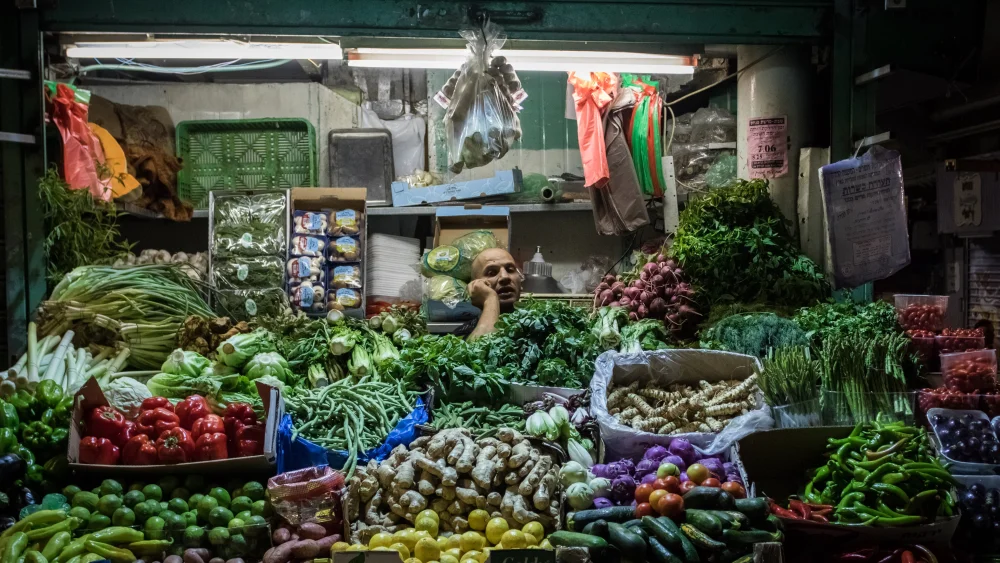
Israeli authorities are tightening inspections of Palestinian agricultural produce following findings that raised public health concerns, the Defense Ministry’s Coordinator of Government Activities in the Territories unit told JNS on Wednesday.
“Following irregular findings identified in inspections of agricultural produce at the Judea and Samaria crossings, and the resulting public health concerns, COGAT has decided to implement a series of immediate measures to strengthen inspection and enforcement mechanisms,” the unit stated in response to a JNS inquiry.
COGAT said it would expand testing of produce entering the Jewish state’s pre-1967 borders from Palestinian Authority-controlled areas, with sampling of up to 100% of imports based on risk assessments. Additional inspections will also be carried out “at the cultivation sites through authorized laboratories,” according to the statement.
Produce selected for testing will be quarantined pending laboratory results, and growers and distributors found to have violated Israeli law could face “fines, forfeiture of guarantees and removal from the list of authorized entities.”
COGAT noted that the steps were formulated in cooperation with the Ministry of Health, as well as the Ministry of Agriculture and Food Security and its Central Unit for Enforcement and Investigations.
Health officials told Knesset lawmakers in February that nearly every second cucumber that enters Israeli supermarkets from P.A. farmers is contaminated with “extremely high” levels of hazardous pesticides.
The Knesset Health Committee heard that approximately 15,000 tons of produce are imported annually from P.A.-controlled areas, with testing showing “abnormally” high rates of pesticide residues in recent years.
Ziva Hamma, director of the Health Ministry’s Food Risk Management Department, told MKs that although regulations required produce from the P.A. to be held pending lab testing, in practice, the shipments were often immediately distributed, with the results arriving days later.
According to the data presented at the hearing, 50% of Palestinian-grown cucumbers sampled were found to contain high pesticide residues, along with 49% of tomatoes and 66% of hot peppers.
In 13% of samples, more than five different pesticides were detected, and 14% contained organophosphate compounds—neurotoxic substances that health officials say pose risks to fetal development and could, with prolonged exposure, increase the likelihood of Parkinson’s disease.
Amos Zuaretz, the ministry’s coordinator for Judea and Samaria, revealed that official regulations were bypassed due to “economic and security considerations,” in an effort to avoid harming the P.A.'s economy.
Many elements of Israel’s security brass support Palestinian Authority control over parts of Judea and Samaria as a “moderating force,” as opposed to Hamas and other Iranian-backed terrorist organizations.
However, Israeli Prime Minister Benjamin Netanyahu said in December 2023 that the difference between Hamas and the Palestinian Authority, which is controlled by Mahmoud Abbas’s Fatah terrorist faction, “is only that Hamas wants to destroy us here and now, and the P.A. wants to do it in stages.”