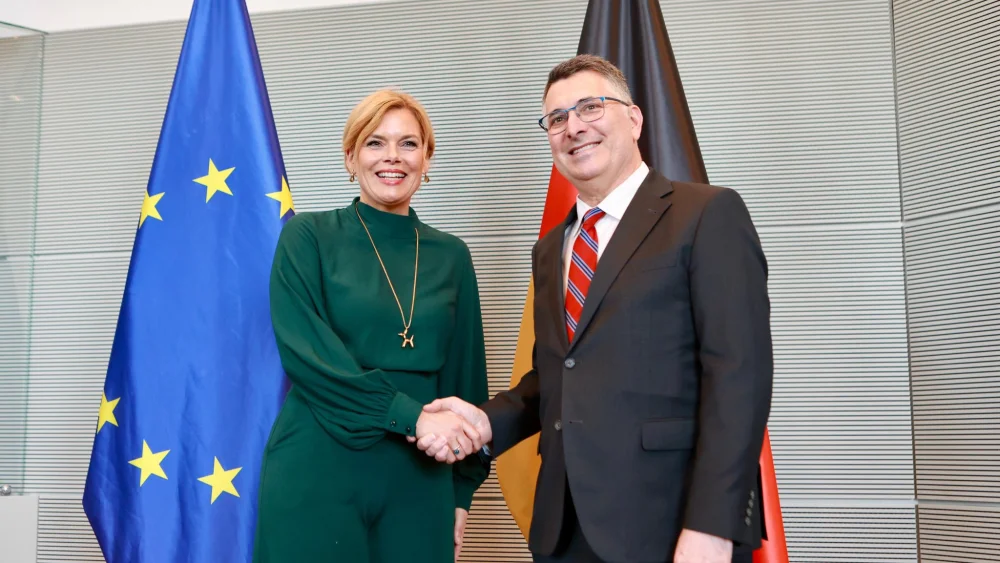
Israeli Foreign Minister Gideon Sa’ar said on Monday that he’d briefed the president of the European Parliament’s European People’s Party, Manfred Weber, on talks with Lebanon and on “hostile governments” to Israel working against “Europe’s own interests.”
The statement by Sa’ar on X came amid talks by E.U. officials on applying sanctions against Israel following the electoral defeat of former Hungarian prime minister Viktor Orban. Orban had prevented several attempts to punish Israel, which required a consensus among the 27 member states. Ireland, Spain and Slovenia are some of the countries that, reportedly, are pushing for sanctions on Israel.
Spoke with the President of the European People’s Party @ManfredWeber.
— Gideon Sa'ar | גדעון סער (@gidonsaar) May 18, 2026
I briefed him on Iran and our direct negotiations with the Lebanese government.
I described the attempt of certain hostile governments in Europe to drag the EU to a radical, anti-Israeli approach. This… pic.twitter.com/ISlqPHwHpY
The European Parliament, where the center-right European People’s Party is the largest political party, is widely considered to be an overall friendlier forum toward Israel than the executive branches of the European Union. Weber belongs to Germany’s Christian Social Union, a sister party of Chancellor Friedrich Merz’s party.
Sa’ar wrote that he’d briefed Weber “on Iran and our direct negotiations with the Lebanese government,” adding: “I described the attempt of certain hostile governments in Europe to drag the EU to a radical, anti-Israeli approach. This contradicts Europe’s own interests. The same hostile governments are also harming the Transatlantic Alliance. The Western world should stand together.”
Simone Rodan-Benzaquen, the senior envoy for Europe at the Foundation for Defense of Democracies (FDD), told JNS that “Sa’ar is right” about how “some of the same political and ideological actors pushing for a maximalist anti-Israel posture are also deeply hostile to U.S. President Donald Trump, and the broader transatlantic alliance.” However, the United States has taken steps to alienate European governments regardless, she noted, including making territorial demands in Greenland, “debates over troop deployments, and growing uncertainty about long-term American commitments,” which “have genuinely shaken European confidence,” she said.
Last week, Israel and Lebanon held their third round of direct talks on crucial issues, including borders. Israel has deployed troops in outposts across southern Lebanon, where Hezbollah terrorists have launched attacks on Israel. Lebanon’s government has said it intends to enforce a monopoly on the possession of weapons and demanded that Hezbollah disarm.
France, the former colonialist power in Lebanon, maintains close ties with some groups in that country and has expressed opposition to any Israeli action there, including strikes on Hezbollah terrorists.